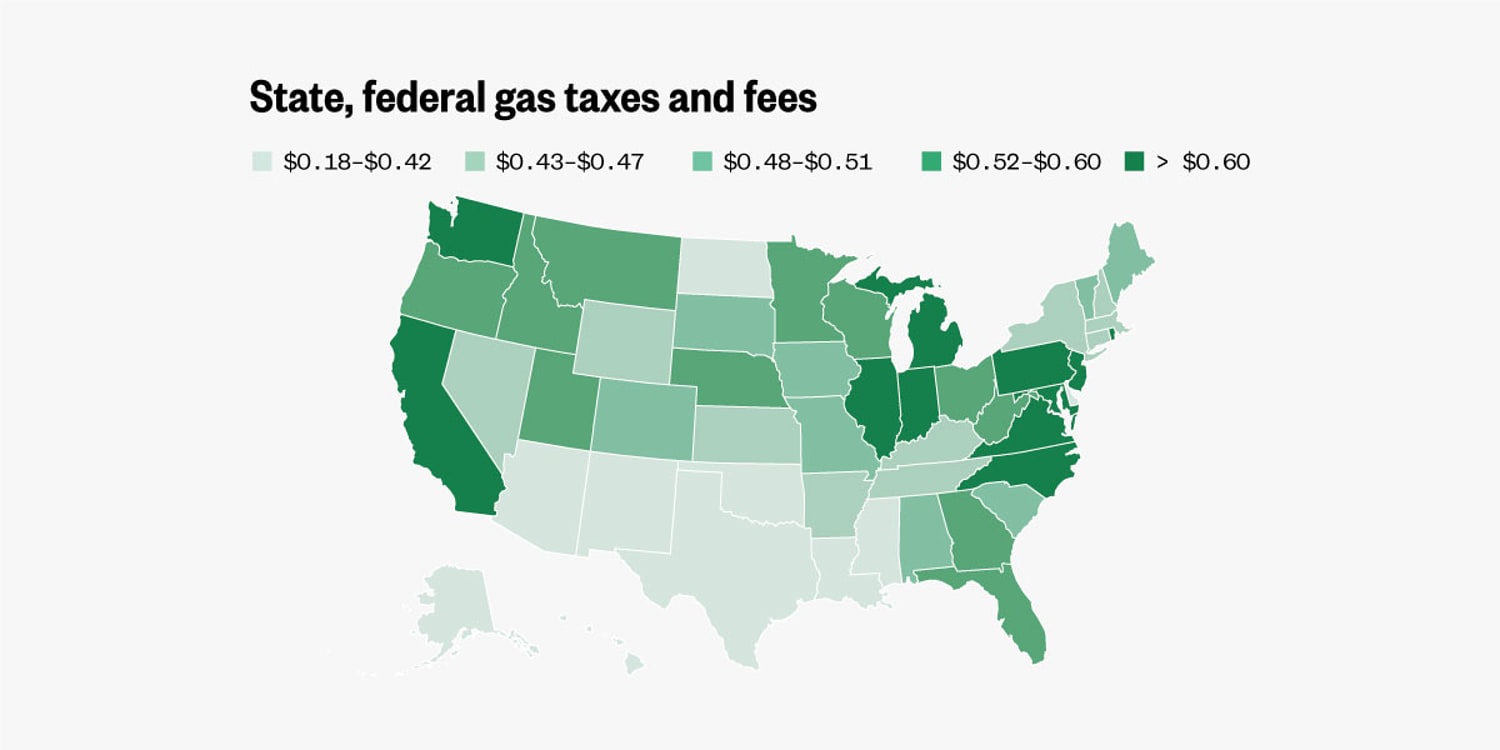
You pull up to the pump, swipe your card, and watch the numbers climb. Most of us focus on the "Price per Gallon" displayed in neon lights, but that number is a lie. Well, maybe not a lie, but it’s certainly not the whole truth. A massive chunk of what you’re paying never reaches the oil company or the station owner. It goes straight to the government.
Federal and state gas taxes are the invisible passengers in your vehicle. They fund the bridges you cross and the potholes you dodge, yet most drivers couldn't tell you exactly how much they’re contributing to the treasury every time they fill up. If you live in California, you're getting squeezed. If you’re in Alaska, you’re getting a relative bargain. The disparity is honestly wild.
The Federal Government Takes Its Cut First
Every single driver in the United States pays a baseline tax. The federal government hasn't raised its gas tax since 1993. Let that sink in. Bill Clinton was in his first term, "I Will Always Love You" was at the top of the charts, and gas cost about $1.11 per gallon.
The federal tax stands at 18.4 cents per gallon for gasoline and 24.4 cents per gallon for diesel. This money flows into the Highway Trust Fund. It sounds straightforward, but here's the kicker: because that rate isn't tied to inflation, its purchasing power has cratered. The 18.4 cents you pay today buys a lot less asphalt than it did thirty years ago.
Politicians hate touching this. Raising the federal gas tax is seen as political suicide, so they just let it sit there while the infrastructure it's supposed to maintain slowly crumbles. They’ve had to bail out the Highway Trust Fund with general treasury money multiple times just to keep the lights on. It’s a broken system, and you’re paying for the inefficiency through wear and tear on your car.
Why Your State Tax Is Probably Climbing
While the federal government stays frozen in time, states are getting aggressive. Because the feds aren't providing enough for local repairs, states have to pick up the slack. This is why the map of gas taxes looks like a patchwork quilt of frustration.
State taxes aren't just one flat fee. They’re often a mix of several different levies. You’ve got the base excise tax, but then you’ve also got environmental fees, inspection fees, and sometimes even a general sales tax applied on top of the whole mess.
California currently holds the crown for the highest state gas tax in the nation. Between the excise tax and various environmental programs like the Low Carbon Fuel Standard, Golden State drivers are paying over 68 cents per gallon to the state alone. When you add the federal tax, you’re looking at nearly 90 cents of every gallon going to the government.
On the flip side, states like Alaska and Mississippi keep things relatively low, often under 20 cents. Why the gap? It usually comes down to geography and politics. Alaska has oil revenue to lean on. California has an aging, massive infrastructure network and a political climate that prioritizes carbon reduction over cheap fuel.
The Sneaky Impact of Inflation and Variable Rates
Some states got tired of voting on tax hikes every few years. They decided to automate the pain. About half of the states in the U.S. now use "variable-rate" taxes. This means the tax rate adjusts automatically based on inflation or the price of fuel.
If the price of gas goes up, the tax might go up too. If inflation spikes, the tax follows. This ensures the state’s revenue keeps pace with the cost of construction materials like steel and concrete. It’s smart policy for the state, but it’s a gut punch for your wallet when prices at the pump are already soaring.
Take Illinois or Pennsylvania. These states have some of the highest burdens because their formulas are designed to capture as much revenue as possible to feed massive pension debts and sprawling transit systems. You aren't just paying for the road under your tires; you're paying for the administrative weight of the state itself.
Why Electric Vehicles Are Changing the Math
Gas taxes are a "user fee." The idea is simple: if you use the road, you pay for the road. The more you drive, the more gas you buy, and the more you contribute to repairs. It was a perfect system for the 20th century.
It’s failing now.
Electric vehicles (EVs) don't use gas. A Tesla Model 3 weighs significantly more than a Honda Civic because of its batteries, meaning it actually causes more wear and tear on the pavement. Yet, the Tesla owner pays zero in gas taxes. To fix this, many states have started charging "EV Registration Fees."
These fees can range from $50 to over $200 a year. It’s the state’s way of saying, "We see you." However, many experts argue these flat fees don't come close to covering what a heavy EV would have paid in gas taxes over 15,000 miles. It’s an ongoing battle. As more people ditch internal combustion engines, expect state governments to get even more creative. Some are even testing "VMT" taxes—Vehicle Miles Traveled. They want to track your odometer and bill you by the mile. Talk about a privacy nightmare.
How to Track Where Your Money Goes
It’s easy to get cynical about where this money disappears. If you’re paying 60 cents a gallon in taxes, why are there still potholes on your commute?
Most state Departments of Transportation (DOT) publish annual reports. If you actually look at them, you’ll see the lion’s share goes to "Maintenance and Operations." This isn't the flashy stuff like building new six-lane highways. It’s the boring, expensive stuff: filling cracks, repainting lines, and keeping bridges from falling into rivers.
In some states, a portion of the gas tax is legally "diverted." This is the part that should make you mad. New York and New Jersey, for instance, have historically diverted hundreds of millions of dollars from highway funds to pay for mass transit like subways and buses. If you’re a rural driver who never touches a train, you’re essentially subsidizing the city commuter’s ticket every time you fill up your truck.
The Real Cost Breakdown at the Pump
To understand the price of gas, you have to look at the four-part split defined by the U.S. Energy Information Administration (EIA).
- Crude Oil: Usually about 50-60% of the cost. This is dictated by global markets and OPEC decisions.
- Refining: About 15-20%. This is the cost of turning the sludge into the stuff that makes your engine go.
- Distribution and Marketing: 10-15%. This is the truck driver’s salary and the profit margin for the station.
- Taxes: 10-20% depending on where you live.
Notice that the "Taxes" portion is the only one that stays relatively stable. When oil prices crash, the tax stays the same. That’s why you never see gas drop to zero dollars. Even if the oil was free, you'd still be paying the government for the privilege of pumping it.
Stop Guessing and Start Comparing
If you’re planning a road trip, where you fuel up matters. Crossing a state line can save you five or six dollars on a full tank.
States like Missouri and Oklahoma often have significantly lower taxes than their neighbors. If you’re driving from Illinois to Missouri, wait until you cross the Mississippi River to hit the gas station. You’ll see a price drop of 30 cents or more immediately. It’s not because the oil is cheaper there; it’s because the state legislature is taking a smaller bite out of your sandwich.
Keep an eye on your local ballot. Many states are currently debating "gas tax holidays"—temporary suspensions of the tax to provide relief when inflation gets too high. While these feel good at the pump, they often lead to a backlog of road repairs that end up costing you more in alignments and blown tires later.
The next time you’re standing at the pump, look for the little sticker with the state seal. It’s usually there, tucked away near the bottom. It tells you exactly what that state is charging you. It’s a small reminder that while you own the car, the government owns the road—and they aren't letting you use it for free.
Check your state's current rate through the American Petroleum Institute (API) or your local DOT website. Knowing the numbers won't make the gas any cheaper, but at least you'll know exactly who to blame when the total hits $80. Fill up strategically, avoid the high-tax states when you can, and keep your tires inflated to squeeze every last drop out of the gallons you've already paid the "toll" on.