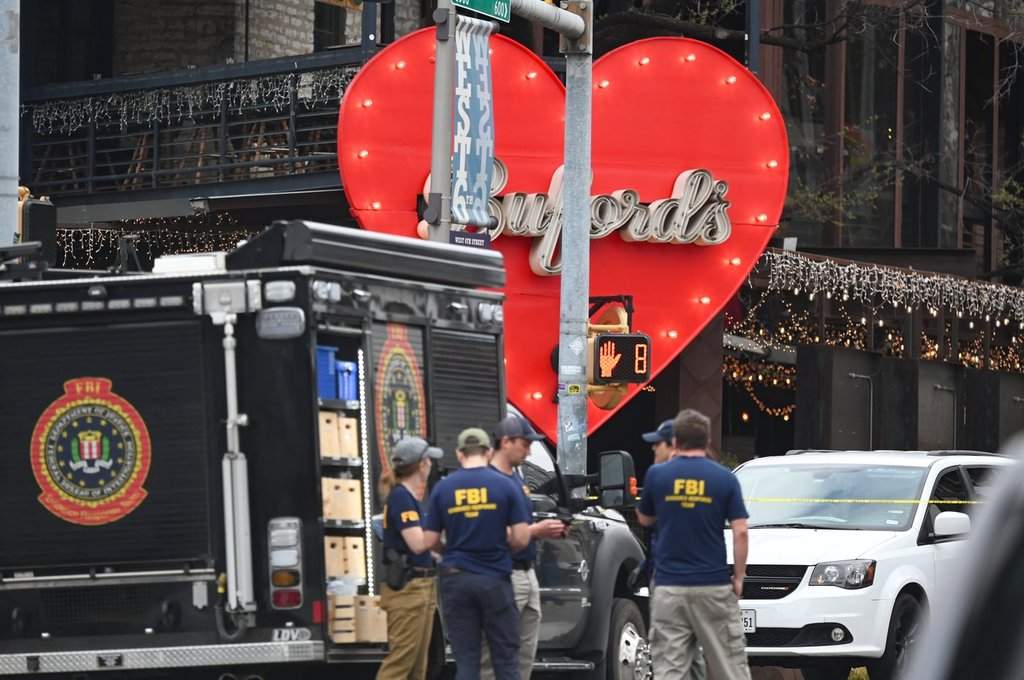
The bloodstains on the pavement of West Sixth Street were still damp when the narrative began to shift from a local tragedy to a geopolitical crisis. At 1:56 a.m. on March 1, 2026, a 53-year-old man named Ndiaga Diagne pulled his SUV in front of Buford’s Backyard Beer Garden and opened fire. By the time the smoke cleared, two civilians were dead, 14 were wounded, and the shooter had been neutralized by a police response that took less than sixty seconds.
But the speed of the tactical response was no match for the speed of the fallout. This was not a standard barroom brawl or the tragic byproduct of a weekend dispute. Diagne was wearing a sweatshirt emblazoned with the words "Property of Allah" and a T-shirt featuring an Iranian flag design. He struck just 24 hours after the United States and Israel launched coordinated strikes against Iranian targets.
Austin is now the unwilling stage for a new era of domestic vulnerability. While the initial reporting focused on the body count, the investigative reality is far more complex. This event suggests a terrifying intersection of mental health history, lone-wolf radicalization, and the immediate, violent reverberations of a war occurring 7,000 miles away.
The Calculated Chaos of West Sixth Street
Witnesses report that Diagne didn't just stumble onto the scene. He drove his SUV around the block multiple times, circling the crowded nightlife hub like a predator assessing a herd. When he finally struck, it was with the chilling precision of someone who had practiced the transition from a vehicle-based assault to a foot-based slaughter.
He began by firing a pistol through his car window, spraying the patio of Buford's with lead. As patrons dove for cover behind heavy wooden tables and metal railings, Diagne didn't flee. He parked, stepped out of the vehicle, and leveled a rifle at the fleeing crowd.
The 700 block of West Sixth Street is a gauntlet of glass and concrete. There are few places to hide. If it weren't for the "heavy police presence" mandated for weekend nightlife, the death toll would likely have climbed into the dozens. The Austin Police Department (APD) and the FBI are now dissecting every second of the 60-second window it took for officers to close the distance and kill the gunman.
The Paper Trail of a Naturalized Citizen
Ndiaga Diagne was not a ghost. He was a naturalized U.S. citizen who arrived from Senegal in 2000 on a tourist visa. He followed the traditional path: marriage to a citizen in 2006, lawful residency, and finally, naturalization in 2013. He had lived in New York before moving to Pflugerville, Texas, in 2017.
Behind this veneer of the American dream lay a fractured psyche. Sources within the investigation indicate that Diagne had a history of "mental health episodes" that had brought him into contact with state authorities in the past. Yet, he was not on any federal terror watch list. He was the classic "soft target" attacker: a man with just enough stability to legally exist in society, but enough instability to be ignited by a global event.
Why the Iranian Connection Matters
The FBI’s Joint Terrorism Task Force (JTTF) isn't just looking at the clothes Diagne wore. They are looking at the timing. The U.S. and Israeli strikes on Iran on February 28, 2026, were intended to be surgical military operations. However, the Austin shooting proves that modern warfare has no front lines.
Governor Greg Abbott’s immediate activation of the Texas National Guard and the Department of Public Safety (DPS) is a tacit admission that the state is on a war footing. When Abbott warns against those using the Middle East conflict to "threaten Texas," he isn't just talking about foreign agents. He is talking about the millions of people who consume the same digital propaganda that Diagne likely did in the hours leading up to the attack.
The Intelligence Gap
The problem for law enforcement is the shift in radicalization patterns. We are no longer dealing solely with cells communicating through encrypted channels. We are dealing with "stochastic terrorism," where a violent political climate acts as a trigger for a volatile individual.
The FBI found a Quran in Diagne's SUV, but they also found "indicators" of a deeper nexus to the current conflict. The question isn't whether Tehran sent him—most experts agree they didn't. The question is why a man in Pflugerville felt compelled to die for a flag he hadn't seen in years.
The Fragility of the Entertainment District
For years, Austin has grappled with the safety of its Sixth Street corridor. In 2021, a shooting left 14 wounded. The city responded with more lights, more cameras, and more cops. On March 1, those measures worked in a tactical sense—the shooter was stopped quickly.
But the psychological damage is permanent. Mayor Kirk Watson noted the "significant trauma" brought to the city. This trauma stems from the realization that even a massive police presence cannot prevent a motivated individual from firing the first shot.
The Legal and Civil Fallout
As the victims recover—three of whom remain in critical condition—the legal machinery of Texas will begin to churn. While the shooter is dead, the victims' families will look for accountability.
Texas liquor laws and liability statutes (often called Dram Shop laws) are notoriously rigid. Usually, they target bars that over-serve intoxicated patrons. In this case, Buford’s was a victim, not a perpetrator. However, the conversation will inevitably shift toward "negligent security" claims. Did the venue have enough barricades? Was the patio layout a "killing box"?
In a state that prides itself on open-carry culture and personal liberty, the fortification of public spaces is a bitter pill to swallow. We are moving toward a reality where a simple night out at a beer garden requires the security protocols of a federal building.
The Strategy of Decisive Force
Governor Abbott’s rhetoric of "decisive and overwhelming force" is aimed at a domestic audience. It is a signal to the millions of Texans that the state will not tolerate spillover from international conflicts. But force is a reactive tool. It does nothing to solve the problem of the radicalized loner in the suburbs.
The investigative focus has shifted to Diagne's digital footprint. Every post, every search, and every "like" is being cataloged by the FBI to determine if there were warning signs that were missed. If a man with a known mental health history can wear an Iranian flag and walk into a crowded district with a rifle, the system is fundamentally broken.
Texas is now at the center of a national security debate that transcends gun control or border security. It is about the volatility of the American public in an era of globalized, instant-access conflict. We are seeing the death of the "local" news story. A shooting in Austin is now an Iranian retaliation. A mental health crisis in a suburb is now a national security threat.
The investigation into Ndiaga Diagne will continue for months. They will trace the origin of his weapons. They will interview everyone he ever spoke to in Pflugerville. They will try to find a "handler" who doesn't exist. In the end, they will likely find that the killer was a man who lived in the shadows of our society until the glare of a distant war gave him a reason to step into the light.
The Austin bar shooting is the first major casualty of a war that most Americans thought was happening "over there." We now know that "over there" is as close as the patio of the local beer garden. The state can add more patrols and the FBI can open more files, but the reality of the soft target remains. As long as the world is at war, the streets of Austin—and every other American city—will remain a potential battlefield.


