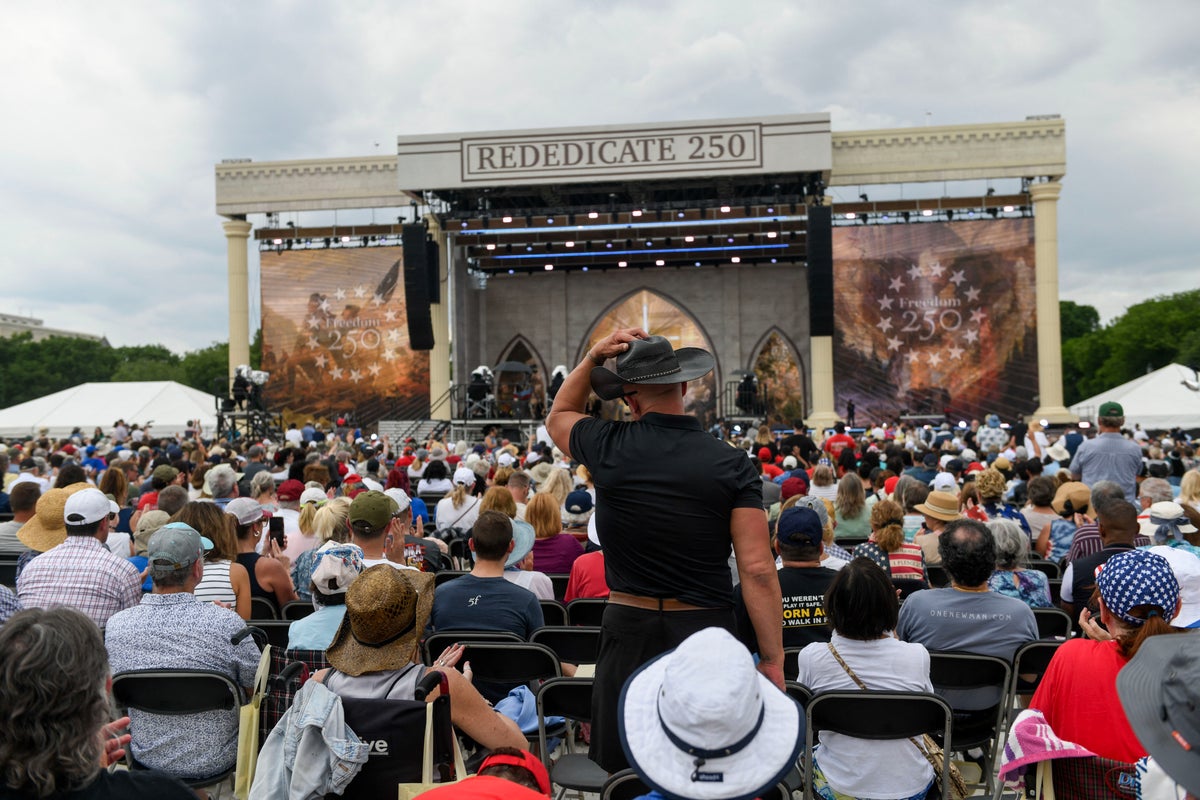
On Sunday, thousands of conservative Christians gathered on the National Mall for Rededicate 250, a daylong prayer rally timed ahead of America’s semiquincentennial. Amid standard sermonizing and political video addresses from Cabinet members, author Eric Metaxas drew laughter and cheers by declaring that God had “raised up a great man” in Donald Trump to finally build a White House ballroom. It sounds like a punchline, but it reveals the central strategy of the modern religious right. The proposed ballroom is not an architectural afterthought; it has become a theological and legislative battleground where executive ambition meets a billion-dollar congressional funding fight.
To understand why a reception space has taken on messianic importance, one must look past the theatricality of the National Mall. The political movement supporting the administration has long shifted away from demanding personal piety from its leaders. Instead, it operates on a transaction grounded in historical and biblical structuralism. By framing a real estate project as a divine mandate, the administration’s allies are cementing a narrative where executive power and religious destiny are fundamentally intertwined.
The reality of the ballroom project, however, is deeply matted with fiscal friction and legislative maneuvers.
The Billion Dollar Budget Battle
During his campaign and early second term, Trump pitched the White House ballroom as a self-sustaining venture. The official narrative was simple. The structure would cost roughly $400 million, and it would be funded entirely by private donors. This promise of fiscal neutrality quickly evaporated when the project hit the congressional meat grinder.
House Republicans recently attempted to attach $1 billion in security provisions specifically designated for the ballroom to a massive, must-pass spending bill aimed at funding Immigration and Customs Enforcement and Customs and Border Protection. The strategy was clear. By tucking the ballroom security capital into a critical national security package, opponents would be forced to vote against border enforcement to kill the ballroom funding.
The gambit failed on a technicality. The Senate Parliamentarian ruled that the ballroom provision violated the strict rules of budget reconciliation. Under these guidelines, legislation sidestepping a filibuster must relate directly to federal spending and taxation, rather than specialized capital projects masked as security infrastructure.
Ballroom Financial Reality vs. Projection
┌──────────────────────────────────────┬──────────────────────────────────────┐
│ Initial Admin Projection             │ Congressional Reality                │
├──────────────────────────────────────┼──────────────────────────────────────┤
│ Cost: $400 Million                   │ Security Appropriation: $1 Billion   │
│ Funding: 100% Private Donors         │ Vehicle: Emergency Spending Bill     │
│ Status: Budget Neutral               │ Status: Blocked by Parliamentarian   │
└──────────────────────────────────────┴───────────────────────────────────┘
This legislative setback exposes a structural truth. Private donors may write checks for gold leaf and chandeliers, but the American taxpayer is being asked to foot the bill for the permanent security apparatus, logistical rerouting, and structural fortification required to implant a massive entertainment venue into a historic fortress.
The Threat Narrative as a Funding Engine
The administration's push for an internal ballroom intensified dramatically following security breaches and targeted violence in the capital, notably the shooting incident at the Washington Hilton during the White House Correspondents’ Dinner. For decades, presidents have used the Hilton’s cavernous basement ballroom for major galas, relying on Secret Service sweeps to secure the off-site location.
The administration has weaponized this security vulnerability to transform the ballroom from a luxury vanity project into an urgent matter of presidential survival. The argument is straightforward. The outside world is too dangerous for the executive branch, meaning the state must construct a secure, insular citadel where the president can gather with allies, donors, and foreign dignitaries without leaving federal protection.
This rationale resonates deeply with the crowd that gathered on the National Mall. For Christian nationalist organizers, the physical isolation of the presidency mirrors their own cultural objective: building parallel, protected institutions divorced from a secular society they view as hostile and decaying.
Erasing the Establishment Clause
The rhetoric on display at Rededicate 250 was not an anomaly. It was a clear demonstration of how top tier administration officials view the concept of governance. Cabinet members used their official platforms to advance a highly specific, exclusionary version of American history.
- Defense Secretary Pete Hegseth delivered a video address urging the nation to pray on bended knee, explicitly invoking Jesus Christ as the guiding force behind George Washington's military strategy.
- Secretary of State Marco Rubio echoed this sentiment, asserting that the United States did not merely happen to be a majority-Christian nation, but was actively birthed by a divine command to spread the Christian faith across the globe.
This framework openly challenges the traditional understanding of the First Amendment. By asserting that the nation’s foundational purpose is inherently sectarian, the administration’s defenders create a environment where secular legal objections—like budget rules or the separation of church and state—are viewed not as legitimate policy disagreements, but as spiritual opposition.
The Evangelical Transaction
The willingness of evangelical leaders to attribute divine purpose to a real estate project is part of a well-worn political compromise. Observers often point out the glaring disconnect between the tenets of traditional Christian morality and the personal conduct or rhetoric of the president. At the National Prayer Breakfast earlier this year, Trump used the podium to mock political rivals, berate wind farms, and castigate the opposition party, prompting some traditional faith leaders to express open dismay.
Yet for the political organizers driving the movement, these aesthetic friction points do not matter. They view the executive not as a moral exemplar, but as an instrument of political and cultural restructuring.
If King Cyrus could be used in biblical narratives to rebuild the temple walls without adhering to the faith of the builders, then a modern president can be championed for building a White House ballroom. The physical structure represents legitimacy. It provides a permanent, state-sanctioned stage where the religious right can command the spotlight, moving their operations directly into the seat of federal power.
The fight over the ballroom is far from finished. Despite the Senate Parliamentarian’s ruling, house leaders are already looking for alternative legislative vehicles to secure the necessary security funding. The administration has shown it is entirely willing to stall broader budget negotiations to protect its priority infrastructure projects.
The domestic political landscape is no longer debating whether church and state should be separate. The debate has moved to who controls the infrastructure of the state itself, and how much the public will be forced to pay to build it.