The heavy silence of a wood-paneled office in Washington D.C. carries a different weight than the silence of a gravel driveway in South Dakota. One smells of old parchment and expensive coffee; the other smells of dry earth and the metallic tang of a spent shell casing. Between these two worlds, a bridge has buckled.
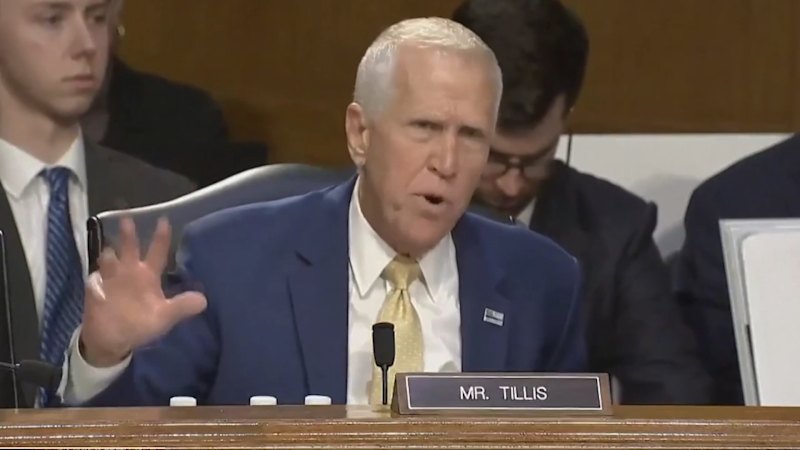
Thom Tillis is a man who understands the architecture of a slow build. The North Carolina Senator has spent a career navigating the intricate, often exhausting machinery of the American legislature. He is a creature of process. He believes in the invisible guardrails that keep a society from veering into the ditch. So, when he sat down to address the nation’s latest political firestorm, it wasn’t just about a dog. It was about the terrifying ease with which we lose our way.
The story that sparked the friction is now etched into the public consciousness like a scar. Kristi Noem, the Governor of South Dakota and once a rising star in the firmament of the Republican Party, shared a story in her memoir about Cricket. Cricket was a fourteen-month-old wirehaired pointer. She was high-energy, "untrainable" in the Governor's estimation, and had ruined a pheasant hunt before killing a neighbor's chickens.
Noem led the dog to a gravel pit. She killed it. Then, for good measure, she killed a "nasty" goat.
To Noem, this was an exercise in rural grit. It was meant to be a badge of authenticity—a signal to the base that she is a woman who does not flinch when the "tough" work needs doing. But to Thom Tillis, and a growing chorus of others, it looked less like grit and more like a collapse of character.
The Anatomy of a Cold Shoulder
When Tillis spoke out, he didn't use the frantic, caps-lock language of the internet outrage machine. He used the steady, disappointed tone of a man watching a colleague burn down their own house. He made it clear: some lines, once crossed, cannot be uncrossed.
Politics is often described as a game of chess, but that metaphor is too clean. It’s more like a communal trust exercise. We agree on certain shared values so that we don't have to fight over every single inch of ground. One of those values—deeply embedded in the American psyche—is the stewardship of the vulnerable.
When a leader boasts about killing an animal not out of necessity, but out of frustration or political posturing, the machinery of trust grinds to a halt. Tillis recognized that Noem hadn't just alienated "animal lovers" or "liberals." She had alienated the very people she claimed to represent: those who understand that true strength is measured by what you protect, not what you destroy.
Consider a hypothetical young farmer in the Midwest. Let’s call him Elias. Elias has a dog that isn't particularly good at herding. The dog is a nuisance. It gets underfoot. It scares the sheep. But Elias doesn't take the dog to the gravel pit. Why? Because Elias understands that his authority over that animal comes with a debt of mercy. He understands that "toughness" isn't the ability to pull a trigger on a creature that trusts you; it's the patience to find a different way.
By lashing out at Noem, Tillis was effectively standing up for the Eliases of the world. He was asserting that being "rural" or "conservative" isn't a license for cruelty.
The Invisible Stakes of a Memoir
The fallout wasn't just about optics. It was about the future of a political movement. For years, the Republican party has been engaged in an internal tug-of-war between the "institutionalists" like Tillis and the "disruptors" like Noem.
The disruptors believe that the old rules are dead. They think that the only way to lead is to be the loudest, toughest person in the room. They view empathy as a bug, not a feature. Noem’s story was a gamble. She bet that her audience would see the gravel pit as a symbol of her resolve.
She lost that bet.
Tillis’s critique serves as a lighthouse. It reminds us that there is still a faction of leadership that believes in the weight of words and the permanence of actions. In the halls of the Senate, where Tillis operates, your word is your currency. If you can justify the unnecessary killing of a dog in a book meant to introduce you to the world, what else can you justify?
That is the question that haunts the corridors of power now.
It isn't just about a pointer named Cricket. It’s about the standard we set for the people who hold the keys to the kingdom. We are living in an era where the "shock factor" is often confused with "authenticity." We see it in business, where CEOs brag about firing thousands via Zoom to show they are "lean." We see it in tech, where "move fast and break things" often results in breaking the very fabric of our privacy.
The Cost of Being "Tough"
We have a distorted view of what it means to be a leader. We have started to crave the "strongman" or "strongwoman" archetype so desperately that we’ve forgotten the difference between a leader and a bully.
A leader carries the burden. A bully passes it on.
Noem’s decision to include the story in her book—to curate it, edit it, and present it as a testament to her character—suggests a profound disconnect from the people she hopes to lead. It suggests she thought we were all more cynical than we actually are.
Tillis, by contrast, tapped into something much older and more resonant. He tapped into the idea of the "gentle-man" or "gentle-woman." The person who possesses great power but chooses to use it with restraint.
The political implications are staggering. Noem was once a top-tier contender for the Vice Presidential slot. Now, her name is synonymous with a gravel pit. She tried to project a vision of a leader who can make the hard calls, but instead, she projected a vision of a leader who lacks the imagination to solve problems without violence.
Thom Tillis didn't have to say much to make his point. In the world of high-stakes politics, sometimes the most devastating weapon is a simple statement of the obvious. He didn't need to shout. He just had to point at the red line in the dust that Noem had so confidently walked across.
The Echo in the Gravel Pit
There is a specific kind of silence that follows a gunshot in a canyon. It’s a silence that demands an explanation.
As Noem continues her media rounds, attempting to "contextualize" or "defend" the story, the silence only grows louder. Every time she speaks, she reminds the public of the dog that didn't understand why it was being led to the pit. She reminds us of the goat that was just being a goat.
And every time Thom Tillis or his colleagues distance themselves, they are reinforcing a boundary. They are saying that the "toughness" required to lead a nation is not the same thing as the coldness required to kill a pet.
We often think of politics as a series of policy debates—taxes, healthcare, border security. But at its heart, it is a story we tell about ourselves. It is a collective agreement on who we are and what we will tolerate.
The clash between Tillis and Noem is a chapter in that story. It’s a chapter about whether we want leaders who see the world as a series of problems to be "handled" or a series of lives to be respected.
The gravel pit is empty now. The book is on the shelves. The Senator has made his peace with the truth. But the image of that fourteen-month-old dog, tail wagging in anticipation of a game that never came, remains. It sits in the back of the mind, a quiet reminder that while power can be taken, respect must be earned—and it can be lost in the time it takes to pull a trigger.
The dust in South Dakota eventually settles. The wind sweeps over the plains, erasing the tracks of the truck and the dog. But the memory of the choice lingers, a shadow that no amount of political sunlight can quite manage to burn away.