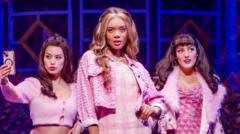
Renée Rapp didn't just play Regina George. She owned the character in a way that felt almost dangerous. When the news broke that she’d transition from the Broadway stage to the 2024 film adaptation, the internet didn't just react; it shifted. We’re talking about a role originally defined by Rachel McAdams in 2004, a performance so iconic it basically became the blueprint for the "mean girl" archetype for two decades. Replacing that is a nightmare for most actors. But for Rapp, taking on the Queen Bee was, in her own words, monumental.
It wasn't just a career milestone. It was a cultural reset for a character that needed a serious update for the Gen Z era.
The Weight of the Pink Plastic Crown
Walking into a role like Regina George involves more than just learning lines. You’re stepping into a legacy of biting insults and "fetch" references that have been memed to death. Most actors would try to mimic McAdams. They’d do the high-pitched, airy voice and the subtle, terrifying smile. Rapp didn't do that. She brought a vocal power and a physical presence that made Regina feel less like a high school bully and more like a final boss in a video game.
The transition from stage to screen is notoriously tricky. Broadway requires you to play to the back row. Film requires you to internalize everything so the camera can catch the micro-expressions. Rapp managed to bridge that gap by leaning into the sheer athleticism of the role. You can see it in "World Burn." She isn't just singing; she’s commanding the space. It’s a performance that acknowledges the past while firmly planting a flag in the present.
Why the 2024 Regina George Had to Be Different
We don't live in 2004 anymore. The original Mean Girls was a product of its time—a time of low-rise jeans and a very specific type of social warfare. In 2024, the "mean girl" isn't always the one screaming in the hallway. She’s the one with the most followers, the best lighting, and a devastatingly cool exterior.
Rapp understood this shift perfectly. Her Regina is more calculated. There’s a layer of self-awareness there that makes her more relatable and, frankly, more terrifying. She isn't just a caricature of a blonde popular girl. She’s a person who knows exactly how much power she holds and isn't afraid to use it. That’s the "monumental" aspect she keeps referring to. It’s about representing a modern version of female power, even if that power is used for chaotic evil.
Critics often point to the "musical" element as a barrier for some audiences. Let’s be real. People are skeptical of movie musicals. They often feel forced or cheesy. But Rapp’s background as a recording artist and a Broadway powerhouse meant she could sell the songs as emotional outbursts rather than just "musical numbers." She made the music feel like a natural extension of Regina’s ego.
Breaking the Broadway to Hollywood Barrier
It’s rare to see an actor successfully navigate the jump from the Richard Rodgers Theatre to a global film premiere without losing their edge. Usually, Hollywood casts a "big name" who can barely carry a tune, then uses studio magic to fix the vocals. We’ve seen it happen dozens of times, and it usually results in a lukewarm reception from theatre fans.
Casting Rapp was a win for authenticity. She’d already played the role on Broadway, so she knew the character’s DNA better than anyone. But she also had the star power and the "it factor" to carry a major motion picture. This wasn't just a casting choice; it was a statement. It told the industry that musical talent actually matters when you’re making a musical. Imagine that.
Her performance also sparked a massive conversation about queer representation in mainstream media. Rapp has been incredibly open about her identity, and that honesty bled into her portrayal of Regina. It added a layer of subtext that wasn't there in 2004. It made the character feel richer and more complex. It wasn't just about a burn book; it was about the messy, complicated reality of being a young woman today.
The Ripple Effect on Future Reboots
If you look at the box office numbers and the streaming data, it’s clear that the 2024 Mean Girls struck a chord. Much of that success sits squarely on Rapp’s shoulders. She proved that you can take a beloved IP, change the medium, and still make it feel fresh.
The industry is watching. We’re likely going to see more casting directors looking for "the next Renée Rapp"—someone who can sing, act, and command a social media following of millions without breaking a sweat. She’s set a new standard for what a triple threat looks like in the 2020s.
It’s about more than just wearing pink on Wednesdays. It’s about the work. Rapp spent years honing her craft, from winning the Jimmy Awards to grinding on Broadway. That’s the part people often skip over. They see the "monumental" moment but miss the decade of preparation that led to it.
If you want to see how a modern star is built, look at Rapp's trajectory. She didn't wait for permission to be the lead; she just acted like one until the rest of the world caught up.
Go watch the "World Burn" sequence again. Pay attention to the breath control. Look at the eyes. That’s not just a girl in a costume. That’s an artist at the top of her game, redefining a legacy for a whole new generation. If you’re an aspiring performer or just a fan of the craft, study what she did here. It’s a masterclass in taking up space. Get into the music, watch her live performances, and realize that the pink outfit was just the beginning.