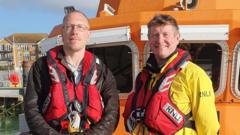
You don't think about the RNLI until you're gasping for air in fifty-degree water or watching the tide swallow the only path back to dry land. Most people assume the Royal National Lifeboat Institution is a government service, funded by taxes like the police or fire brigade. It isn't. It’s a charity run almost entirely by people who leave their dinner tables, their warm beds, or their day jobs the second a pager buzzes. Without these volunteers, the UK and Ireland’s coastline would be a graveyard.
The math is simple and terrifying. Over 140,000 lives have been saved by this organization since it started in 1824. That’s not just a statistic. It’s generations of families that exist today because someone decided to launch a boat into a Force 10 gale for a stranger. If you’ve ever stood on a pier during a storm, you know the raw power of the Atlantic. Deciding to head out into that while everyone else is hunkering down takes a specific kind of grit that you just don't see much anymore.
The myth of the professional lifesaver
We have this mental image of lifeboat crews as weathered sailors who spend all day staring at the horizon with binoculars. That’s rarely the case. Today’s crew members are plumbers, office managers, teachers, and mechanics. They’re your neighbors.
When that pager goes off, they have minutes to reach the station. They swap jeans for drysuits and yellow wellies in a blur of motion. They don't get paid a penny for the risk. In fact, many of them spend their own time fundraising just to keep the station doors open. It’s a massive commitment that shifts the weight of safety onto the shoulders of the community rather than the state.
The training is brutal. You can’t just be a "good swimmer" and hope for the best. Volunteers undergo rigorous sea survival training at the RNLI College in Poole. They learn how to right a capsized lifeboat, how to provide trauma care in a pitching hull, and how to use advanced radar in zero visibility. They do this on their weekends.
What happens when the pager stays silent
Coastal safety isn't just about the dramatic rescues you see on the news. A huge chunk of the work happens on the beach before anyone even gets wet. RNLI lifeguards—who are also part of this ecosystem—patrol over 240 beaches. They’re the ones spotting the "flash rip" currents that look like calm water but act like a conveyor belt to the open sea.
If you’re heading to the coast, you need to understand rip currents. They don't pull you under; they pull you out. Most people drown because they panic and try to swim against the current. They exhaust themselves and go under. The RNLI’s "Float to Live" campaign is probably the most effective piece of safety advice ever issued. Lean back, spread your arms and legs, and wait. It sounds too easy to work. It saves lives every single week.
The staggering cost of staying afloat
It costs roughly £400,000 a day to run the RNLI. That covers the boats, the fuel, the kit, and the training. Because they refuse government funding to maintain their independence, every single pound comes from donations.
The boats themselves are marvels of engineering. The Shannon-class lifeboat, for example, uses water jets instead of propellers. This lets it operate in shallow water and maneuver with incredible precision. It’s also self-righting. If a massive wave rolls it over, it flips back upright in seconds. But these machines cost millions.
We take this for granted. We go to the beach, we take out the paddleboard, or we go for a coastal run, assuming a safety net exists. That net is woven by volunteers. If the donations stop, the boats stay on the trailers. It’s that blunt.
Why the sea is getting more dangerous
You might think modern technology makes the sea safer. We have GPS. We have smartphones. We have better weather apps. But the opposite is happening.
Better gear gives people a false sense of security. I've seen people head out on stand-up paddleboards in offshore winds with no buoyancy aid and a phone in a plastic bag. They think they can just call for help if things go south. They don't realize how fast the wind can push a light board away from the shore. By the time they call, they're a mile out and shivering.
Cold water shock is the silent killer. Even on a hot summer day, the water around the UK is cold enough to trigger an involuntary gasp reflex. You breathe in water, your heart rate spikes, and you lose motor control. Even a strong swimmer can drown in minutes. The RNLI volunteers know this. They aren't just fighting the waves; they're fighting a ticking clock against hypothermia.
Respecting the water isn't optional
If you want to support the people who keep us safe, the best thing you can do is not need them. That starts with a reality check.
- Check the tide times. It sounds basic, but being cut off by the tide is one of the most common reasons for RNLI callouts. The sea moves faster than you can walk.
- Wear a lifejacket. If you're on a boat or a kayak, put it on. It doesn't work if it's tucked under the seat.
- Carry a way to call for help. A phone is okay, but a waterproof VHF radio or a personal locator beacon (PLB) is better.
- Know your limits. The Atlantic doesn't care about your ego. If the conditions look dodgy, stay on the sand.
The RNLI isn't just a British institution; it’s a global model for how maritime SAR (Search and Rescue) should work. They share their expertise with organizations all over the world to help drown-proof other nations. They do all this while remaining a charity.
Next time you see a lifeboat crew out on a shout, remember they aren't getting a paycheck. They’re out there because they believe that no one should drown. That’s a heavy burden to carry for free. Support them by being smart on the water and, if you can, by tossing a few coins in the bucket. They're the only ones coming for you when the sky turns black and the land disappears.
Don't wait until you're the one looking for a bright orange boat on the horizon to appreciate what they do. Check the weather, respect the swell, and always tell someone where you're going. Coastal safety starts with you, but it ends with them.