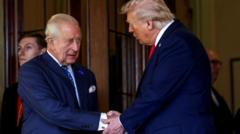
The media is currently obsessed with the "diplomatic tightrope" King Charles III must walk during his visit to the United States. They talk about "soft power" as if it’s a tangible currency you can trade for trade deals or defense pacts. They analyze every handshake and photo op for signs of a "Special Relationship" renewal.
They are all looking at a ghost.
The traditional narrative suggests that a royal visit is a high-stakes chess move designed to smooth over post-Brexit friction or solidify Western alignment. In reality, the British monarchy has transitioned from a political instrument into a high-end luxury export. Treating this trip as a "diplomatic challenge" is like treating a Broadway tour as a session of Congress. It’s a category error that obscures the real, cold mechanics of modern transatlantic power.
The Soft Power Myth is Costing Us Clarity
Mainstream pundits love the term "soft power." It’s the ultimate intellectual safety blanket. It allows analysts to pretend that a garden party at the British Embassy actually moves the needle on steel tariffs or AUKUS implementation.
It doesn’t.
I have spent decades watching these state-level interactions from the inside. When the cameras turn off, the US Trade Representative isn't thinking about the King’s speech; they are thinking about domestic dairy lobbies and the price of semiconductors in Taiwan. Soft power is the glitter you throw on a hard-power carcass to make it look alive.
The "diplomatic challenge" isn't about avoiding gaffes or navigating partisan divides in DC. The real challenge is the UK’s desperate attempt to remain relevant in a multipolar world where the US is increasingly isolationist and focused on the Pacific. The King isn't there to lead; he is there to remind the Americans that the UK still exists as a premium brand.
Stop Asking if the Visit is a Success
The "People Also Ask" sections of the internet are filled with queries like "How does the King influence US policy?" or "Will the royal visit improve trade?"
The brutal honesty? It won't. The premise of the question is flawed because it assumes the King is a political actor. He is a constitutional ornament. By design, he cannot influence policy. To suggest otherwise is to fundamentally misunderstand the British constitution and American pragmatism.
If you want to know if the visit is "working," don't look at the joint statements. Look at the luxury retail data. Look at the tourism bookings. Look at the "Crown" effect on British exports. This isn't diplomacy; it's the world's most expensive marketing activation.
The Republican Elephant in the Room
Critics argue that the King faces a "hostile" environment in a country born from a revolution against his ancestors. They point to the rise of anti-monarchist sentiment and "woke" critiques of colonial history as existential threats to the visit’s success.
This is a surface-level distraction.
The American public’s relationship with the monarchy isn't based on political theory; it's based on celebrity culture. The real "threat" to the Crown in America isn't a republican movement; it's boredom. If the King is seen as a stodgy relic, he fails. If he is seen as a controversial symbol of a bygone era, he succeeds, because controversy drives engagement.
The "diplomatic challenge" isn't about apologizing for the 18th century. It’s about competing with the Kardashians for the 21st-century attention economy.
The Economic Reality: Hard Power Doesn't Do Lunch
Let’s look at the data the mainstream media ignores.
The US-UK trade relationship is worth over $300 billion annually. That number is driven by financial services, aerospace, and pharmaceuticals. It is governed by complex regulatory frameworks and the World Trade Organization.
- Defense Procurement: The F-35 program and nuclear submarine tech sharing are decided in the Pentagon and Whitehall, not over tea.
- Taxation: The ongoing battle over Digital Services Taxes is a legislative war, entirely immune to royal charm.
- Intelligence: The Five Eyes alliance is a structural necessity for both nations, independent of who wears the crown.
Imagine a scenario where the King gives the greatest speech in the history of the House of Windsor. Does it change the US position on the Northern Ireland Protocol? No. Does it fast-track a free trade agreement that has been stalled for years? Not by a single day.
The Luxury Brand Strategy
If we accept that the King has zero political leverage, we can finally see the visit for what it is: The Great British Pivot.
The UK is no longer a manufacturing powerhouse or a global hegemon. It is a service economy that trades on heritage, education, and "prestige." The King is the Chief Brand Officer of "UK PLC."
When he visits a tech hub in California or a community project in Chicago, he isn't conducting diplomacy. He is performing a quality-control check on the British image. He is there to signal that British "excellence"—that intangible, slightly snobbish, highly marketable trait—is still open for business.
The downside to this approach? It’s fragile. If the brand becomes too associated with internal family drama or the perceived decline of the British state, the value of the "Royal Warrant" drops. This is the only real "challenge" the King faces: staying "aspirational" in an era of cynicism.
Why the Media Keeps Getting it Wrong
Journalists frame these visits as political dramas because politics is easy to write about. "Will he mention climate change?" is a better headline than "The systemic irrelevance of constitutional monarchs in bilateral trade negotiations."
But sticking to the political narrative is a disservice to the reader. It creates a false sense of how power actually works. It suggests that a single man’s personality can override the structural interests of the world’s largest economy.
It can’t.
We need to stop analyzing the King’s "diplomatic impact" and start analyzing the ROI of the Royal Family as a national asset. If we treated the Crown like a sovereign wealth fund or a nationalized industry, our analysis would be far more accurate—and far more cynical.
The Actionable Truth for the UK
If the UK wants real influence in Washington, it needs to stop relying on the ghost of the Special Relationship and the pageantry of the Crown.
- Pivot to Tech: Stop talking about history and start talking about AI regulation and biotech.
- Acknowledge the Shift: Accept that the US is looking toward the Indo-Pacific and position the UK as a vital maritime and intelligence partner in that specific theater.
- Dump the Sentimentality: Treat the US as a competitor and a partner, not a "cousin."
The King’s visit is a beautiful, expensive, and ultimately hollow spectacle. It’s a victory of form over substance. Enjoy the photos, admire the tailoring, but don't for a second believe that history is being made.
History is being made in the Senate Finance Committee and the offices of Silicon Valley venture capitalists. The King is just the intermission entertainment.
Turn off the television and look at the balance sheets. That's where the real "Special Relationship" lives or dies.