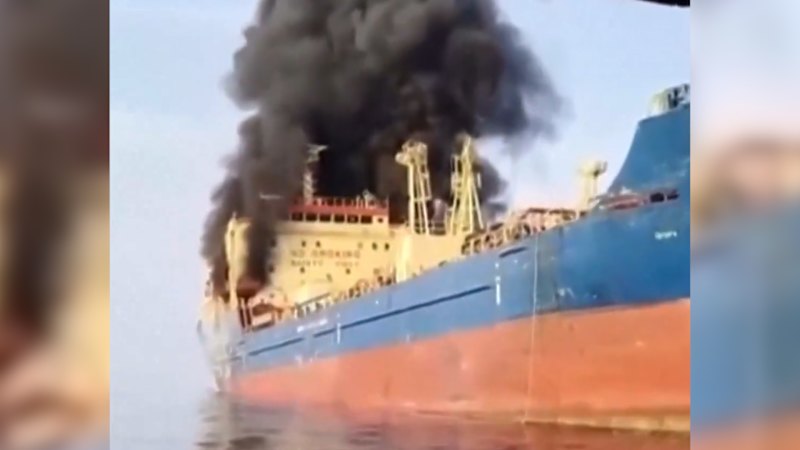
The recent explosion targeting a commercial tanker off the coast of Oman is not an isolated incident of maritime misfortune. It is a calculated message. While initial reports often focus on the immediate damage or the frantic distress calls, the reality is that the Gulf of Oman has become a primary chessboard for state-on-state friction that avoids the "red lines" of open war. This strike represents a significant escalation in the use of suicide drones to disrupt the global energy supply chain without the fingerprints of a formal military engagement.
For the global economy, the stakes are measured in more than just hull repairs. The Arabian Sea serves as the throat of the international oil trade. When a vessel is hit, the ripples move instantly through the insurance markets in London and the energy trading floors in Singapore. This is not just about one ship. It is about the viability of the most critical transit corridor on the planet.
The Architecture of a Deniable Strike
The mechanics of the attack point to a sophisticated level of planning that surpasses the capabilities of common pirates or localized insurgents. We are seeing the deployment of one-way attack (OWA) unmanned aerial vehicles. These are essentially flying IEDs. They are small, relatively cheap to produce, and incredibly difficult to track on standard civilian radar systems until the moment of impact.
By using these drones, the aggressor achieves two things. First, they prove that they can strike a moving target with precision hundreds of miles away from a mainland base. Second, they maintain a thin veil of "plausible deniability." Because the wreckage of a drone is often scattered into the ocean or consumed by the fire it creates, proving the exact point of origin becomes a forensic nightmare that takes weeks, if not months, to settle. By the time the evidence is presented to the UN Security Council, the news cycle has moved on, and the geopolitical point has already been made.
Why Oman is the New Flashpoint
For years, the Strait of Hormuz was the primary site of tension. It is narrow, congested, and easy to harass. However, the international community responded by flooding that area with naval patrols and "Operation Sentinel" task forces. Consequently, the theater of conflict has pushed further south into the open waters off Oman.
This shift is tactical. The waters off the Omani coast offer more room for an aggressor to hide. In the vastness of the Arabian Sea, a small launch craft can blend in with the thousands of dhows and fishing vessels that dot the horizon. It is a "gray zone" environment where the rules of engagement are murky. Oman itself has long tried to maintain a neutral, Swiss-like stance in Middle Eastern diplomacy, acting as a back-channel mediator between Tehran and Washington. Targeting ships in its vicinity puts immense pressure on Muscat to pick a side, potentially fracturing one of the few stable diplomatic bridges left in the region.
The Insurance Crisis Looming Over the Fleet
Shipping companies operate on razor-thin margins. When a tanker is hit, the immediate cost is not just the physical repair. It is the "War Risk" premium. Underwriters at Lloyd’s and other major syndicates monitor these incidents with predatory focus. One hit can cause premiums for every vessel in the region to spike overnight.
If these attacks continue, we will see a "risk creep" where certain zones become effectively uninsurable for smaller operators. This forces the trade into the hands of larger, state-backed fleets or, more dangerously, into the "shadow fleet." The shadow fleet consists of aging, poorly maintained tankers with opaque ownership structures that operate without standard insurance. They are the ghosts of the sea. If one of these vessels is hit and suffers a catastrophic spill, there is no corporate entity to hold accountable and no insurance fund to pay for the cleanup. The environmental risk to the Omani coastline is staggering.
Tactical Evolution of the Drone Threat
The technology used in these strikes is evolving faster than the defensive measures meant to stop them. Traditional naval defense is built around stopping supersonic missiles or heavy torpedoes. Using a million-dollar interceptor missile to shoot down a $20,000 drone is a losing game of attrition.
Current Defense Limitations
- Radar Clutter: Small drones flying low to the water are often lost in the "clutter" of waves and sea spray.
- Response Time: From the moment a drone is visually identified to the moment of impact is often less than 60 seconds.
- Electronic Warfare: While jamming can work, it can also interfere with the tanker’s own navigation systems, creating a different kind of safety hazard in crowded shipping lanes.
We are entering an era where commercial vessels may need to carry their own active defense systems. This creates a legal and security minefield. Do we want private oil companies operating laser point-defense systems or kinetic interceptors? The militarization of the merchant marine is a genie that, once out of the bottle, will be impossible to restrain.
The Intelligence Gap
There is a persistent failure in maritime domain awareness. We can track the AIS (Automatic Identification System) signals of every major ship, but we have almost zero visibility into the small-craft movements that facilitate these attacks. Intelligence agencies are currently playing catch-up. They are trying to map the supply chains that move drone components from manufacturing centers to launch points in coastal huts or converted fishing boats.
The reality is that as long as there is a market for deniable aggression, these attacks will persist. They are the perfect tool for a mid-sized power looking to punch above its weight class. They can rattle the global economy for the price of a mid-sized sedan.
Tracking the Money and the Metal
To understand the next move, look at the "ghost" exports. Whenever there is a breakdown in nuclear negotiations or a fresh round of sanctions, a tanker in the Arabian Sea tends to find itself in the crosshairs. It is a violent form of bartering. The aggressor is signaling that if their ability to sell energy is restricted, no one else’s energy exports will be safe either.
This is a structural flaw in the global energy market. We rely on a 19th-century concept of "freedom of the seas" that is being systematically dismantled by 21st-century remote technology. The "freedom" part of that equation only exists as long as everyone agrees to play by the rules. Those rules are currently being shredded.
Beyond the Hull Damage
When the crew of a hit tanker is evacuated, the story usually ends for the general public. But for the maritime industry, the headache is just beginning. There are salvage rights to negotiate, diverted cargoes that miss their "laycan" windows at refineries, and the psychological toll on the seafarers. There is already a global shortage of qualified officers. If the Arabian Sea becomes a "combat zone" by default, the cost of labor will skyrocket, or worse, the talent will simply vanish.
No one wants to work on a floating bomb that can be targeted by a teenager with a remote control 300 miles away.
The international community needs to stop treating these hits as isolated criminal acts and start recognizing them as a new form of undeclared, low-intensity naval warfare. The response cannot just be more patrols. It must involve a total overhaul of maritime security law and a concerted effort to hold the manufacturers of these "deniable" weapon systems accountable. Until the cost of launching a strike outweighs the geopolitical gain, the drones will keep flying.
Check the hull integrity. Double the watch. The Arabian Sea is no longer a transit zone; it is a front line. Ship owners should immediately review their "War Risk" clauses and consider shifting to more expensive, but better-protected, eastern transit routes if they want to avoid being the next headline.