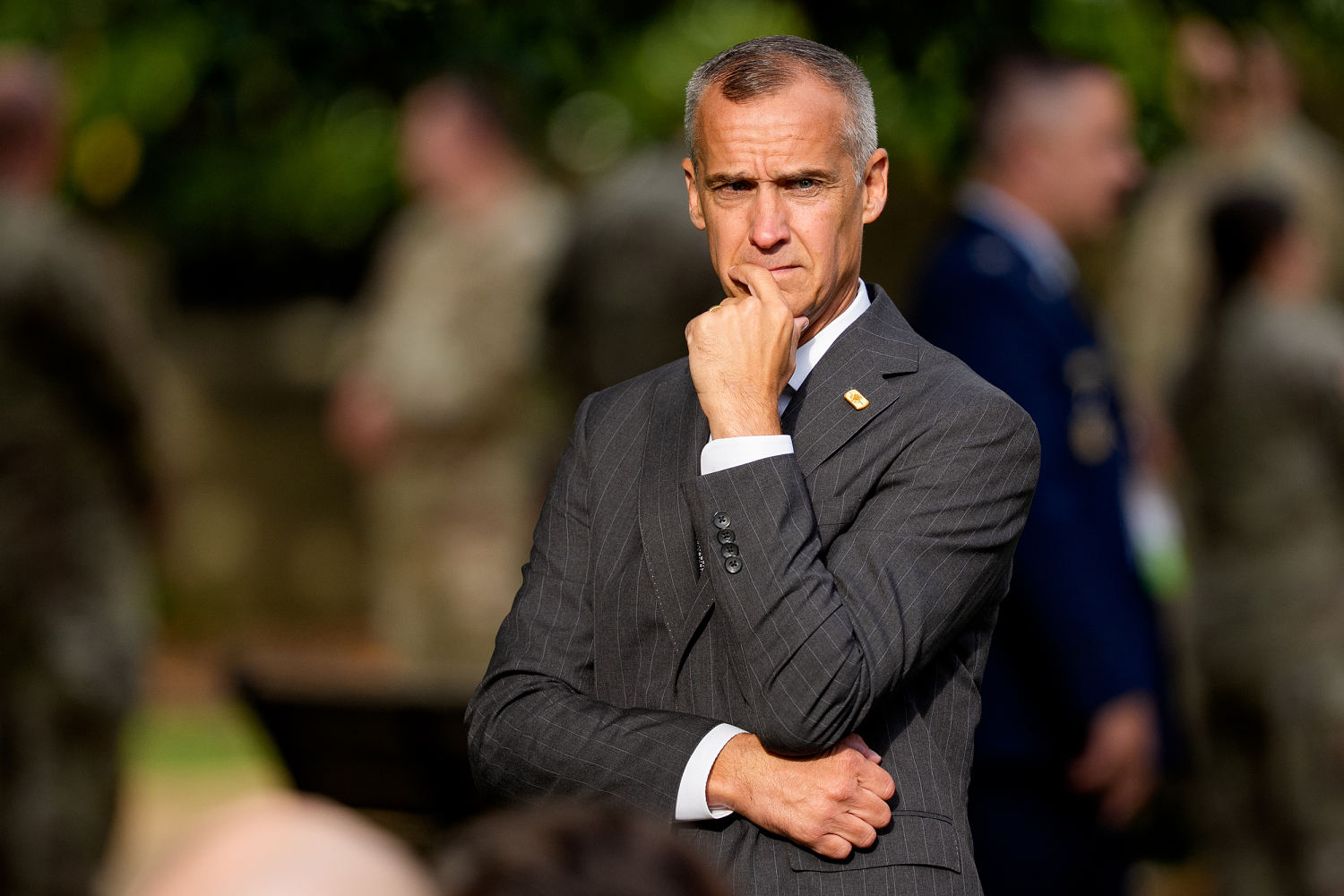
The Department of Homeland Security is a fortress of career clock-watchers, high-level strategists, and a sprawling bureaucracy that usually moves with the speed of cooling lava. But for a few feverish weeks, the hallways of the Nebraska Avenue Complex felt different. There was a vibrating tension in the air, the kind that precedes a summer storm or a corporate raid.
Corey Lewandowski had arrived. Meanwhile, you can find related stories here: The Calculated Silence Behind the June Strikes on Iran.
He didn't come as a permanent fixture, but as a temporary advisor, a ghost in the machine designed to streamline the transition for Kristi Noem. To those who have followed the jagged trajectory of modern American power, the name alone carries a specific weight. It’s the sound of a door slamming. It’s the visual of a sharp suit in a scrum. It is the personification of the "Let Trump be Trump" era.
Then, just as quickly as the oxygen in the room changed, the pressure dropped. To understand the complete picture, we recommend the detailed analysis by NBC News.
The Department of Homeland Security (DHS) confirmed this week that Lewandowski has exited the building. His departure wasn't a firing, nor was it a scandal in the traditional sense. It was something more clinical: a systemic rejection. When the person you were sent to advise is no longer in the seat, the advisor becomes a shadow without a body. With Kristi Noem’s sudden and unceremonious ouster from the leadership track, the mechanical gears of the federal government simply reset.
Power in Washington is often described as a liquid, but it functions more like a magnetic field. When the magnet is removed, the iron filings—the advisors, the strategists, the loyalists—simply scatter.
Consider a hypothetical mid-level analyst at DHS. We'll call her Sarah. For fifteen years, Sarah has tracked migration patterns and port security under four different administrations. She survives by following the process. To Sarah, a figure like Lewandowski represents a disruption to the process. He represents the "outsider" energy that views bureaucracy not as a safety net, but as a cage.
For a brief window, Sarah and her colleagues had to look at their spreadsheets through the lens of a man known for blunt force. They had to weigh their data against the political instincts of a street fighter. And then, the news broke about Noem. The anchor was cut.
The exit of Corey Lewandowski is the final punctuation mark on a chapter that never truly got past the table of contents.
The official line from DHS was characteristically dry. They noted that his temporary assignment had concluded following the change in leadership. It’s the kind of sentence that hides a thousand frantic phone calls and a dozen shifted allegiances. It ignores the human reality of what it’s like to be the "enforcer" in a room full of people who are waiting for you to leave.
There is an inherent friction in the way our government functions today. On one side, you have the "Deep State"—a term often used as a slur, but which actually describes the millions of people like Sarah who keep the lights on regardless of who is in the Oval Office. On the other side, you have the "Disruptors," the Lewandowskis of the world who believe the only way to fix a broken system is to break it further.
When these two worlds collide, the result is rarely a productive fusion. It’s usually a stalemate.
Lewandowski’s tenure at DHS was never about long-term policy. It was about presence. It was about signaling to the rank and file that the old ways of doing business were under scrutiny. But signaling only works if the person holding the megaphone stays on the stage.
The "Noem Factor" changed everything. Kristi Noem, once the rising star of the plains, found herself in a political wilderness of her own making. Her departure from the DHS orbit wasn't just a career setback; it was a vacuum. And in Washington, a vacuum is filled in seconds.
We often think of government departments as monolithic entities, but they are ecosystems. When a top predator leaves, the entire food chain shifts. The departure of an advisor like Lewandowski allows the career staff to breathe again, to return to the comfort of the "standard operating procedure."
But there is a cost to this cycle of disruption and reset.
Every time a high-profile political figure enters a department only to be flushed out weeks later, the institutional memory of that department takes a hit. Trust erodes. The "Sarahs" of the world stop looking at the new guy as a leader and start looking at him as a weather event—something to be hunkered down against until it passes.
This isn't just about one man or one department. It's about the volatile chemistry of modern governance. We are living in an era where the shelf life of a political appointment is shorter than a gallon of milk. This creates a permanent state of "transitional" government, where nothing is built to last because everyone is waiting for the next ouster.
Lewandowski is a survivor. He has been "out" before, only to find his way back into the inner circle through sheer persistence and a refusal to be ignored. He doesn't need the DHS badge to have influence. In many ways, he is more dangerous to the status quo when he is outside the building, whispered into the ears of those who still hold the levers of power.
The hallways at the Nebraska Avenue Complex are quieter now. The vibrating tension has faded. The career staff have gone back to their meetings about maritime security and cyber threats. The "outsider" has been processed out.
But as the sun sets over the Potomac, you can’t help but wonder if the fortress is actually more secure, or if it’s just more isolated.
The silence isn't necessarily peace. Sometimes, it's just the sound of a system holding its breath, waiting for the next disruption to walk through the front door.
The desk is clear. The badge has been deactivated. The storm has moved on, leaving nothing behind but a few empty offices and the nagging feeling that the next one is already forming on the horizon.