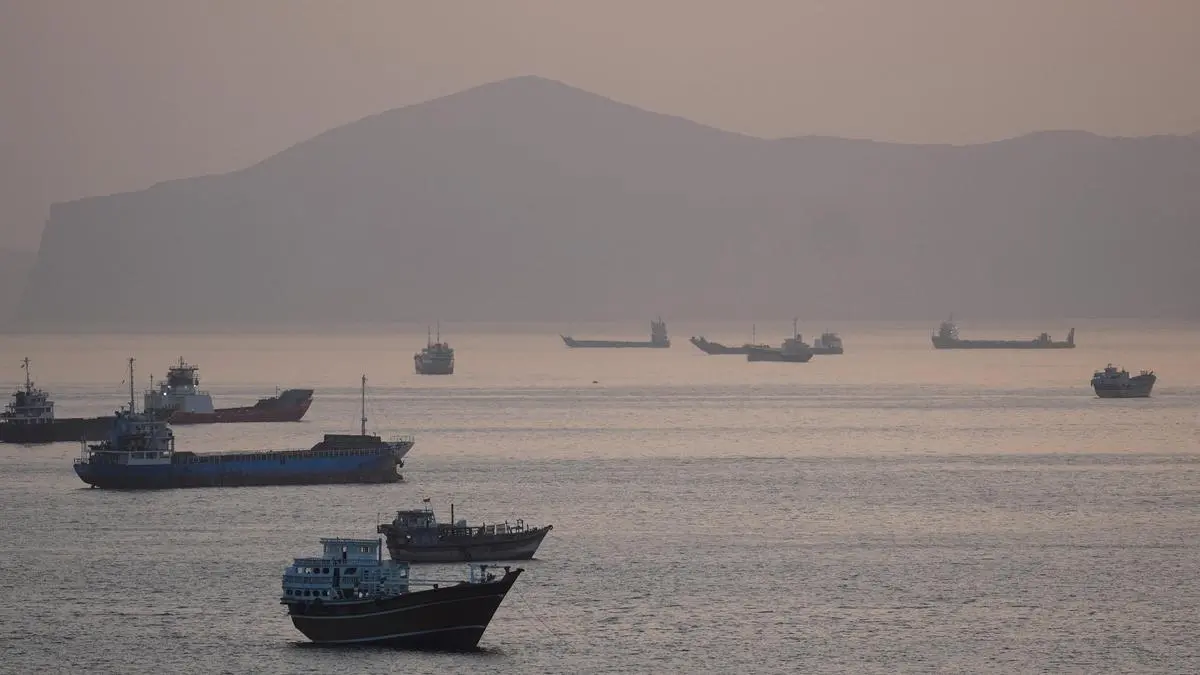
The sea should be loud.
On a normal day in the Strait of Hormuz, the air is thick with the rhythmic thrum of massive diesel engines and the crackle of radio chatter in a dozen different languages. It is a choke point of human ambition. Twenty-one miles wide at its narrowest, it serves as the jugular vein of the global energy market. To stand on the shore of Oman or the deck of a passing tanker is to witness the industrial heartbeat of the world.
Now, there is mostly silence.
The pulse has slowed to a crawl. In recent weeks, the number of ships threading this needle has plummeted by more than 90 percent. Where a steady procession of steel giants once moved with the clockwork precision of a conveyor belt, there are now fewer than ten ships a day. It is a ghost town of saltwater and brine.
This is not just a statistic for a spreadsheet. It is a fundamental shift in how the modern world stays upright.
The Invisible Captain
Consider a man like Elias. He is a hypothetical second mate on a Very Large Crude Carrier (VLCC), a vessel longer than the Eiffel Tower is tall. In a standard year, Elias worries about the weather, the fatigue of his crew, and the endless maintenance of a ship that is essentially a floating city of oil.
Today, Elias watches a screen. He isn't looking for storms. He is looking for drones, for swarming fast-boats, and for the jagged lines on a radar that indicate a missile lock.
The Strait of Hormuz is the world's most important oil transit point. Roughly 20 percent of the world’s daily oil consumption passes through this narrow corridor. When the traffic drops from a flood to a trickle, the pressure doesn't stay in the Persian Gulf. It travels. It moves through underwater cables, through high-frequency trading algorithms in London, and eventually, it reaches the gas pump in a small town in Ohio or a heating bill in a flat in Berlin.
The "West Asia tensions" mentioned in news briefs are cold terms for a hot reality. When ships stop moving, it’s because the cost of risk has finally outweighed the price of the cargo. Insurance premiums for transiting the Strait have surged to levels that make the journey a desperate gamble. For a ship owner, it’s no longer about a delivery; it’s about whether the hull will remain intact.
The Anatomy of a Choke Point
To understand why ten ships a day is a terrifying number, you have to look at the math of modern life. The world functions on "just-in-time" logistics. We don’t keep massive reserves of everything we need; we rely on the fact that the ship is coming.
The Strait is a funnel. On one side, you have the massive production hubs of Saudi Arabia, Iran, the UAE, Kuwait, and Iraq. On the other, the open maw of the global economy.
Imagine a garden hose providing water to a massive city. Now, imagine someone placing a heavy boot on that hose. The water doesn't just stop; the pressure builds up behind the blockage while the city on the other side begins to wither.
- The 90 Percent Gap: When traffic drops by 90 percent, the world loses its buffer.
- The Alternative Routes: There are pipelines that bypass the Strait, like the East-West Pipeline in Saudi Arabia, but they cannot handle the volume. They are a bandage on a severed artery.
- The Energy Shift: While the world talks about green energy, the bedrock of global manufacturing and transport remains tethered to the crude that flows through this 21-mile gap.
But the real story isn't the oil. It's the uncertainty. Markets can handle bad news, but they cannot handle a vacuum. A 90 percent drop in traffic is a vacuum of information. It tells the world that the most guarded, most monitored waterway on the planet is currently deemed too dangerous for the standard operations of commerce.
The Human Cost of High Stakes
We often treat "tensions" as a chess game played by states. But the pieces on the board are made of flesh and blood.
When a tanker stops, the crew is stranded. Hundreds of sailors are currently sitting in harbors or drifting in the open sea, waiting for orders that may never come or, worse, orders to head into the line of fire. They are the invisible laborers of globalization. Their anxiety doesn't show up on a stock ticker, but it is the fuel that runs the engine of the maritime industry.
When the traffic stops, the supply chain for food and medicine in the region also begins to fray. The Gulf states import a staggering amount of their daily needs. The same tankers that carry oil out often share the water with container ships bringing in the basic necessities of life.
The silence in the Strait is the sound of a system failing. It’s the sound of a world realizing that its most vital infrastructure is incredibly fragile. We built a global civilization on the assumption that the seas would always be open, that the rules of the road would always be followed, and that the profit motive would always be stronger than the impulse for conflict.
That assumption is currently sinking.
The Ripples in the Dark
Why does this matter to someone who will never see the Persian Gulf?
Because of the ripple effect. Economics is not a series of isolated events; it is a web. When the traffic in Hormuz drops, the ships don't just disappear. They take the long way. They go around the Cape of Good Hope. They burn more fuel. They take more time.
This adds weeks to delivery schedules. It ties up ships that should be elsewhere. Suddenly, there is a shortage of vessels in the Atlantic because they are all stuck on a detour around Africa. The price of shipping a container from Shanghai to New York spikes. The cost of a plastic toy, a laptop, or a head of lettuce increases.
It is a slow-motion car crash. We are watching the impact in real-time, but the debris won't hit our shores for another month.
The 90 percent drop is a warning. It is a signal that the geopolitical architecture we’ve relied on since the end of the Second World War is under a strain it wasn't designed to handle. It's not just about "West Asia." It's about the fact that a few well-placed drones and a shift in political will can effectively switch off the lights for a significant portion of the global economy.
The Weight of the Silence
There is a specific kind of dread that comes with a quiet harbor.
In the ports of Fujairah and Bandar Abbas, the cranes are still. The logistical experts who spend their lives optimizing every second of a ship's turnaround time are now staring at empty berths. There is a sense of powerlessness. You can optimize a route, you can upgrade an engine, and you can automate a port, but you cannot outrun a missile.
We are entering an era where the "invisible hand" of the market is being shoved aside by the very visible hand of military strategy. The Strait of Hormuz is the primary stage for this drama, but the script is being written in capitals thousands of miles away.
The ships that remain—the brave or the desperate few—move with their transponders turned off. They are "dark ships," ghosts in the machine, trying to slip through the silence without being noticed. They represent a return to an older, more dangerous way of doing business. It is a world where trade is a mission, and every horizon holds a threat.
The world is waiting for the sound to return. We are waiting for the thrum, the chatter, and the noise of a functioning planet. But for now, the Strait remains a mirror of our own instability.
It is a narrow, blue strip of water that holds the power to change everything. And right now, it is far too quiet.
The sun sets over the Musandam Peninsula, casting long, golden shadows over the water where dozens of ships should be. There is only the wind. There is only the tide. The pulse is weak, and the rest of the world is just starting to feel the chill.


