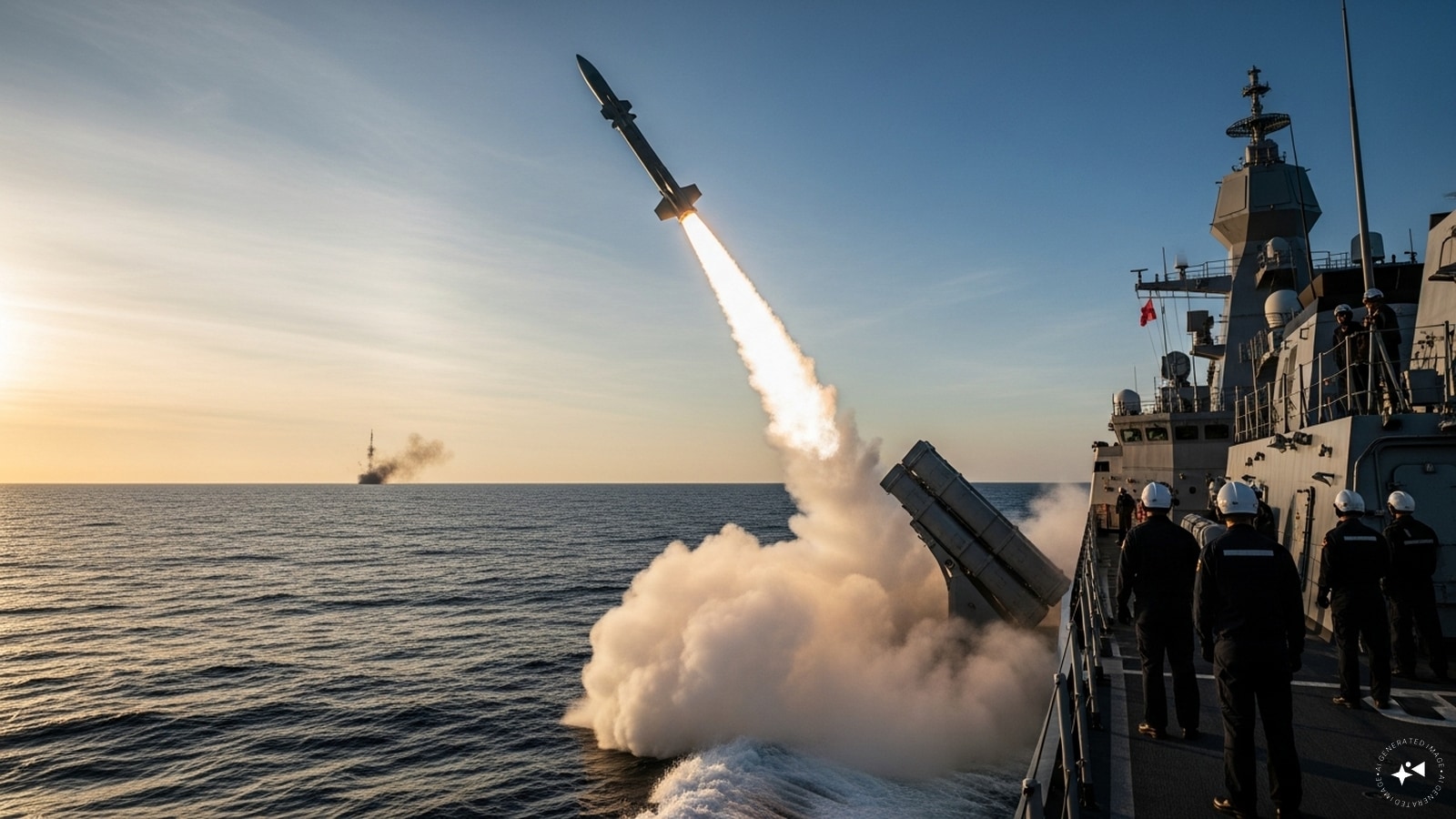
The steel of the deck vibrates before the sound actually hits. It is a deep, bone-rattling hum that begins in the soles of your boots and climbs up through your marrow. On the bridge of a Pakistan Navy destroyer, the air is thick with more than just salt spray; it is heavy with the pressurized silence of men who have spent months preparing for a single second of data.
To a casual observer reading a news ticker, it was just a "successful flight test of a ship-launched missile." To the crew stationed in the turquoise expanse of the North Arabian Sea, it was the culmination of thousands of hours of sweat, technical friction, and the relentless pursuit of a strategic ghost.
They weren't just launching a piece of hardware. They were proving a concept that changes the geometry of the Indian Ocean.
The Weight of the Invisible Target
Modern naval warfare is rarely about the spectacular broadsides of the 1940s. It is a game of math played at distances that defy the human eye. When the Pakistan Navy recently cleared the decks for this extended-range test, the target wasn't a visible ship on the horizon. It was a coordinate in the vast, empty blue, hundreds of kilometers away—a distance that, until recently, would have been considered out of reach for a ship-based strike.
Consider the physics of the problem. A ship is a moving platform on a restless sea. To hit a target at an "extended range," the missile’s brain must account for the curvature of the earth, the shifting wind gradients of the upper atmosphere, and the microscopic wobbles of the vessel at the moment of ignition.
One mistake—a single line of corrupted code or a faulty sensor—and millions of dollars of indigenous engineering becomes an expensive firework that splashes harmlessly into the abyss.
But when the countdown reached zero, the reality was different.
The missile cleared the canister in a violent burst of white smoke and orange flame, shedding its booster and leveling out into a high-speed sprint. On the radar screens inside the Combat Information Center, the crew watched a tiny green blip. That blip represented more than kinetic energy. It represented a shift in the regional balance of power. By hitting a target at this new, undisclosed distance, Pakistan effectively told the world that its "buffer zone" just got much, much wider.
The Hands Behind the Metal
We often talk about defense technology as if it exists in a vacuum, as if these machines build themselves. In reality, this successful test was a victory for the anonymous engineers in labs across Pakistan who have spent years trying to break their reliance on foreign military imports.
There is a specific kind of quiet pride in an indigenous achievement. It is the pride of the technician who spent forty-eight hours straight debugging a guidance system so it wouldn't rely on external GPS signals that could be jammed in a conflict. It is the pride of the naval officer who knows that his ship is no longer just a defensive shield, but a long-reach sword.
Imagine a young tactical officer, let's call him Lieutenant Khan. He isn't thinking about "strategic deterrence" or "geopolitical ripples" in the moment of the launch. He is thinking about the calibration of his sensors. He is thinking about his crew’s safety. He is thinking about the fact that, for the first time, his ship can hold a threat at bay from a distance that ensures he might actually see his family again if things ever turn sour.
The missile’s flight path is a tether. It connects the high-tech aspirations of a nation to the cold, hard reality of its maritime borders.
The Arithmetic of Deterrence
Why does an extra hundred kilometers matter? To the layman, it seems incremental. To a naval strategist, it is everything.
Naval warfare is governed by the "Scout’s Dilemma." If you can see the enemy, but they can’t see you, you win. If you can hit the enemy, but they can’t reach you, you survive. By extending the range of its ship-launched missiles, the Pakistan Navy has effectively pushed the "no-go" zone for any potential adversary further away from its coast.
This isn't about aggression. It is about the math of peace.
When a nation demonstrates that it can strike with precision from over the horizon, it changes the cost-benefit analysis of every other actor in the region. It creates a "fleet-in-being" effect—the mere existence of the capability forces opponents to change their behavior, to stay further out, to think twice before entering contested waters.
The missile doesn't even have to be fired in anger to do its job. Its job is to sit in its tube, silent and ready, casting a long shadow over the waves.
A Sea of Uncertainty
The Arabian Sea is one of the most crowded and consequential patches of water on the planet. It is a highway for the world's energy, a playground for global superpowers, and the front yard of a nation that has often felt squeezed by its neighbors.
In this environment, "good enough" technology is a death sentence. The recent test wasn't just a routine check-up. It was a response to a rapidly evolving neighborhood where supersonic missiles and carrier groups are becoming the standard.
The technical specifications of the missile—the exact range, the payload capacity, the terminal velocity—remain closely guarded secrets. But the message wasn't in the data; it was in the impact. The target, floating in the middle of nowhere, was pulverized. The sensors confirmed a direct hit.
For the technicians monitoring the telemetry, the visual of that impact was a release of years of tension. It confirmed that the propulsion systems could handle the long burn. It confirmed that the seeker head could find a needle in a haystack of waves and whitecaps.
The Human Cost of the Horizon
We live in a world that is increasingly comfortable with the idea of automated war. We see drones on our screens and missiles in our newsfeeds, and we forget the human pulse behind the trigger.
The men and women on that Pakistani vessel during the test weren't just "operating a platform." They were representing a collective national effort to maintain a foothold in an increasingly hostile sea. They were the ones who had to ensure that when the order came, the machine wouldn't fail them.
The success of the extended-range missile is a story of human persistence over mechanical entropy. It is about the struggle to master the elements—the corrosive salt, the crushing pressure, the vast distances—and bend them to a singular will.
As the smoke cleared from the deck and the ship turned back toward the coast of Karachi, the atmosphere on board shifted. The adrenaline faded, replaced by the mundane tasks of a navy at sea. But something had changed. The charts in the plotting room looked different. The circles of influence drawn around the ship had expanded.
The sea is still vast, and it is still dangerous. But for those on board, and for the nation watching from the shore, the horizon no longer feels like a limit. It feels like a beginning.
The missile had done its job. It had traveled further than its predecessors, piercing the veil of the "impossible" and landing exactly where it was told to. In the silent depths of the Arabian Sea, the ripples from that impact are still moving, carrying a message that doesn't need a translator: the sentinel is awake, and its reach is longer than you think.