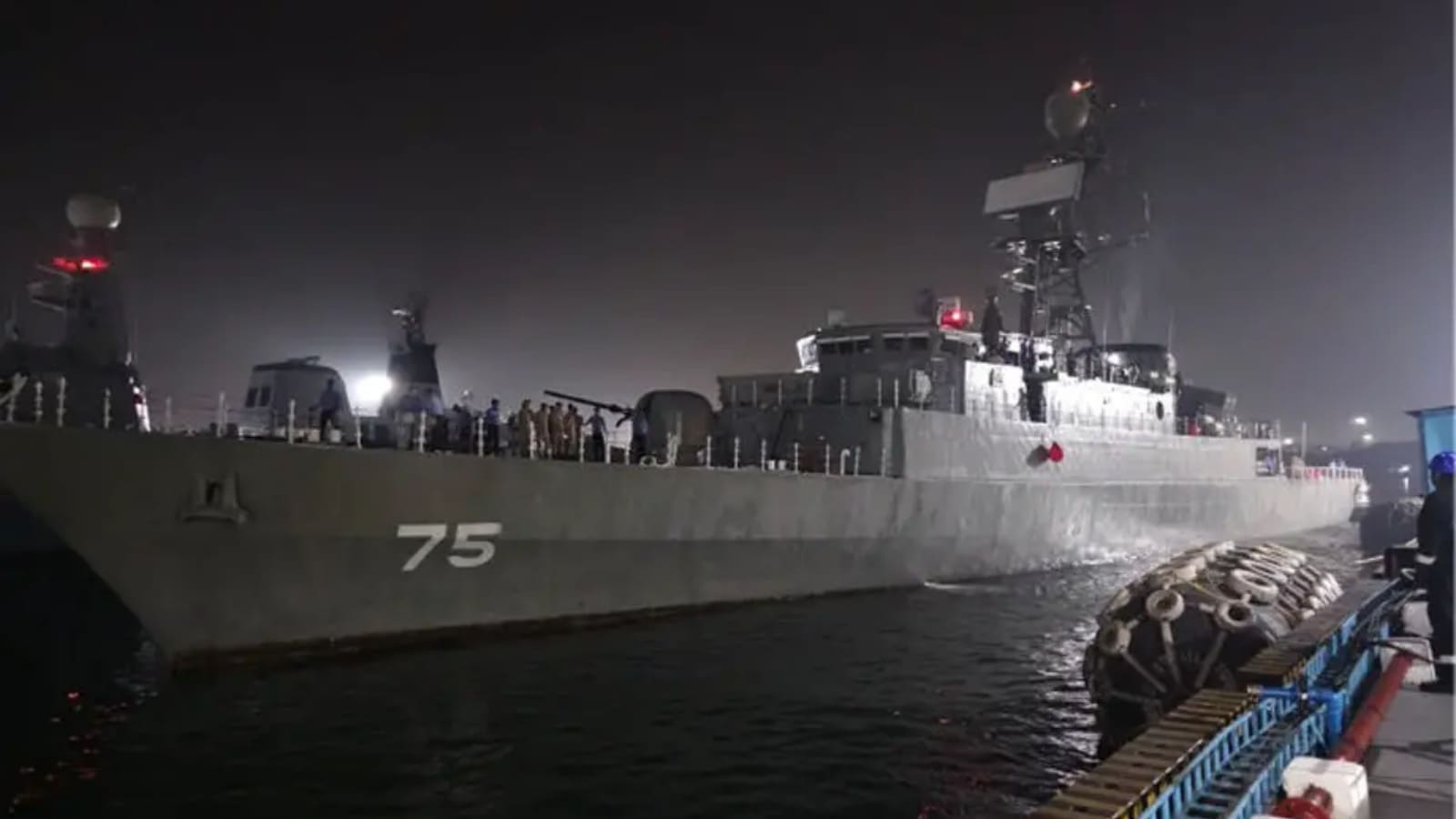
The sudden sinking of a prominent Iranian surface combatant in the deep waters near Sri Lanka has sent shockwaves through the Indian Ocean defense community. While initial reports from Tehran hinted at a mechanical failure or a "navigational mishap" during its return from the Milan naval exercises in India, the physical evidence points toward a much more violent reality. Sources within regional maritime intelligence circles suggest a high-energy underwater event—consistent with a modern torpedo strike—tore through the hull of the vessel, sending it to the seabed in minutes. This wasn't a leak. This was an execution.
For years, the Islamic Republic of Iran Navy (IRIN) has attempted to project power far beyond the Persian Gulf, trying to prove it can operate as a "blue water" force. The loss of this ship, specifically after participating in a high-profile international diplomatic event, is a catastrophic blow to that narrative. If the suspected submarine strike is confirmed, it reveals a terrifying gap in Iran's anti-submarine warfare (ASW) capabilities and suggests that a silent, sophisticated actor is now actively policing Iranian movement in the open ocean.
The Illusion of Blue Water Capability
The Iranian naval strategy has long relied on a mix of aging Western hardware from the pre-1979 era and locally produced "Mowj" class frigates. To the casual observer at a naval parade, these ships look formidable. They carry anti-ship missiles, radar systems, and a crew that projects discipline. However, seasoned analysts have always questioned the structural integrity and electronic warfare suites of these vessels when stripped of the protection of land-based air cover.
Operating in the Indian Ocean is a different beast than the shallow, crowded waters of the Strait of Hormuz. In the Strait, Iran can rely on swarming tactics and land-based batteries. In the vast expanse near Sri Lanka, a ship is an island. Without a sophisticated sonar net or a screening force of destroyers, a lone Iranian frigate is essentially a sitting duck for any modern diesel-electric submarine.
The vessel in question was returning from the Milan exercise, a biennial gathering hosted by the Indian Navy. It was a moment of peak visibility. For an adversary to strike at this specific time is a calculated move designed to maximize embarrassment. It sends a message not just to Tehran, but to the other 50 nations present at the exercise: Iranian hardware cannot survive the transit home.
The Mechanics of an Underwater Kill
Witnesses and satellite imagery from the hours following the disappearance show a massive debris field and a lack of deployed life rafts, which suggests the sinking was near-instantaneous. In a standard mechanical failure, such as a boiler explosion or a catastrophic hull breach from metal fatigue, there is usually a window for a distress call. The silence in this case is deafening.
A modern heavyweight torpedo, such as those fired from an advanced hunter-killer submarine, does not actually hit the ship. Instead, it detonates directly beneath the keel. This creates a massive gas bubble that lifts the ship out of the water, followed by a vacuum that snaps the keel like a dry twig. This "broken back" phenomenon explains why a ship of that size would vanish from radar and sonar almost instantly.
- Acoustic Signature: Iranian vessels are notoriously loud. Their engine mounts lack the modern vibration-dampening tech found in NATO or Chinese counterparts.
- Sensor Deficiency: The sonar suites on these ships are often generations behind, making it nearly impossible to detect a "black hole" class submarine running on battery power in a deep-water thermal layer.
- Structural Vulnerability: Locally manufactured Iranian hulls have frequently been criticized for poor welding standards, which leads to rapid flooding once the primary structure is compromised.
Regional Power Dynamics and the Shadow War
The list of suspects capable of such a precise, stealthy operation is short. While the United States and Israel are the most frequent protagonists in the "shadow war" against Iranian interests, the location of this incident—so close to the Bay of Bengal—adds a layer of geopolitical complexity.
Sri Lanka has recently become a focal point for maritime competition between India and China. Both nations are wary of increased Iranian presence, which often acts as a precursor to broader security shifts or clandestine arms transfers. However, a kinetic strike by a major regional power in international waters is a massive escalation. It suggests that the "rules of engagement" have shifted from harassment and cyber-attacks to direct physical attrition.
If a submarine was indeed responsible, the operation required months of intelligence gathering. The attacker would have needed the vessel’s exact departure time, its planned route, and its expected acoustic profile. This implies a level of surveillance that penetrates the Iranian naval command structure itself.
The Failure of Iranian ASW
The most damning aspect of this sinking is the complete failure of the ship's defensive posture. Iranian naval doctrine has heavily favored "asymmetric" warfare—using small boats and mines to threaten commercial shipping. They have neglected the grueling, high-tech discipline of anti-submarine warfare.
To defend against a submarine, a surface ship needs more than just a hull-mounted sonar. It needs towed arrays that can listen below the "thermocline"—the layer of water where temperature changes abruptly, acting as a sound shield for subs. It needs organic air assets, like SH-3 Sea King or AB-212 helicopters, equipped with dipping sonar and magnetic anomaly detectors. Most Iranian ships in this class carry these helicopters, but their operational readiness is often hampered by a lack of spare parts and outdated electronics.
The ship was likely "blind" to everything happening more than 100 meters below the surface. In the deep trenches of the Indian Ocean, that is a fatal oversight.
Intelligence Gaps and the "Navigational Error" Excuse
Tehran's immediate pivot to blaming "technical issues" is a standard playbook move. By claiming the ship sank due to an internal fault, they avoid the pressure to retaliate against a foreign power. To admit a submarine sank their prized vessel would be to admit that their navy is porous and vulnerable.
But the maritime industry knows the truth. Lloyd’s List and other tracking services show no reports of engine trouble or calls for assistance prior to the disappearance. Furthermore, the Indian Navy, which had been tracking the exercise participants, has remained uncharacteristically quiet. This silence often precedes a quiet diplomatic fallout where the "victim" is told exactly why their ship is now at the bottom of the ocean.
Reassessing the Iranian Threat
For years, Western policy has focused on the "swarm" threat in the Persian Gulf. This incident suggests we need to flip the script. The real story isn't about what Iran can do to others, but how little they can do to protect themselves once they leave their coastal waters.
The sinking proves that Iran’s "Long Arm" is actually quite brittle. They can build missiles and drones, but the complex integration required for a survivable blue-water navy remains out of their reach. You cannot "asymmetric" your way out of a torpedo hit.
The Search for the Wreckage
The race is now on to locate the hull. The water depth in the suspected area exceeds 3,000 feet, making any recovery effort an expensive, high-tech nightmare. Iran does not possess the deep-sea salvage equipment necessary to recover the black box or examine the hull for blast patterns.
If a third party—such as a US-led salvage team or a private maritime intelligence firm—reaches the site first, the proof of a kinetic strike will become public. At that point, the "technical failure" lie collapses. We are looking at a scenario where the physical evidence of a secret war is sitting on the ocean floor, waiting for a remote-operated vehicle to find it.
The Cost of Hubris
This sinking is the ultimate price of projecting a capability that doesn't exist. Iran wanted the prestige of an ocean-going navy without the decades of investment in submarine defense and structural engineering. They sent a parade ship into a combat zone, even if that zone was technically "at peace."
The loss of the vessel isn't just about the hardware or the lives lost; it's about the end of an era. The Indian Ocean is no longer a safe transit corridor for Iranian vessels looking to show the flag. The "silent service" of an unnamed power has just redrawn the map. Tehran must now decide if it will continue these risky long-distance deployments or retreat back to the safety of the Persian Gulf, acknowledging that the open sea belongs to those who control the depths.
Request a satellite bathymetry analysis of the suspected site to identify the exact debris pattern and confirm the underwater explosion.