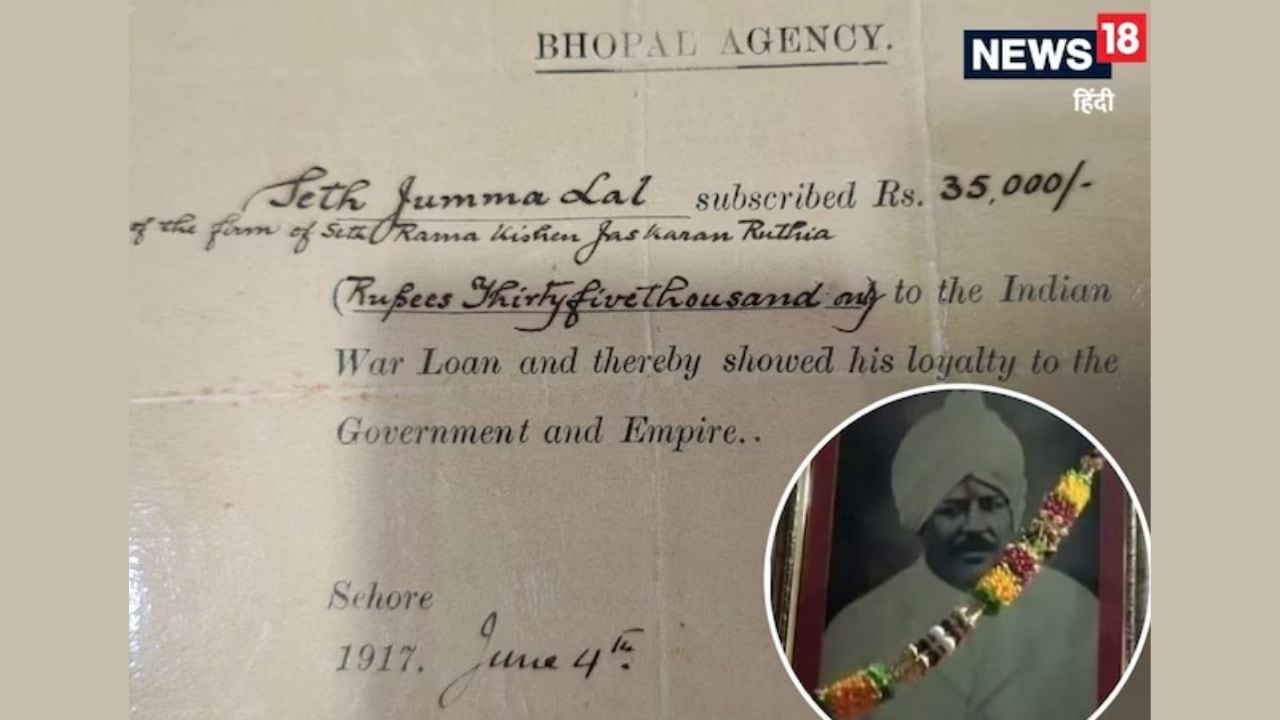
The reclamation of a ₹35,000 debt issued to the British Government in 1942 by an Indian family represents more than a pursuit of familial wealth; it is a clinical case study in the intersection of sovereign risk, monetary debasement, and the legal continuity of state obligations. To evaluate the viability of such a claim, one must move beyond the emotional narrative of "returning money in crores" and instead apply a rigorous framework of Purchasing Power Parity (PPP), the mechanics of Compound Annual Growth Rates (CAGR), and the specificities of the Indian Independence Act of 1947.
The Three Pillars of Value Erosion
The fundamental challenge in settling a debt across an eighty-four-year horizon is the divergence between nominal value and real economic weight. The claim hinges on three distinct variables that determine the final "fair" valuation.
1. The Inflationary Decay Function
Since 1942, the Indian Rupee has undergone significant structural shifts, including multiple devaluations and the transition from a colonial currency pegged to the Pound Sterling to a free-floating fiat currency.
- 1942 Context: In the early 1940s, ₹35,000 was not a middle-class sum; it represented significant capital. For perspective, the gold rate in 1942 hovered around ₹44 per 10 grams (one Tola).
- The Gold Benchmark: If the ₹35,000 had been converted to gold in 1942, the family would have held approximately 7.95 kilograms of gold. At 2026 market prices, that same physical asset would be valued at approximately ₹6 crore to ₹7 crore.
- Consumer Price Index (CPI) Reality: Adjusting for inflation using a standard CPI model suggests a multiplier that exceeds 1,500x, though this varies wildly depending on whether one uses wholesale indices or basic commodity baskets.
2. The Interest Rate Compounding Mechanism
The "Return in Crores" argument relies entirely on the assumption of compounded interest. However, sovereign debt issued during wartime (War Bonds) typically carried fixed simple interest or low compounding rates designed to fund immediate military expenditures, not to generate long-term private equity-style returns.
If the original bond or promissory note specified a 3% annual interest rate (common for the era):
- Simple Interest: The return would be negligible, barely doubling the principal over eight decades.
- Compounded Interest: $A = P(1 + r/n)^{nt}$. Applying a 5% annual compound rate over 84 years turns ₹35,000 into approximately ₹21.6 lakhs. To reach the "crores" cited in the claim, an implied interest rate of 10% to 12% would be required—a rate rarely, if ever, guaranteed by a sovereign entity on a low-risk bond.
3. The Currency Peg and Devaluation
In 1942, the Rupee was pegged to the British Pound at a rate of 1s 6d (1 shilling and 6 pence). The subsequent devaluations of 1949, 1966, and 1991 fundamentally altered the liability profile. If the debt is viewed as a Sterling-denominated obligation, the math shifts toward British inflation indices; if viewed as a Rupee obligation, the domestic fiscal policy of the Indian State becomes the primary driver of value.
The Doctrine of State Succession
The primary legal bottleneck is not the math, but the Principle of State Succession. When India gained independence in 1947, the liability for "Home Charges" and internal debts was bifurcated between the United Kingdom and the newly formed Dominions of India and Pakistan.
Under the Indian Independence (Rights, Property and Liabilities) Order, 1948, the Government of India generally assumed the liabilities for loans, guarantees, and financial obligations contracted by the Secretary of State for India if those obligations were localized to the territory of India.
The claimant faces a "Locus Standi" hurdle:
- Identity of the Debtor: Was the money lent to the "Government of India" (under the British Raj) or the "Imperial Government" in London?
- Statute of Limitations: Article 112 of the Limitation Act, 1963, generally provides a 30-year window for claims by or against the Government. While "extraordinary circumstances" can be argued, a delay of 80 years introduces the doctrine of Laches, where a court may dismiss a claim because the claimant slept on their rights, making a fair trial impossible due to the loss of records and witnesses.
The Cost Function of Litigation vs. Settlement
From a consultancy perspective, the family’s pursuit carries a high Opportunity Cost of Capital.
- Legal Fees: Engaging international law experts to argue state succession and maritime/wartime debt laws requires significant upfront liquidity.
- Verification Costs: The burden of proof lies with the family to produce original certificates. In the 1940s, debt was often recorded in physical ledgers. If the central registry (either in the Bank of England or the Reserve Bank of India) has purged these records under standard document retention policies, the claim becomes un-verifiable.
The "Success Scenario" for the family is likely not a mathematical payout of inflation-adjusted billions, but an Ex-Gratia Settlement. Sovereigns rarely pay adjusted interest on century-old debt because doing so would set a precedent that could bankrupt the modern treasury (e.g., if every descendant of a 19th-century railway bondholder sued for inflation-adjusted returns).
Systematic Bottlenecks in Sovereign Debt Recovery
The claim highlights a broader systemic issue in financial history: the Asymmetry of the Sovereign Contract. When a private citizen lends to a state, they are essentially entering a contract where the state is both the debtor and the lawmaker.
The state can:
- Inflate the debt away: By printing currency, the state reduces the real value of what it owes.
- Legislate a haircut: The state can pass laws capping interest rates on historical claims.
- Invoke Sovereign Immunity: In many jurisdictions, a sovereign cannot be sued in its own courts without its consent, or for "Acts of State" performed during wartime.
Strategic Recommendation for Claimants
The path to recovery does not lie in a standard civil suit for "money had and received." It requires a three-tier tactical approach:
- Administrative Audit: Secure a "Letter of Acknowledgement" from the RBI or the UK Treasury. Without an admission that the debt exists in a current ledger, no court will entertain the valuation phase.
- The Gold-Equivalency Argument: Rather than arguing for 12% compound interest (which is historically unsupported), the legal team should argue for a "Restitution of Value." This uses the 1942 gold price as a floor to maintain the "Spirit of the Principal."
- Diplomatic Channeling: Given the colonial context, this is a political matter as much as a financial one. The claim should be framed as a "Historical Liability" under the framework of bilateral investment treaties, potentially seeking a settlement through the Permanent Court of Arbitration (PCA) if the amounts truly justify the cost.
The most probable outcome is a "Nominal Recognition." Unless the original 1942 document contains a specific "Gold Clause" (which protected lenders against currency fluctuations), the courts are bound by the Nominalist Principle: a debt of ₹35,000 is legally satisfied by the payment of ₹35,000, regardless of the fact that in 1942 it bought a mansion and in 2026 it buys a high-end smartphone.
The family must immediately pivot from calculating "crores" to proving that the debt was never officially discharged or converted into "National Savings Certificates" post-1947. This is a forensic accounting task first, and a legal battle second. If the physical trail is cold, the claim is economically dead.