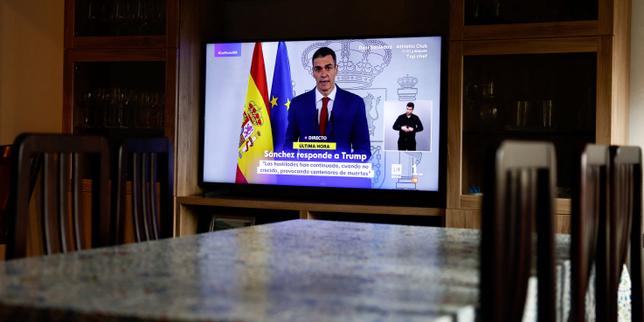
Pedro Sánchez is playing a game of high-stakes pacifism that he cannot win. The recent headlines painting him as the moral holdout against Donald Trump’s Middle East agenda are not just misleading; they are dangerous. The media loves a "David vs. Goliath" narrative where a European leader stands up to a brash American president. But if you look at the actual mechanics of Mediterranean security, Sánchez isn't standing up for peace. He is coasting on a security subsidy he refuses to pay for.
The "lazy consensus" suggests that Spain’s refusal to participate in strikes against Iranian proxies is a principled stance for de-escalation. It isn't. It is strategic parasitism. While Madrid enjoys the benefits of open global shipping lanes and the protection of the NATO umbrella, it refuses to contribute to the actual maintenance of that order when the bill comes due.
The Myth of Spanish Strategic Autonomy
Spain’s current foreign policy rests on a shaky premise: that you can be part of a global trade network without ever having to defend it.
When the Houthis or Iranian-backed cells disrupt the Red Sea, the cost of insurance for every cargo ship heading to the Port of Algeciras spikes. Spain feels the inflation. Spain feels the supply chain lag. Yet, when asked to provide kinetic support or even logistical backing for operations meant to deter these disruptions, Sánchez pivots to "dialogue."
Dialogue is not a strategy; it is a delay tactic. In the world of hard power, silence is interpreted as permission. By refusing to align with a coalition against Iranian aggression, Spain isn't fostering peace. It is signaling to Tehran that the European southern flank is soft.
I have seen this play out in boardrooms and diplomatic corridors for two decades. When one partner in a joint venture stops contributing to the security fund but still expects a full share of the profits, the venture collapses. The U.S. knows this. Trump knows this. And increasingly, the rest of the EU knows this.
Why the "De-escalation" Argument is Factually Flawed
The most common defense of Sánchez is that military intervention only "fuels the fire." This sounds sophisticated in a university lecture hall, but it fails the reality test of 21st-century warfare.
- Deterrence is binary: You either have it or you don’t. If an aggressor knows there are zero consequences for attacking commercial shipping, they will continue.
- Power vacuums are never empty: If the West retreats from the Middle East or the Mediterranean, Russia and China do not move in to "keep the peace." They move in to extract resources and install surveillance.
- The Cost of Inaction: Standard economic models show that a 10% increase in shipping costs due to Red Sea instability translates to a direct hit on Spanish GDP via energy prices. Sánchez is effectively taxing his own citizens to maintain a "moral" high ground that doesn't exist.
The Trump Variable: It’s Not About Personality
The press focuses on the friction between Sánchez and Trump because it's easy to write. It’s "The Progressive" vs. "The Populist." This is a distraction.
Any U.S. administration—including the current one—eventually grows tired of the "Free Rider" problem. Spain spends roughly 1.3% of its GDP on defense. That is well below the 2% NATO mandate. When Sánchez refuses to participate in operations, he isn't just snubbing Trump; he is defaulting on a contract.
Imagine a scenario where a Spanish firm refuses to pay for its cybersecurity but demands that the government bail it out every time it gets hacked. That is exactly what is happening on a geopolitical scale. Spain wants the "Gold" tier security package on a "Freemium" budget.
The Mediterranean Power Shift
While Spain sits on its hands, the center of gravity in the Mediterranean is shifting. Italy and Greece are stepping up. They understand that if Europe doesn't manage its own backyard, someone else will.
- Italy: Meloni has recognized that energy security is national security. Italy is actively securing ties in North Africa and the Levant, backed by a credible naval presence.
- Greece: Investing heavily in defense to counter Aegean instability.
Spain, meanwhile, risks becoming a geopolitical backwater—a scenic tourist destination with zero influence on the events that dictate its economic survival.
The Hidden Danger of Spanish "Neutrality"
The real danger isn't that Spain might get dragged into a war. The danger is that Spain becomes irrelevant to the very alliances that protect it.
When the next major trade agreement is negotiated, or when the next security crisis hits the Maghreb, do you think Washington or London will prioritize the interests of a partner that disappeared when things got difficult? Of course not. Influence is bought with risk. Sánchez is trying to buy it with platitudes.
Critics will say that following the U.S. into the Middle East is a recipe for another "Forever War." That is a straw man. No one is asking Spain to lead an invasion of Tehran. The request is for maritime security—the most basic function of a sovereign nation with a coastline. To frame a refusal to protect trade as a "bold defense of sovereignty" is a masterclass in gaslighting.
The Economic Reality Check
Let’s talk numbers. Spain’s economy is heavily reliant on tourism and exports. Both are sensitive to energy prices. If the Persian Gulf or the Red Sea becomes a no-go zone, the cost of LNG (Liquefied Natural Gas) skyrockets.
Spain has one of the largest regasification capacities in Europe. It should be a leader in energy security. Instead, by playing the "neutral" card, Sánchez is making the country more vulnerable to price shocks controlled by the very regimes he refuses to confront.
The People Also Ask (and the Brutal Truth)
Is Spain's refusal to help actually helping de-escalate the situation?
No. It is a green light for proxies to continue their operations because it proves the West is divided. Disunity is the primary fuel for escalation.
Doesn't Spain have a right to its own foreign policy?
Sovereignty is not a shield against the consequences of your choices. You can choose to stay home, but you cannot choose to remain influential while doing so.
Is Trump right to pressure Spain?
Regardless of his delivery, the underlying math is correct. The era of the American security blank check is over. Europe—and Spain specifically—must start paying for the stability it consumes.
Stop Applauding Weakness
We need to stop treating Sánchez's hesitation as a form of "strategic patience." It is a lack of courage disguised as diplomacy.
Real leadership in the 2020s requires the stomach to defend the systems that keep your people fed and your lights on. It requires acknowledging that the world is not a debating society, but a competitive arena where interests are defended with steel, not just speeches.
Spain is at a crossroads. It can continue to be the "moral" spectator while its neighbors do the heavy lifting, or it can reclaim its status as a serious Mediterranean power. But you can't have it both ways. You can't be a global trader and a regional hermit.
Sánchez’s refusal to act isn't a victory for Spanish independence. It is a slow-motion surrender of Spanish relevance.
The next time a shipment is delayed or a fuel bill rises, remember that "peace" was the excuse given for the vulnerability. Neutrality is just another word for being someone else's problem.
Pick a side or get out of the way.


