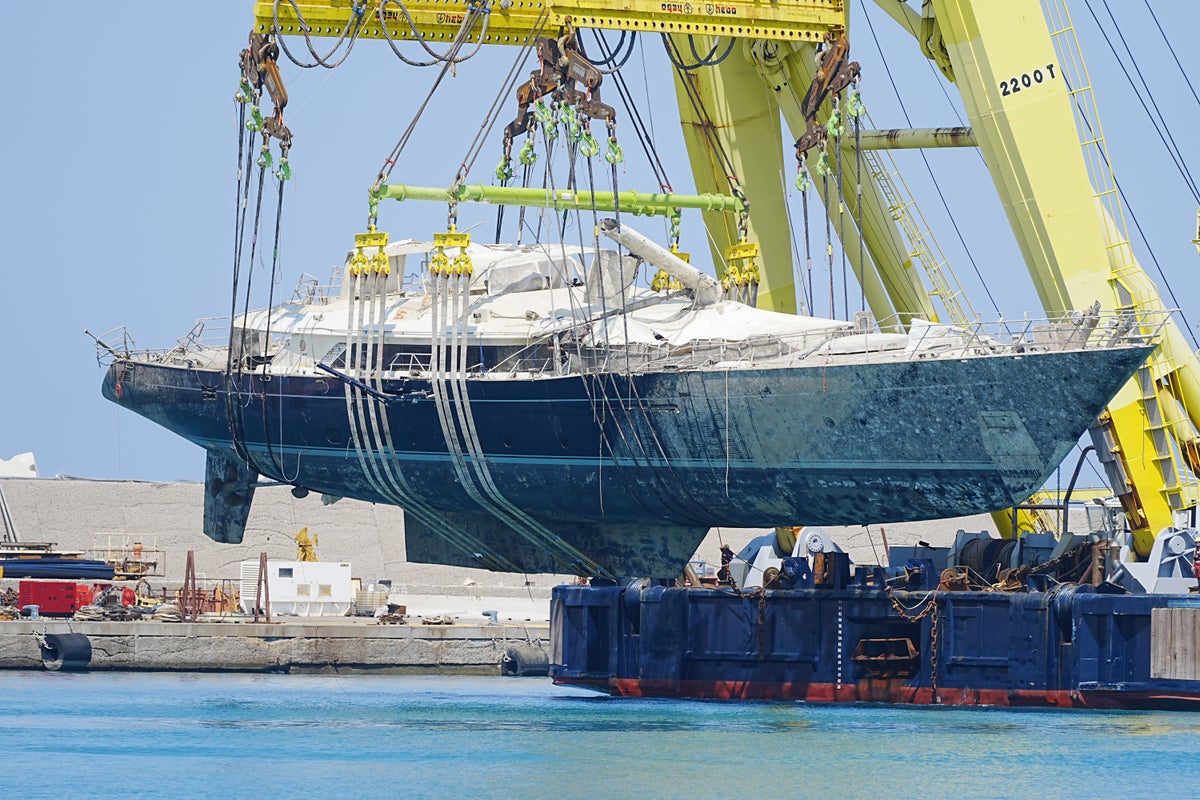
The loss of the Bayesian off the coast of Porticello is not a mystery of meteorology, but a failure of the vessel’s integrated stability envelope. While preliminary reports focus on the absence of a "classic" waterspout or storm, the catastrophic downflooding event suggests a breach of the operational limits inherent in high-performance, large-sloop naval architecture. The fundamental problem lies in the intersection of a 75-meter aluminum mast, a retractable keel configuration, and the critical angle of vanishing stability.
The Physics of the Pendulum: Lever Arms and Center of Gravity
To analyze why the Bayesian sank while nearby vessels remained upright, one must quantify the relationship between the Center of Gravity (CG) and the Center of Buoyancy (CB). In a sailing vessel, the Righting Lever ($GZ$) determines the ship’s ability to return to an upright position after being heeled by external forces.
The Bayesian featured the world’s tallest aluminum mast, standing at 72.27 meters. This creates a massive vertical lever arm. When wind pressure is applied to this surface area—even without sails hoisted—it generates a heeling moment that increases exponentially with the height of the mast.
The Retractable Keel Variable
The vessel’s stability was dynamic rather than static. With the keel fully extended to a depth of nearly 10 meters, the CG is lowered, significantly increasing the $GZ$ value. However, reports indicate the keel may have been retracted (raised) to its 4.83-meter depth to facilitate harbor proximity.
- Keel Up Profile: Raising the keel shifts the CG upward. This reduces the range of positive stability.
- Inertia and Momentum: A higher CG means that once the vessel begins to heel, it possesses less inherent resistance to that motion.
- The Resulting Bottleneck: In a retracted state, the angle at which the vessel can no longer recover (the Limit of Positive Stability) is reached much sooner than in a deployed state.
Downflooding Mechanics: The Point of No Return
A vessel does not sink from a heel alone; it sinks when water enters the hull at a rate exceeding the capacity of the bilge systems. The Bayesian’s design included specific "downflooding points"—engine room vents, hatches, and companionways—that are safe at low angles of heel but become fatal apertures once the deck edge is submerged.
The transition from a survivable heel to a sinking event is defined by the immersion of these openings. If the vessel heeled beyond 40 to 45 degrees, several critical failures likely occurred in sequence:
- Submergence of Ventilation Ducts: Large yachts require massive air intake for propulsion and HVAC. These ducts, if not equipped with automated, water-tight shut-offs (or if those shut-offs failed), become high-volume conduits for seawater directly into the lower machinery spaces.
- The Free Surface Effect: As water enters the hull, it sloshes across the deck. This shifting mass of water creates a "virtual" rise in the Center of Gravity, further reducing stability and accelerating the roll.
- Aperture Integrity: If the shell doors or the stern garage were not fully sealed, the volume of water ingress would overwhelm the vessel's reserve buoyancy within minutes.
The Meteorological Misnomer: Downbursts vs. Waterspouts
Public discourse has fixated on the "storm" or "waterspout" label, but from a naval engineering perspective, the specific weather phenomenon is secondary to the wind-loading it produced. The preliminary report suggests a "downburst"—a localized, powerful downdraft of cool air that hits the surface and spreads out in all directions.
A downburst produces straight-line winds that can exceed 100 knots. Unlike a circular waterspout, which might apply force from multiple directions, a downburst applies a sustained, unidirectional pressure. For a vessel with a 72-meter mast, this is equivalent to a massive mechanical lever being pushed down by an invisible hand.
The failure was likely not caused by a "rogue wave" or a "supercell," but by a gust that exceeded the vessel's Heeling Moment Limit for its specific configuration at that moment. If the keel was up and the hatches were open for ventilation, the margin of error vanished.
Structural and Operational Interdependencies
The Bayesian was a masterpiece of the Perini Navi shipyard, but its "mega-sloop" design carries inherent risks compared to a ketch (two-masted) or a motor yacht.
The Single Mast Limitation
A ketch distributes its sail area and mast weight across two shorter structures, lowering the CG. A sloop concentrates all the weight and windage into a single, towering spire. This makes the vessel highly sensitive to "windage"—the force of wind against the bare mast and rigging. In high-wind scenarios, even "naked" masts can generate enough force to capsize a sensitive vessel if the righting moment is compromised.
The Human-Machine Interface
On a vessel of this complexity, stability is managed through a combination of manual checklists and automated sensors. The "Black Swan" event here is a failure of the Operational Envelope. If the crew did not anticipate the severity of the downdraft, the time required to close heavy hydraulic doors or lower the keel would exceed the duration of the weather event.
- Keel deployment time: Moving a massive keel from 4.8m to 10m is not instantaneous.
- Door sealing protocols: Large yachts often leave interior doors and shell doors open for guest comfort or airflow. In a rapid-onset downburst, these "comfort features" become "sinking vectors."
Dissecting the Preliminary Findings
The report indicates the hull remained intact until it hit the seabed. This eliminates the theory of a structural collision or a hull breach below the waterline. Therefore, the sinking was purely a stability and downflooding event.
The investigation must now quantify the "as-built" versus "as-operated" stability.
- Variable 1: What was the exact volume of water ingress required to overcome the reserve buoyancy?
- Variable 2: Did the ballast move? In some older vessels, shifting lead ballast has caused capsizes, though this is unlikely in a Perini Navi build.
- Variable 3: Was there a failure in the alarm system that should have alerted the crew to the initial water ingress in the engine room?
Strategic Imperatives for Ultra-High-Performance Vessels
The Bayesian incident forces a re-evaluation of the "Extreme Sloop" category. When a vessel pushes the limits of height and depth, the operational margin for error narrows to a razor-thin edge.
The technical community must move toward Automatic Stability Management (ASM). Modern yachts should have systems that automatically seal all non-essential downflooding points and trigger ballast deployment when wind-load sensors detect a specific pressure threshold, independent of human intervention.
For owners and operators, the protocol is clear: when at anchor in a region known for thermal instability, the vessel must be in "High-Security Mode"—keel down, shell doors locked, and the engine room sealed. The Bayesian was lost not because the weather was unprecedented, but because the vessel was in a low-stability configuration when a high-energy event occurred.
The data suggests that the transition from a stable state to a sinking state occurred in under 16 minutes. In naval architecture, this is a "rapid-onset" failure. Future designs must prioritize the Time-to-Sink metric, ensuring that even in a 90-degree knock-down, the rate of ingress is throttled by design, not just by operational discipline. The ultimate strategic fix is the elimination of large, non-automated apertures on vessels with extreme vertical centers of gravity.


