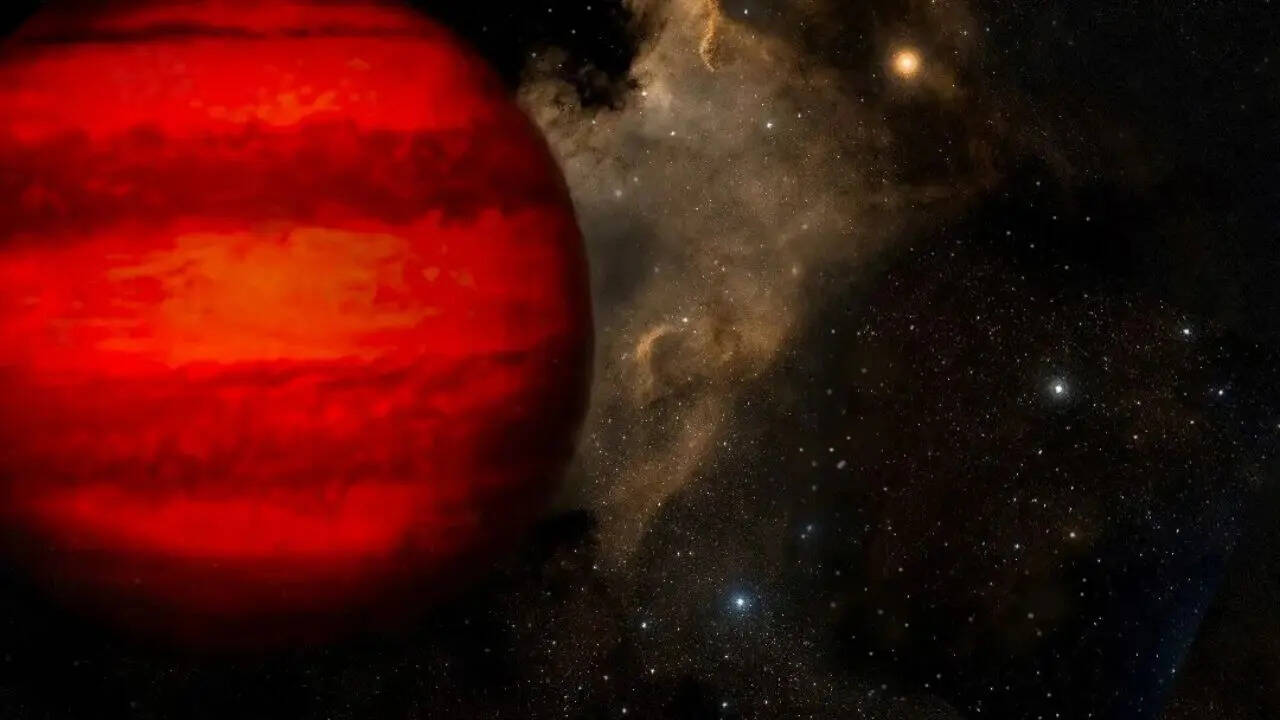
The universe is a graveyard of things that almost happened. Somewhere in the deep, velvet blackness of the constellation Boötes, two failed stars are locked in a dance so violent and so intimate that it defies the natural order of the heavens. They are brown dwarfs. In the cold language of astrophysics, a brown dwarf is a "substellar object," something too heavy to be a planet but too light to ignite the nuclear furnace of a true star. They are the cosmic middle child—overlooked, dim, and perpetually cooling toward an icy end.
But these two have decided to fight back. If you liked this piece, you should read: this related article.
They are spiraling toward each other at a pace that should be impossible. Every fifty-seven minutes, they complete a full orbit. Think about that for a second. Two massive celestial bodies, each dozens of times heavier than Jupiter, are swinging around one another in less time than it takes to watch a mediocre sitcom episode. They are screaming through space, shedding gravitational energy, and drawing closer with every frantic revolution.
This isn't just a curiosity for people with telescopes. It is a glimpse into a loophole in the laws of physics. We are watching a "death spiral" that might actually result in a birth. For another perspective on this development, see the recent update from Reuters.
The Weight of Failure
To understand the stakes, you have to understand the profound loneliness of being a brown dwarf. When a cloud of gas collapses to form a star, it needs to reach a specific, crushing pressure at its core to begin fusing hydrogen. If it hits that mark, it shines for billions of years. If it misses—by even a fraction of a percent—it becomes a brown dwarf. It glows with a dull, residual heat for a while, then fades into a dark cinder.
It is a life defined by "not quite."
The system in question, known to researchers as ZTF J2020+5033, shouldn't exist in its current state. Under normal circumstances, these two objects would have drifted apart or remained in a stable, lazy orbit for eternity. Instead, they are trapped. They are so close that the gravity of the slightly larger twin is literally peeling the outer layers off its partner.
It is a celestial heist.
Imagine a person standing on a bridge, holding onto a railing as a gale-force wind tries to pull them off. Now imagine that wind is actually the gravitational pull of a brother standing just inches away. One dwarf is feeding on the other, vacuuming up hydrogen and helium, growing fatter and more volatile by the millennium.
A Physics-Defying Friction
Why is this happening so fast? Space is a vacuum; there should be nothing to slow them down. But nature has a way of creating its own drag. Scientists believe a process called magnetic braking is the culprit.
Think of it like this: the stars are spinning, and as they spin, they throw out magnetic field lines. These lines catch on the thin, ionized gas surrounding the pair, creating a "friction" that acts like an invisible brake. As they slow down, they lose centrifugal force. Gravity wins. They fall inward.
Most of the time, this process is agonizingly slow. It takes billions of years. But in ZTF J2020+5033, the braking is happening at a lightning pace. They are closing the gap so rapidly that they will collide or merge in a timeframe that is a mere blink in cosmic history.
What happens when two "failures" merge? They might finally find the mass they need to succeed. If enough material is swapped, or if the eventual collision is violent enough, the pressure at the center of the new, combined mass could cross that magical threshold. The furnace could kick on. The "dead" objects could ignite into a shimmering, living star.
The Human Element in the Cold Dark
It’s easy to get lost in the numbers—the 57-minute orbit, the 1,000-light-year distance, the millions of degrees of heat. But the reason we care, the reason we spend billions on observatories like the Zwicky Transient Facility to find these tiny blips of light, is because we recognize our own struggle in them.
We live on a planet orbiting a stable, middle-aged star that behaves itself. We rely on the predictable. But the universe is mostly made of the unpredictable and the broken. Seeing a system like this reminds us that the "rules" of stellar evolution are more like suggestions. There is a loophole for everything. Even a failed star can find a way to burn if it finds the right partner and the right kind of friction.
Consider the scientists who found this. They weren't looking for a "death spiral." They were sifting through mountains of data, looking for tiny fluctuations in brightness. It is tedious, exhausting work. It requires a specific kind of faith—the belief that among the quadrillions of points of light, one of them is doing something weird enough to change how we see the world.
When they found that 57-minute signal, it wasn't just a data point. It was a heart rate. It was the pulse of a system pushing itself to the absolute limit.
The Invisible Stakes
If this system ignites, it becomes a "Cataclysmic Variable." That sounds like a disaster, but in the cosmos, it’s a promotion. It means the system has become a high-energy engine, flickering and flashing as it consumes itself.
But there is a darker side to the story. If the mass transfer happens too quickly or the magnetic braking is too aggressive, they might not become a star. They might just vanish. They could rip each other apart, scattering their guts into the void, leaving behind nothing but a cloud of cold dust.
The margin for error is razor-thin.
We are watching a high-stakes gamble played out over millions of miles. If the donor dwarf gives up too much too fast, it shrinks and moves away, breaking the cycle. If it holds on too tight, it gets dragged into the abyss. Success requires a perfect, terrifying balance of consumption and resistance.
The Mirror in the Sky
We often think of the stars as eternal, fixed points in a grand, clockwork theater. We like to think that once a path is set—once a star "fails"—its fate is sealed. But ZTF J2020+5033 tells us that the universe is a place of second chances, provided you are willing to endure the friction.
The magnetic lines are taut. The orbit is tightening. Somewhere out there, two dark orbs are rushing toward a metamorphosis that will either light up the neighborhood or end in a silent, dusty funeral.
We watch because we want to know if failure is permanent. We watch because we want to see the spark.
In the time it took you to read this, those two dwarfs have completed nearly half of their journey around each other. They are moving faster now. They are getting hotter. They are reaching out across the vacuum, desperate to become something more than the sum of their parts.
The furnace is waiting.
Would you like me to find the specific coordinates of ZTF J2020+5033 and the names of the lead researchers who first identified its 57-minute period?


