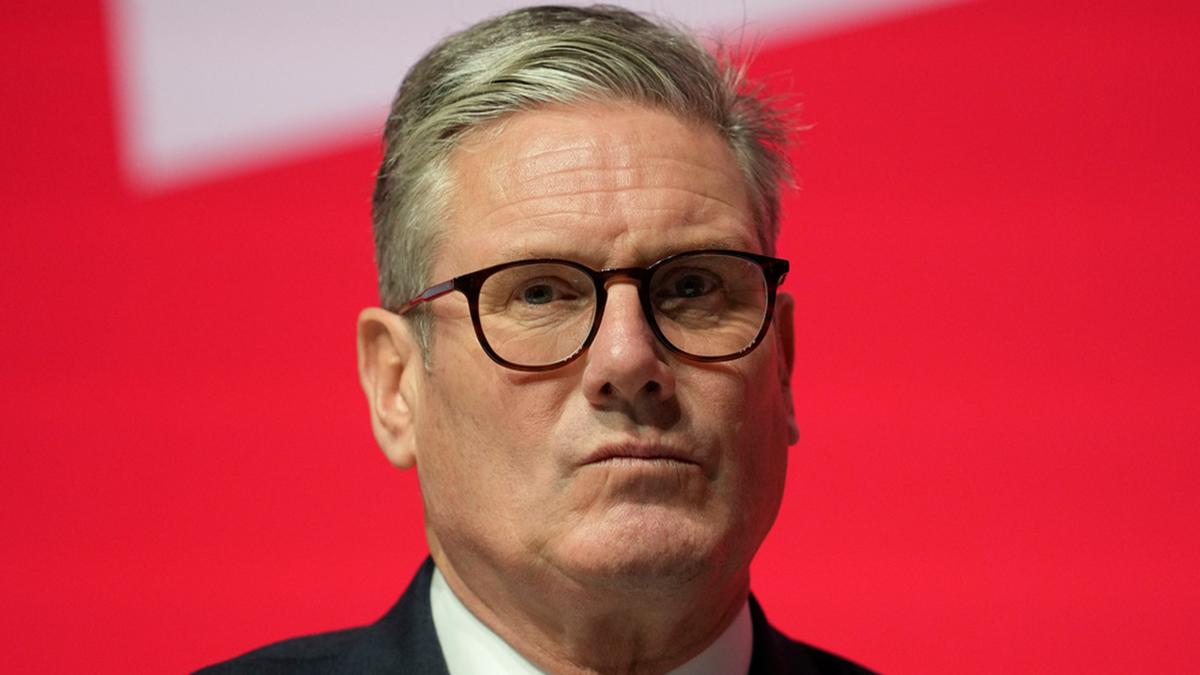
The British media is currently drunk on a specific kind of nostalgia. They are trying to frame Keir Starmer’s recent friction with Donald Trump as a cinematic moment of national dignity. They call it a "Love Actually" moment, referencing the scene where Hugh Grant’s fictional Prime Minister stands up to a boorish American President. It’s a charming script. It’s also a total delusion that threatens to leave the United Kingdom economically isolated and strategically irrelevant.
Standing up to the leader of the world’s largest economy isn't a sign of strength when you are a mid-sized island nation struggling with stagnant growth and a fractured trade relationship with your nearest neighbors. It is vanity masquerading as principle. Meanwhile, you can find other events here: The Cold Truth About Russias Crumbling Power Grid.
The consensus view—that Starmer is "defending British values" by clashing with the Trump campaign over election interference claims—misses the cold, hard math of the 2026 global economy. In the real world, morality plays don't pay the bills. Trade deals do.
The Myth of the Moral High Ground
The "lazy consensus" suggests that a Prime Minister must prioritize ideological purity over pragmatic engagement. This is the same logic that has seen the UK’s productivity gap widen compared to its G7 peers. We are obsessed with "sending messages" while our competitors are busy signing contracts. To understand the bigger picture, check out the recent analysis by Al Jazeera.
When the Labour Party sent activists to campaign for the Democrats, it wasn't a bold strike for democracy. It was a staggering display of diplomatic incompetence. In the world of high-stakes geopolitics, you do not bet the house on one horse when the other horse has a 50% chance of controlling your economic weather for the next four years.
I have watched dozens of political administrations make this exact mistake. They confuse the applause of their Twitter base with the stability of their national interest. You don't get points for being "right" if being right results in 20% tariffs on British steel, Scotch whiskey, and automotive parts.
The Tariffs Are Coming and We Are Unarmed
Let’s dismantle the premise that the UK can afford a cold war with a Trump administration. Trump’s "America First" agenda is built on reciprocal (or punitive) tariffs. If the UK is viewed as an ideological enemy rather than a strategic partner, we move to the front of the line for the "Universal Baseline Tariff."
Imagine a scenario where the US imposes a blanket 10% tariff on all imports. For a UK economy already reeling from the friction of post-Brexit trade with Europe, this isn't just a hurdle. It’s a brick wall.
- Pharmaceuticals: Our biggest export to the US. A trade war makes UK labs uncompetitive overnight.
- Financial Services: The City of London relies on regulatory equivalence and cooperation. If the White House decides to play hardball, the capital flight to New York or Frankfurt will accelerate.
- Defense: AUKUS and intelligence sharing aren't guaranteed. They are maintained through rapport.
The competitor's article celebrates Starmer "standing tall." In reality, he’s standing on a trapdoor. You cannot "stand up" to your most important security partner when your own defense budget is a rounding error compared to theirs.
Stop Asking the Wrong Questions
People often ask: "Should the UK sacrifice its values for a trade deal?"
This is a flawed, binary question designed to make the person asking it feel superior. The real question is: "Does the UK have the economic leverage to dictate terms to the United States?"
The answer is a resounding no.
The UK currently exists in a geopolitical no-man's-land. We are not in the EU single market, and we are now alienating the only other major power that could provide an economic counterweight. This isn't "sovereignty." It’s isolation. True leadership isn't about giving a spicy speech that plays well on the evening news; it’s about ensuring that your citizens can afford their mortgages and that your industries don't vanish.
The Cost of the "Special Relationship" Delusion
The "Special Relationship" has always been a British invention to soothe the ego of a fading empire. To Washington, it is a relationship of convenience. When the UK stops being convenient—or worse, becomes a nuisance—the "Special" part evaporates.
By engaging in a public spat over campaign volunteers, Starmer has handed the Trump team a grievance they can use as leverage in every future negotiation. If you think the "art of the deal" involves forgiving a foreign leader who tried to undermine your election, you haven't been paying attention for the last decade.
The Counter-Intuitive Path Forward
If the UK wants to survive the next four years, it needs to stop playing for the cameras and start playing for the spreadsheets. This means a radical shift in strategy:
- Aggressive Neutrality: Stop commenting on domestic US politics. Period. The "activist" wing of the party needs to be put on a leash.
- Economic Realism: Acknowledge that the US holds all the cards. Negotiations should focus on "carve-outs" for specific UK industries rather than a grand, mythical Free Trade Agreement that is likely dead on arrival.
- The European Pivot: If the US is going protectionist, the UK must accelerate its "reset" with Brussels. We cannot be at war with both of our largest trading partners simultaneously. That isn't a strategy; it's a suicide pact.
The "Love Actually" moment in the movie ended with a pop song and a happy ending. In the version Starmer is currently writing, the credits roll on a country with higher inflation, lower investment, and a "special relationship" that consists of being ignored by the person in the Oval Office.
Real power isn't about who speaks the loudest. It’s about who can afford to walk away from the table. Right now, the UK is sitting at that table with an empty wallet and a loud mouth.
Drop the script. Burn the movie posters. Start acting like a nation that needs a job more than it needs a moral victory.