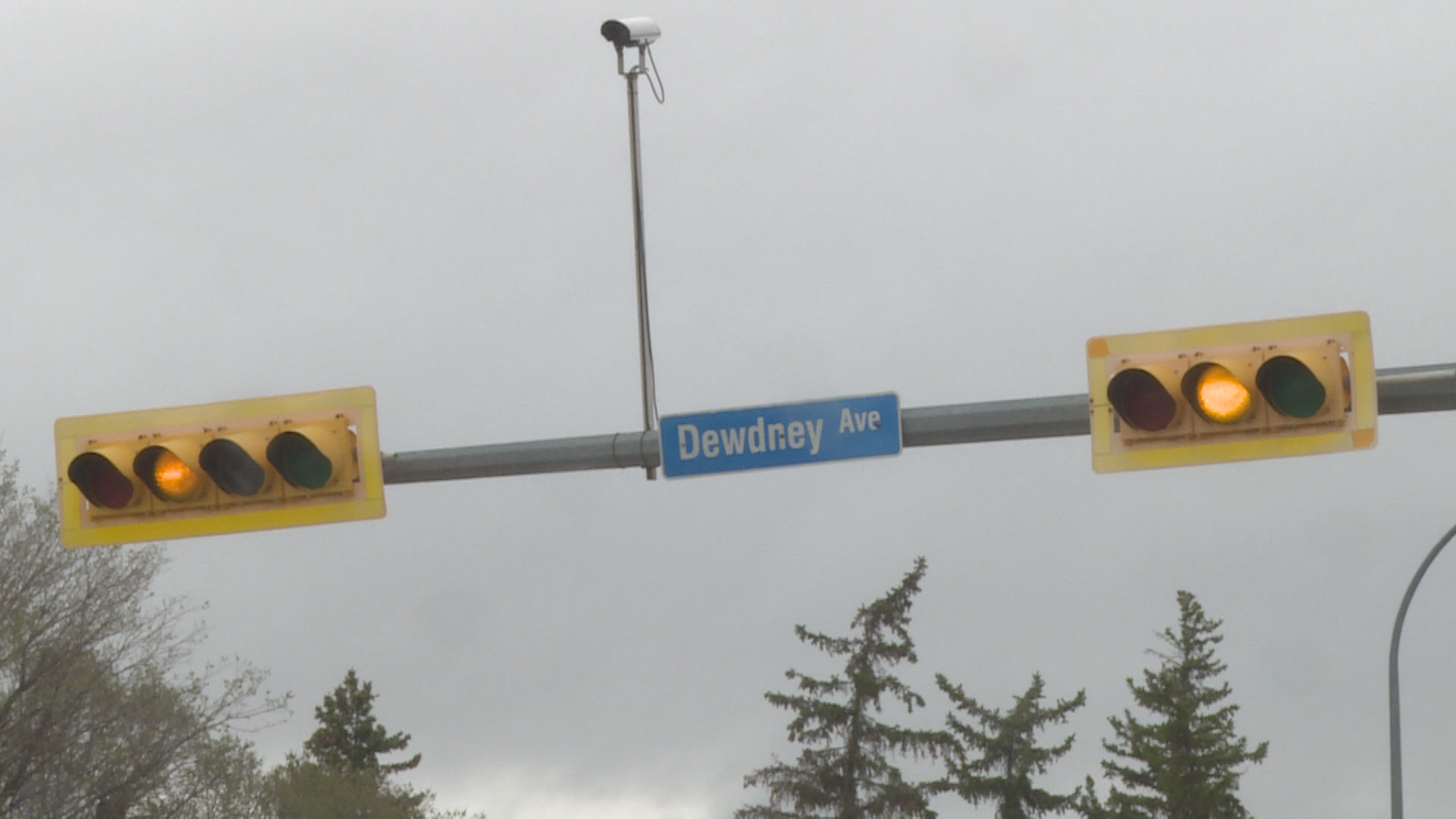
Municipal planners are celebrating again. The City of Regina just gave the green light to a suite of traffic safety improvements at the intersection of Lewvan Drive and Dewdney Avenue. On paper, it sounds like an open-and-shut case of proactive governance. This junction holds the crown as the city's most accident-prone bottleneck, averaging 38 collisions a year over the last three semesters. The public wants a fix. The media wants a headline. The city is handing them new lane configurations, extended turn lanes, and re-timed signals.
Everyone is clapping. Everyone is wrong. For a more detailed analysis into this area, we suggest: this related article.
This is the classic infrastructure trap: treating a foundational design flaw with a cosmetic Band-Aid. We are conditioned to believe that when an intersection sees a high volume of metal-on-metal violence, the solution is to add more paint, more concrete, more signs, and longer turning arrows.
I have watched cities dump tens of millions of dollars into these exact types of "safety upgrades" for over fifteen years. The result? The underlying danger does not vanish. It just migrates down the road, or worse, mutates into a different kind of risk. By widening lanes and attempting to optimize flow under the guise of safety, we are actually building more dangerous corridors. We are designing roads that scream "go faster" while hanging a tiny sign that begs drivers to slow down. For further background on the matter, comprehensive reporting can also be found on USA Today.
The lazy consensus in modern traffic engineering assumes that if an intersection is broken, you fix the intersection. The contrarian reality is that the intersection is fine. The network surrounding it is broken, and our fundamental concept of "safety improvements" is a dangerous illusion.
The Peltzman Effect: Why Safe Infrastructure Breeds Reckless Drivers
To understand why Regina’s new project will fail to achieve its long-term safety goals, you have to understand human psychology. You cannot engineer out human behavior. In fact, when you try to make a space feel safer, humans instinctively adjust their behavior to maximize efficiency, completely erasing the safety margin you just paid to build.
This is known as the Peltzman Effect, a theory of risk compensation introduced by economist Sam Peltzman.
Imagine a scenario where a driver approaches the Lewvan-Dewdney intersection under its old, cramped configuration. The driver is anxious. The turning lane is backed up onto the mainline. Visibility feels tight. Because the environment feels hostile, the driver's nervous system kicks into high gear. They grip the wheel. They look twice. They slow down.
Now look at the upgraded version. The city lengthens the turn lanes all the way back toward Saskatchewan Drive. They widen the turning radius. They install highly visible, dedicated turning arrows that partition the traffic perfectly.
What happens inside the driver's brain? The anxiety disappears. The environment now feels completely forgiving. The driver relaxes, checks their phone, taps the accelerator, and glides into the turn at 55 km/h instead of 30 km/h.
By removing the friction, you have removed the caution.
When you expand an intersection to minimize conflicts, you reduce minor fender-benders but increase the severity of the remaining crashes. A low-speed t-bone because someone was confused by a tight layout results in dented plastic and an insurance claim. A high-speed collision because a driver felt entitled by a massive, wide-open green arrow results in a trip to the trauma bay. The city is trading high-frequency, low-severity accidents for low-frequency, high-severity disasters.
The Lie of Dedicated Left-Turn Arrows
The core of Regina's plan relies heavily on altering signal timing and lane extensions—specifically to manage left turns. Urban commuters love dedicated left-turn signals. They feel like a personal invitation from the city to move without fear.
But look at the mechanics of traffic flow across a grid. A dedicated left-turn phase is a zero-sum game. If you give 20 seconds of protected green light to the left-turn lane on northbound Lewvan, you have to take 20 seconds away from the straight-through traffic on eastbound Dewdney.
This triggers a cascade failure across the entire corridor.
When you choke the straight-through green time to accommodate complex turning phases, you create massive queues during peak hours. Anyone who drives Lewvan knows the frustration of hitting a wall of red lights from 9th Avenue North all the way down. When drivers are forced to sit through two or three cycles of a light just to clear a single intersection, their patience evaporates.
What do impatient drivers do when they finally get a green light? They hammer the gas. They run yellow lights three seconds after they turn red. They make aggressive, erratic lane changes to bypass the slow-moving queue.
The safety upgrade at Lewvan and Dewdney will likely cause a spike in aggressive driving and red-light running at neighboring intersections. You haven't solved the problem; you’ve just exported the frustration to the next block.
Stop Widening Lanes to Fix Congestion
The public outcry surrounding this intersection isn't just about safety; it’s about delay. The opening of major commercial hubs out west, like the Westerra Costco, means traffic volumes are exploding. The standard response from city hall is to build bigger buckets to hold the water. Lengthen the lanes. Add a lane. Spread things out.
This ignores the law of induced demand, a principle proven by transportation researchers like Gilles Duranton and Matthew Turner. If you build more capacity for cars, more cars will show up to fill that capacity. Widen the approach to Lewvan, and you simply invite more regional traffic to use Lewvan as their primary artery instead of taking peripheral routes like Pinkie Road.
Wider intersections also create a secondary, lethal problem: they increase the pedestrian crossing distance.
Lewvan and Dewdney isn't just an automotive conduit; it is an intersection where human beings have to cross. When you widen an intersection to add turning lanes, you increase the physical distance a pedestrian has to walk to get from one side to the other.
A wider road means a pedestrian spends more time exposed in the middle of a conflict zone. It forces engineers to lengthen the pedestrian clearance timings, which further reduces the green time available for vehicles, worsening the very congestion the city was trying to fix in the first place. It is a dog chasing its own tail.
What Real Traffic Reform Looks Like
If adding lanes, lengthening turn pockets, and stacking signals doesn't work, what does?
The answer requires a complete shift in how we view urban movement. We have to stop treating urban arterials like high-speed highways. Lewvan Drive is currently signed at 70 km/h. That is a lethal speed for an urban environment with at-grade intersections.
Here is the unconventional, hard-to-swallow medicine that actually works:
1. Radically Lower the Speed Limit
Don't upgrade the intersection to accommodate 70 km/h traffic converging at 90-degree angles. Drop the entire corridor to 50 km/h. Lower speeds shrink stopping distances exponentially. A vehicle traveling at 50 km/h can stop in nearly half the distance of a vehicle traveling at 70 km/h. Lower speeds mean that when human error inevitably occurs, the consequences are manageable, not fatal.
2. Implement True Traffic Calming, Not Signalization
Signals tell drivers when to look, but physical design tells drivers how to behave. If you want drivers to slow down at a major junction, you don't give them a wide, sweeping asphalt runway. You narrow the lanes. You introduce vertical deflections or tight radii that physically force a vehicle to slow down to navigate the space safely.
3. The Roundabout Reality Check
The immediate defense from local drivers is always the same: "Multi-lane roundabouts don't work here. People don't know how to use them. The winter weather makes them impossible."
This is provincial exceptionalism at its worst. Step outside the local bubble. Look at Carmel, Indiana—a city that has replaced more than 140 traditional intersections with roundabouts. Their injury accident rate dropped by nearly 80 percent. Look at Norway or Sweden, where multi-lane roundabouts handle massive traffic volumes in brutal sub-zero winter conditions every single day without turning into a demolition derby.
A roundabout eliminates the most dangerous type of collision entirely: the high-speed, left-turn t-bone. It forces all traffic to slow down to a uniform, manageable speed (usually around 30 to 40 km/h) and turns every conflict into a low-angle, low-impact merge.
Is there a downside? Yes. Roundabouts require a larger physical footprint, and the initial learning curve causes a temporary spike in minor, low-speed sideswipes as drivers adapt. But trading a fatal head-on crash for a scraped bumper is a trade any rational planner should make instantly. If Regina can handle a complex Diverging Diamond Interchange (DDI) on its outskirts, pretending drivers can't handle a roundabout is an insult to the intelligence of the local population.
The Cost of the Safe Illusion
The hard truth is that the City of Regina is choosing the path of least political resistance. Putting up new traffic lights and painting longer lines looks like action. It appeases the vocal drivers who demand a faster commute to the new Costco, and it satisfies the surface-level definition of "doing something about safety."
But as long as we keep pouring millions into optimizing a flawed, car-centric grid that rewards speed and punishes vulnerability, the collision numbers will remain stubborn. True safety isn't found in making an intersection more accommodating to fast cars. True safety is found in making fast cars uncomfortable.
Until city planners find the courage to prioritize design over paint and speed reduction over volume capacity, the intersection of Lewvan and Dewdney will remain a monument to the failures of conventional engineering. Stop trying to fix the intersection. Rebuild the system.