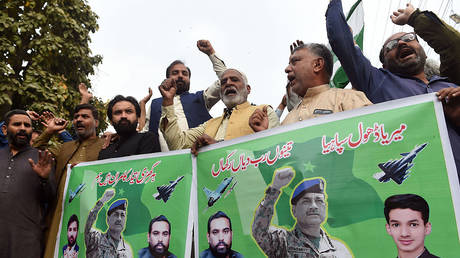
The recent assertion from Islamabad that India and Afghanistan have witnessed only a "fraction" of Pakistan’s military capabilities is not a mere rhetorical flourish; it is a calculated signaling of Strategic Depth 2.0. This doctrine rests on the premise that conventional military parity is secondary to the credible threat of unconventional escalation and the deployment of "full-spectrum deterrence." By quantifying the gap between demonstrated force and latent capacity, Pakistan is attempting to recalibrate the risk calculus of its neighbors.
The Triad of Pakistan’s Military Posture
To understand the claim of "fractional" exposure, one must dissect the three distinct layers of Pakistan's force projection.
- Conventional Threshold Management: This involves the use of frontline assets—primarily the Army’s strike corps and the Air Force’s (PAF) multi-role squadrons—to manage border skirmishes. These are the visible elements used in operations like Swift Retort (2019).
- Sub-Conventional Proxies and Hybridity: This layer operates below the threshold of open war, utilizing non-state actors and information warfare to fix enemy resources without committing regular troops.
- Strategic/Nuclear Overhang: The most significant "unseen" fraction. Pakistan’s development of Tactical Nuclear Weapons (TNWs), such as the Nasr (Hatf-IX) missile system, is designed specifically to neutralize India's "Cold Start" doctrine.
The Calculus of Reserved Capability
When a military power claims to have reserved the majority of its strength, it refers to the Force Multiplier Effect. Pakistan’s military budget, while significantly smaller than India’s in absolute terms (roughly $6-8 billion versus India’s $70+ billion), is optimized for a high-intensity, short-duration conflict. The "unseen" capabilities likely involve several specific technological and operational domains.
Electronic Warfare and Cyber Kinetic Integration
While border exchanges involve artillery and small arms, the latent capability lies in Integrated Electronic Warfare (IEW). The PAF and the Navy have invested heavily in Chinese and Turkish electronic countermeasure (ECM) suites. In a full-scale escalation, the objective would be the "blindness" of the adversary's Integrated Air Command and Control System (IACCS). The fractional use seen so far lacks the saturation of the electromagnetic spectrum required to cripple modern sensor-fused networks.
The Role of Stand-Off Weapons (SOW)
Most engagements along the Line of Control (LoC) or the Durand Line utilize direct-fire or short-range ballistic assets. The "fraction" refers to the non-employment of long-range cruise missiles like the Babur or Ra’ad series. These assets allow for precision strikes deep within enemy territory without crossing the border, creating a No-Go Zone for adversary logistics.
The Afghan Frontier: Managing the Blowback
The tension with the Taliban-led administration in Kabul represents a shift in Pakistan’s Western flank strategy. The "fractional" comment here serves as a warning of a transition from border fencing to Kinetic Border Management.
- Operation Azm-e-Istehkam: This represents a shift toward intelligence-based operations (IBOs).
- Air Superiority: Pakistan’s ability to conduct high-altitude drone strikes and manned aerial bombardments remains largely untapped in the Afghan context.
- Economic Levers as Military Force: Pakistan views its control over Afghan transit trade and border crossings (Chaman and Torkham) as a non-kinetic extension of its military capability.
The friction arises from the Dilemma of the Durand Line. Islamabad expects a client-state relationship, while Kabul asserts a nationalist sovereignty that defies the colonial-era border. Pakistan’s "unseen" capability here is the potential for a large-scale "buffer zone" operation, which would involve the permanent displacement of militant sanctuaries through mechanized infantry incursions—a step Islamabad has hesitated to take due to the risk of a total breakdown in relations.
The Indian Equation: Neutralizing the Cold Start
The primary target of the "fraction" rhetoric is New Delhi. India's military strategy focuses on Proactive Strategy (Cold Start), which aims to seize shallow territorial gains within 48 to 72 hours to use as bargaining chips.
Pakistan’s counter-strategy relies on the Nasr Missile System. This creates a "Low Threshold" for nuclear use. By deploying sub-kiloton weapons against advancing tank columns on its own soil, Pakistan intends to negate India’s conventional superiority. The world has seen the "fraction" of Pakistan's conventional air defense, but it has never seen the operationalization of its tactical nuclear umbrella.
Strategic Bottlenecks and Limitations
Despite the bravado of the "fraction" claim, several structural constraints dictate the reality of Pakistan’s power projection.
- The Fiscal Constraint: Sustaining a "Full-Spectrum" military requires a robust economy. Pakistan’s debt-to-GDP ratio and reliance on IMF bailouts create a Sustainability Gap. A military cannot be "infinite" if its fuel and spare parts supply chains are vulnerable to foreign exchange shocks.
- The Two-Front Paradox: Historically, Pakistan’s military doctrine was "India-Centric." The deteriorating situation in Afghanistan forces a split in resource allocation. Every battalion moved to the Western border is a battalion unavailable for the Eastern front.
- Technological Dependency: Much of the "unseen" capability is built on Chinese hardware (JF-17 Block III, VT-4 tanks, Type 054A/P frigates). While this provides a modern edge, it creates a dependency on Beijing for technical support and replenishment during a prolonged conflict.
The Intelligence-Military Complex
A significant portion of the "unseen" fraction resides in the Inter-Services Intelligence (ISI). The ability to conduct Asymmetric Attrition is a core component of Pakistani strategy. By fostering decentralized militant networks, the state can exert pressure on its neighbors without the political cost of a formal declaration of war. However, this strategy is currently backfiring on the Afghan border, as the Tehrik-i-Taliban Pakistan (TTP) utilizes the same asymmetric tactics against the Pakistani state itself.
Quantifying the Escalate-to-De-escalate Model
The logic of "only a fraction" follows a specific mathematical function of deterrence:
$D = (C \times W) / R$
Where:
- $D$ = Deterrence
- $C$ = Demonstrated Capability
- $W$ = Perceived Will to use it
- $R$ = Risk of retaliation
By suggesting that $C$ (Capability) is actually much higher than what has been demonstrated, Islamabad is attempting to inflate the value of $D$ without actually incurring the $R$ (Risk) of a full-scale deployment.
The Shift to Precision and Stealth
The next evolution of this "fraction" will likely manifest in the Unmanned Aerial Systems (UAS) domain. Pakistan’s acquisition of the Turkish Bayraktar TB2 and Akinci drones, alongside the Chinese Wing Loong II, changes the "Cost-per-Kill" ratio. In previous decades, a "fraction" of power meant a battalion of infantry. Today, it means a swarm of loitering munitions.
The integration of these systems into the C4ISR (Command, Control, Communications, Computers, Intelligence, Surveillance, and Reconnaissance) framework allows for a "leaner" but more lethal force projection. This is the "Modernization Paradox": Pakistan may reduce its total number of active personnel while simultaneously increasing its lethality through automation and precision.
The Strategic Play
For regional actors and international observers, the "fraction" claim should be treated as a signal that Pakistan is moving away from traditional defensive realism toward a more assertive Pre-emptive Signaling posture.
The immediate strategic requirement for India and Afghanistan is to map the specific "unseen" assets—specifically in the realms of electronic warfare and tactical nuclear delivery. Failure to account for these "latent" capabilities in war-gaming scenarios leads to a dangerous underestimation of the threshold at which a conventional skirmish could spiral into a strategic exchange.
The focus must shift from counting boots on the ground to analyzing the integration of autonomous systems and the psychological readiness of the command structure to authorize tactical nuclear use. This is the only way to neutralize the "fractional" advantage claimed by Islamabad.