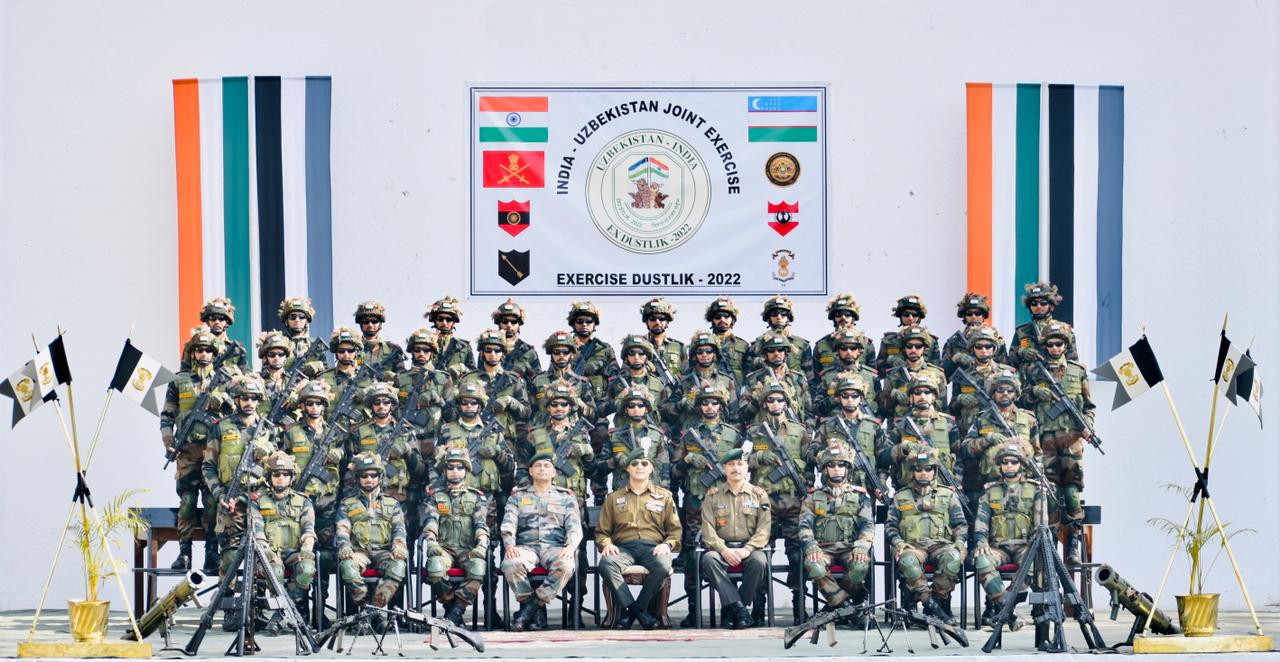
The commencement of the India-Uzbekistan bilateral military exercise, Dustlik 2026, in Namangan marks a shift from symbolic diplomacy to functional interoperability within the Fergana Valley’s volatile geographic context. While standard reporting frames this as a routine exchange of counter-terrorism tactics, a structural analysis reveals a sophisticated hedging strategy by Tashkent and a power projection initiative by New Delhi. The exercise serves as a live-fire laboratory for three specific operational objectives: mountain warfare doctrinal alignment, the integration of semi-autonomous tactical assets, and the validation of trans-continental logistical chains that bypass traditional Eurasian bottlenecks.
The Triad of Operational Integration
The utility of Dustlik 2026 is defined by three distinct layers of military cooperation that move beyond the "joint drill" veneer. Recently making waves in this space: Nepal Pursues the Paper Trail to End Political Impunity.
1. High-Altitude Tactical Synchronization
The terrain surrounding Namangan necessitates a focus on sub-conventional warfare in mountainous environments. India brings a century of Himalayan experience to the table, specifically in the deployment of small-unit tactics designed for terrain where traditional mechanized support is neutralized by gradient and altitude. The logic here is "force multiplication through decentralization." By training Uzbek forces in Indian high-altitude patrolling protocols, both nations create a shared vocabulary for border security that is resistant to the infiltration tactics common to non-state actors in the region.
2. Technological Convergence and Attrition Management
A significant portion of the 2026 iteration focuses on the use of Unmanned Aerial Systems (UAS) and Counter-UAS (C-UAS) technology. The mechanism of modern skirmishes has shifted toward low-cost, high-attrition assets. Further details into this topic are detailed by BBC News.
- Intelligence, Surveillance, and Reconnaissance (ISR) loops: The exercise tests the speed at which sensor data from Indian-manufactured drones can be processed by Uzbek field commanders.
- Electronic Warfare (EW) Resiliency: Testing the hardening of communication links against localized jamming—a direct response to lessons learned from contemporary conflicts in Eastern Europe and the Caucasus.
- Precision Munitions: The transition from indiscriminate suppressive fire to targeted kinetic strikes in urban and mountainous settings.
3. Logistic Interoperability under Stress
Military efficacy is a function of supply chain resilience. Dustlik 2026 tests the ability of the Indian Air Force and Army to sustain a footprint in a landlocked Central Asian state. This involves the "Plug-and-Play" model of equipment maintenance, where Indian technical teams utilize Uzbek infrastructure to service platforms, ensuring that the operational tempo remains high despite the distance from primary manufacturing hubs.
Geographic Determinism and the Fergana Valley Variable
The choice of Namangan is not incidental. Located in the Fergana Valley, it sits at the intersection of Kyrgyzstan, Tajikistan, and Uzbekistan. This region is the heartbeat of Central Asian stability. By conducting maneuvers here, India signals its willingness to be a security guarantor in a region traditionally dominated by the Russian-Chinese duopoly.
The security architecture of the Fergana Valley is plagued by three systemic risks:
- Ethno-Territorial Friction: Porous borders and historical grievances make the region susceptible to rapid-onset conflict.
- Radicalization Corridors: The valley has historically served as a recruitment ground for extremist factions.
- Water-Energy Nexus: Competing demands for the Syr Darya river’s resources create a permanent state of low-level tension.
Dustlik 2026 acts as a stabilizing force by professionalizing the Uzbek military response to these threats. The exercise focuses on "Cordon and Search" operations and "Deep Room Combat," which are technical requirements for neutralizing threats within the densely populated urban clusters of the valley without triggering wider civil unrest.
The Cost Function of Strategic Autonomy
For Uzbekistan, the partnership with India is a calculated move to diversify its security dependencies. The "Multi-Vector Foreign Policy" practiced by Tashkent requires a delicate balance.
- The Russian Constraint: While Uzbekistan remains part of the post-Soviet security sphere, the ongoing overextension of Russian forces necessitates a secondary partner capable of providing high-tier training and hardware.
- The Chinese Influence: Beijing’s focus on the Belt and Road Initiative (BRI) brings infrastructure but also the risk of debt-driven security concessions. India offers a "Third Way"—security cooperation without the heavy-handed geopolitical strings attached to the Great Power competition.
India’s motivation is rooted in the "Extended Neighborhood" policy. The primary bottleneck for Indian influence in Central Asia has always been geography—specifically the lack of direct land access. Dustlik 2026 bypasses this by focusing on the "Air-Bridge" capability. The cost of maintaining this presence is high, but the dividend is a seat at the table in the Heartland of Eurasia, preventing a total strategic vacuum that hostile actors could exploit.
Tactical Methodology: From Theory to Kinetic Application
The exercise is structured around a "Phase-Gate" progression model.
Phase I: Doctrinal Synchronization
Officers from both sides conduct tabletop exercises to align command-and-control (C2) structures. This addresses the "Language of Combat" barrier. If a joint operation were to occur in a real-world crisis, the time-to-action would be dictated by how quickly an Uzbek colonel can communicate intent to an Indian major.
Phase II: Specialized Skill Acquisition
This involves the physical drills:
- Heli-borne insertions: Practicing rapid deployment into inaccessible terrain.
- Improvised Explosive Device (IED) Neutralization: Utilizing Indian expertise gained from decades of internal security operations.
- Sniper-Spotter Integration: Enhancing long-range engagement capabilities in mountain passes.
Phase III: The Final Validation Exercise (FVX)
A 48-hour continuous simulation where forces must neutralize a hypothetical insurgent cell in a mock village. This is where the integration of UAS and ground troops is pressure-tested. Success is measured not just by the "neutralization" of the target, but by the minimization of collateral damage and the speed of medical evacuation (MEDEVAC) procedures.
The Divergence from Traditional Defense Diplomacy
Most bilateral exercises are performative. Dustlik 2026 differs because it addresses the "Equipment Compatibility Gap." As Uzbekistan seeks to modernize its Soviet-era inventory, India’s defense industry—now producing world-class radar systems, light combat helicopters, and protected mobility vehicles—presents a viable procurement path. The exercise serves as a live demonstration of Indian hardware in the specific environmental conditions of Central Asia (extreme temperature fluctuations and fine-grain dust).
This creates a feedback loop:
- Observation: Uzbek forces identify gaps in their current mobility or surveillance.
- Demonstration: Indian units showcase specific tools (e.g., the Kalyani M4 or Swathi Weapon Locating Radar).
- Evaluation: Tashkent assesses the feasibility of integrating these tools into their standing army.
Risks and Operational Limitations
A rigorous analysis must acknowledge the friction points. The first limitation is the "Intermittency Factor." A once-yearly exercise cannot replace permanent basing or a unified command structure. There is a risk that the skills honed during Dustlik 2026 will atrophy without a sustained, year-round exchange program.
The second limitation is the "Intelligence Silo" problem. While tactical data is shared during the exercise, strategic intelligence remains closely guarded. For a true security partnership to evolve, there must be a mechanism for real-time threat sharing regarding the movement of extremist groups across the Afghan border. Without this, the exercise remains a tactical success but a strategic incomplete.
Finally, the "Geopolitical Sensitivity" of the region cannot be ignored. Every increment of Indian-Uzbek cooperation is watched by Islamabad and Beijing. If the exercise scales too rapidly or includes "offensive" maneuvers (such as long-range missile simulations), it may trigger a counter-escalation from neighboring states, paradoxically decreasing the stability of the Fergana Valley.
Strategic Forecast: The Professionalization of the Frontier
The trajectory of India-Uzbekistan military relations points toward the creation of a "Regional Security Node." By 2028, expect these exercises to expand into trilateral or multilateral formats, potentially including Kazakhstan or Kyrgyzstan. This would effectively create a "Security Belt" that is independent of both the CSTO (Collective Security Treaty Organization) and Western-led initiatives.
The focus will likely shift toward:
- Cyber-Kinetic Integration: Protecting critical infrastructure (dams, power grids) from hybrid attacks that precede a physical invasion.
- AI-Driven Reconnaissance: Implementing machine learning algorithms to analyze satellite and drone imagery of the mountainous borders.
- Space-Based Assets: Utilizing Indian satellite constellations for secure communications and terrain mapping for Uzbek ground forces.
To maximize the utility of this partnership, the next strategic play involves the formalization of a "Technical Support Hub" in Namangan or Tashkent. This facility would provide a permanent presence for Indian defense technicians, ensuring that the interoperability validated during Dustlik 2026 becomes a persistent capability rather than an annual event. Moving from "Exercise-based Engagement" to "Sustained Technical Presence" is the only way to transform tactical gains into a durable regional deterrent.