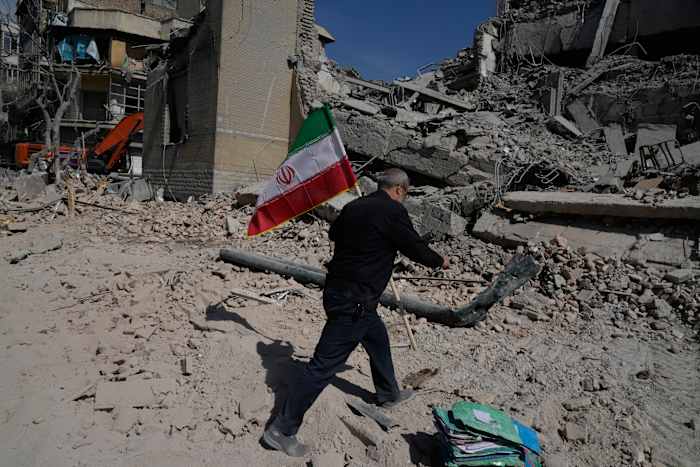
The kinetic exchange between Iran and Israel represents a transition from proxy-managed attrition to direct, state-on-state ballistic confrontation. This shift renders traditional "gray zone" containment strategies obsolete. When Iran launches a multi-vector wave of missiles, it is not merely seeking tactical destruction; it is testing the saturation limits of integrated air defense systems (IADS) and the political resolve of Western backers. The effectiveness of this offensive is measured by the ratio of interceptor cost to missile cost, the depletion rate of defensive batteries, and the subsequent legislative paralysis in the United States regarding military aid.
The Triad of Iranian Escalation Logic
Iran’s military strategy operates through three distinct operational layers. Understanding these layers is vital to predicting the duration and intensity of the current crisis.
- Saturation Dynamics: By utilizing a mix of low-cost loitering munitions (Shahed-series drones) and high-velocity ballistic missiles (such as the Kheibar Shekan), Iran forces the defender to make split-second economic and tactical choices. Drones function as "sensor decoys," intended to illuminate radar signatures and drain the Iron Dome or David’s Sling interceptors before the primary ballistic wave arrives.
- Psychological Displacement: The intent is to normalize direct strikes on Israeli soil, eroding the "deterrence by punishment" doctrine that has historically governed Israeli defense.
- Signal Intelligence (SIGINT) Harvesting: Each wave provides Tehran with granular data on the response times, radar blind spots, and interceptor trajectory patterns of the Arrow-3 and Patriot systems.
The Economic Asymmetry of Interception
The fundamental crisis is not one of technology, but of industrial capacity and the "Cost-Per-Kill" (CPK) ratio. Israel’s defense architecture is a tiered system designed for specific threat profiles:
- Iron Dome: Optimized for short-range rockets. Each interceptor costs approximately $40,000 to $50,000.
- David’s Sling: Targets medium-to-long-range missiles and cruise missiles. Costs escalate to roughly $1 million per firing.
- Arrow-2 and Arrow-3: Designed for exo-atmospheric interception of long-range ballistic missiles. These units are estimated at $2 million to $3.5 million per interceptor.
In contrast, the production cost of an Iranian liquid-fueled ballistic missile is a fraction of the cost of the high-end interceptors required to stop it. This creates a Defensive Attrition Trap. If Iran can sustain a launch cadence that exceeds the production rate of interceptor missiles, the defense system reaches a "saturation floor" where it must prioritize high-value assets (military bases, government hubs) over civilian population centers.
Legislative Gridlock as a Strategic Variable
The refusal of US Republicans to advance measures halting or funding specific air campaigns introduces a non-kinetic variable into the conflict. This legislative friction functions as a "force multiplier" for Iranian interests.
The bottleneck in Washington is defined by two primary friction points:
- The Fiscal Linkage Constraint: Domestic political actors are increasingly tying foreign military financing (FMF) to unrelated domestic policy shifts, such as border security or general spending cuts. This decoupling of immediate military necessity from legislative approval creates a lag time that adversaries can exploit.
- The Stockpile Depletion Concern: There is a growing consensus within the defense establishment that the US cannot simultaneously supply high-intensity conflicts in Eastern Europe and West Asia without hollowing out its own "Pacific Contingency" reserves. This creates a strategic hesitation that Iran perceives as a window of opportunity.
Tactical Breakdown of Missile Volleys
The technical composition of the Iranian strikes suggests a move toward precision-guided munitions (PGMs). Unlike the indiscriminate Grad rockets used by non-state actors, the current wave utilizes inertial navigation systems (INS) paired with satellite guidance.
The success of an aerial campaign in this context is defined by Leakage Rates. If an IADS has a 95% effectiveness rate, a volley of 100 missiles ensures that 5 will strike their targets. If Iran increases the volume to 300, 15 missiles "leak" through. In a nuclear or chemical environment, a 1% leakage rate is catastrophic. In a conventional environment, a 5% leakage rate targeting critical infrastructure (power grids, desalination plants, airfields) can achieve strategic paralysis.
The Failure of Proportionality as a Deterrent
The international community's reliance on "proportionality" has failed to account for the divergent risk tolerances of the actors involved. For a state like Iran, which operates under heavy sanctions, the marginal cost of escalation is lower than the marginal cost for a highly integrated, Western-aligned economy like Israel.
The current crisis confirms that Extended Deterrence—the idea that US power shields its allies from direct state attack—is under severe strain. When US legislative bodies block or delay support, it signals a shift from "unconditional backing" to "conditional alignment." This nuance is not lost on regional strategists in Tehran, Riyadh, or Tel Aviv.
Logistics and the Supply Chain of Defense
The ability to sustain this conflict depends on the "Deep Magazine" capacity of the Israeli Air Force and the IDF.
- Interceptor Resupply: Unlike standard munitions, interceptors for systems like the Arrow-3 cannot be mass-produced overnight. They involve complex seeker heads and solid-fuel rocket motors with long lead times.
- Maintenance Cycles: Continuous operation of radar arrays and launch batteries leads to "electronic fatigue" and mechanical failure. Without a lull in hostilities, the reliability of the defense umbrella decreases over time.
- Regional Cooperation: The role of neighboring states in providing airspace for interceptions or early warning data remains a volatile variable. If local actors perceive the US as wavering due to internal political deadlock, they are more likely to adopt a posture of neutrality to avoid Iranian retaliation.
Calculated Risk and the Threshold of Total War
We are currently observing a "Calibration Phase." Iran is attempting to find the maximum level of violence it can inflict without triggering a full-scale ground invasion or a nuclear response. The US legislative blockade provides Iran with a buffer; as long as the primary superpower is internally divided, the likelihood of a coordinated, multi-national "Decapitation Strike" remains low.
The technical reality of the situation is that defense is significantly more expensive and logistically taxing than offense. For every hour the US Congress spends debating the merits of an air campaign, the industrial base of the adversary continues to churn out low-cost kinetic solutions.
The strategic play here is not to wait for a diplomatic "off-ramp" that does not exist. Instead, the focus must shift toward Rapid Reconstitution of Defensive Magazines and the decoupling of emergency military aid from domestic partisan maneuvering. Failure to synchronize legislative speed with the velocity of ballistic threats will result in a systematic breakdown of the regional security architecture, forcing Israel into a "Samson Option" posture where it feels compelled to use disproportionate force to ensure survival.
The immediate requirement is the establishment of a dedicated, non-discretionary funding stream for IADS resupply, bypassing the standard legislative cycles that are currently being weaponized by both domestic and foreign interests.