The HK$17,000 fine recently levied against Hong Kong landlords for ignoring water seepage orders represents more than a localized regulatory penalty; it serves as a quantifiable metric for the breakdown of private property maintenance incentives within a high-density urban environment. When the Joint Office (JO) of the Food and Environmental Hygiene Department and the Buildings Department intervenes with a court-ordered fine, it signals a terminal failure in the bilateral negotiation between property owners. The friction between individual property rights and collective structural integrity has reached a point where the cost of non-compliance is being recalibrated to force administrative efficiency.
The Economic Architecture of Seepage Disputes
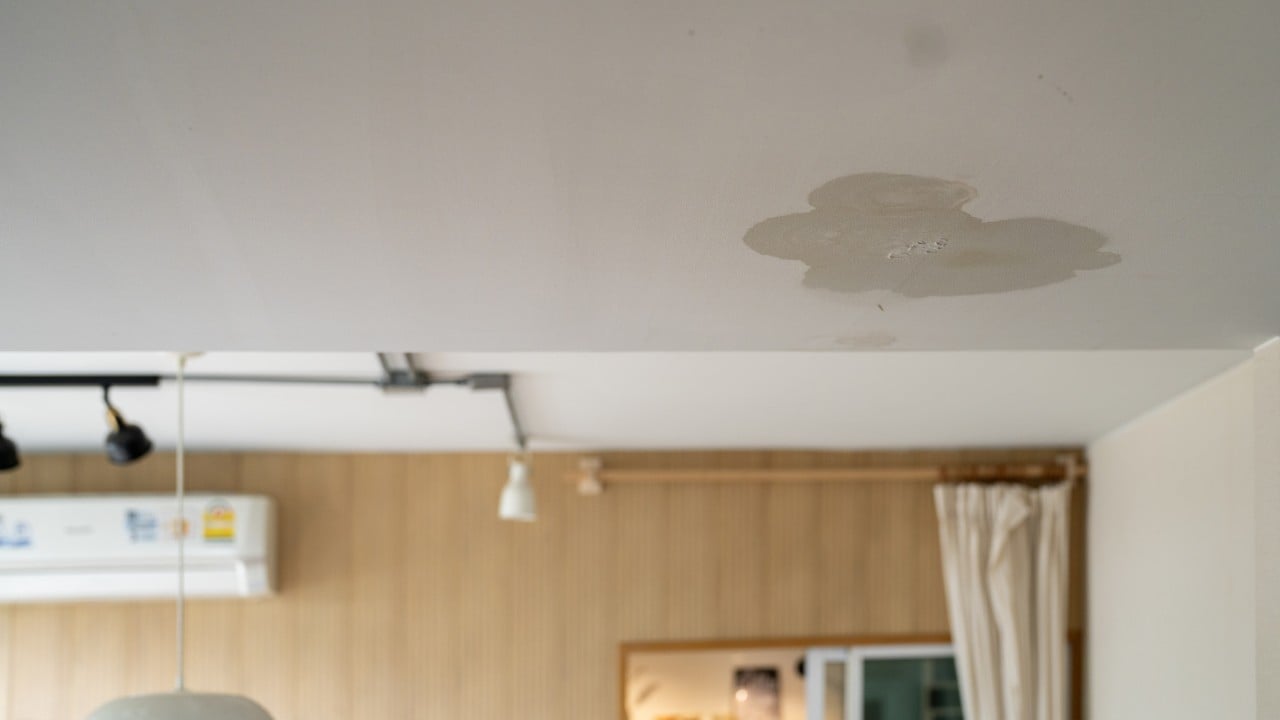
Water seepage in multi-story residential blocks is an externality problem. The source of the leak (the "Originator") often incurs zero immediate cost, while the victim (the "Recipient") suffers asset devaluation and loss of utility. This asymmetry creates a "Hold-up Problem" in game theory: the Originator has no financial incentive to allow inspections or repairs until the legal or administrative cost exceeds the repair cost.
The HK$17,000 penalty is an attempt to bridge this incentive gap. However, the mechanism is often sluggish because the Joint Office follows a rigid three-stage protocol:
- Initial Screening: Confirmation of the nuisance.
- Professional Investigation: Identifying the source through color-water tests, infrared thermography, or microwave moisture meters.
- Enforcement: Issuing a Nuisance Notice or a Nuisance Order.
The failure of this system lies in the timeline. The average investigation exceeds 90 days. During this period, the Recipient's property continues to degrade. Landlords who ignore these orders are often calculating the Net Present Value (NPV) of the fine versus the immediate capital expenditure of a full bathroom waterproofing renovation, which can easily exceed HK$50,000. In this context, a HK$17,000 fine is not a deterrent—it is a deferred maintenance fee.
The Three Pillars of Investigation Failure
When a landlord ignores a seepage order, the failure typically occurs within one of three structural pillars. Analyzing these pillars reveals why the current regulatory framework struggles to maintain the housing stock of Hong Kong.
1. The Technical Verification Barrier
The Joint Office relies heavily on "color-water tests," a low-tech method where dye is poured into drainage pipes to see if it appears in the unit below. This method has a high failure rate in complex high-rises where seepage may be caused by pressurized supply pipes or structural cracks rather than drainage leaks. If the JO cannot definitively prove the source, they cannot issue a Nuisance Order. Landlords aware of these technical limitations use non-cooperation as a strategy to wait out the investigation until it is closed due to "inconclusive evidence."
2. The Information Asymmetry Gap
Landlords, particularly those who do not reside in the property, lack real-time data on the structural health of their assets. They rely on tenants or neighbors for information. If a tenant is uncooperative because they fear a renovation will lead to a rent hike or eviction, the landlord remains insulated from the physical reality of the seepage. By the time a court summons arrives, the structural damage is often systemic rather than localized.
3. The Legal Enforcement Latency
The transition from a "Nuisance Notice" to a "Nuisance Order" and finally to a "Prosecution" involves multiple bureaucratic layers. The legal system in Hong Kong treats property rights with high reverence, meaning the threshold for a "Warrant to Effect Entry" is significant. Landlords exploit this latency, betting that the administrative cost for the government to pursue a criminal conviction is higher than the social cost of the leak.
The Cost Function of Non-Compliance
To understand why a HK$17,000 fine was necessary, one must break down the landlord's cost function. A rational landlord minimizes the following:
$$Total Cost = C_{repair} + (P_{fine} \times P_{conviction}) + C_{opportunity}$$
Where:
- $C_{repair}$ is the actual cost of fixing the leak.
- $P_{fine}$ is the statutory penalty (max HK$10,000 to HK$25,000 depending on the ordinance).
- $P_{conviction}$ is the probability that the JO will actually follow through to the court stage.
- $C_{opportunity}$ is the loss of rental income during the repair period.
In the current Hong Kong market, $P_{conviction}$ is historically low. The Joint Office handles tens of thousands of complaints annually, but only a fraction lead to successful prosecutions. When the probability of being fined is low, the expected value of the penalty is negligible compared to the certain $C_{repair}$. The recent HK$17,000 fine is a signal from the judiciary that $P_{fine}$ is being pushed to the upper limits of the statutory range to compensate for the low $P_{conviction}$.
Structural Cascades and Collateral Depreciation
The danger of ignored seepage is not merely cosmetic. It initiates a structural cascade. Water ingress into reinforced concrete triggers carbonation and chloride attack, leading to the corrosion of steel rebars. As rebar rusts, it expands, causing "concrete spalling."
The logic of the negligent landlord fails here: by avoiding a HK$20,000 waterproofing repair today, they are inviting a HK$200,000 structural remediation project five years from now. Furthermore, if the seepage affects the common areas or the structural integrity of the building slab, the Building Management Office (BMO) can potentially trigger an even more expensive Mandatory Building Inspection Scheme (MBIS) notice.
In Hong Kong’s vertical urbanism, a leak is never isolated. It is a shared liability. The refusal to cooperate with the JO is essentially a short-term liquidity play that destroys long-term asset value.
The Limit of Administrative Intervention
The Joint Office is frequently criticized for its "lack of teeth." This criticism stems from a misunderstanding of its role. The JO is a public health entity, not a civil mediator. Its mandate is to stop "nuisances," not to settle disputes between neighbors.
The limitations of the JO include:
- No Power to Award Damages: The JO can fine a landlord, but that money goes to the government, not to the victim who has to pay for their own ceiling repairs.
- Standard of Proof: The JO requires a high level of scientific certainty before taking legal action. This is why private "Surveyor Reports" are often more effective in civil court than JO investigations.
- Resource Dilution: With an aging building stock (buildings over 50 years old are increasing rapidly), the sheer volume of cases exceeds the investigative capacity of the FEHD and BD.
Strategic Reorientation for Property Owners
Landlords must shift from a reactive, "evade-and-delay" mindset to a proactive risk management framework. The increase in fine severity suggests that the government is no longer willing to subsidize the administrative cost of private disputes.
For the Recipient (the victim), the strategy should not rely solely on the Joint Office. The JO is a tool for evidence gathering, not for restitution. The superior play is to use the JO's findings as the basis for a civil injunction in the District Court or the Small Claims Tribunal. A civil judgment can include damages for "loss of enjoyment" and "diminution of property value," which far exceed the statutory fines of the JO.
For the Originator (the source), the strategy should be "Early Settlement and Mitigation." The moment a Nuisance Notice is issued, the probability of a fine becomes a measurable risk. The cost of a legal defense and the eventual fine, combined with the inevitable repair cost, will always exceed the cost of an immediate, negotiated repair.
The Institutional Shift Toward Mandatory Insurance
The recurrence of these HK$17,000 fines highlights a gap in the Hong Kong insurance market. While most "Home Insurance" policies cover water damage, many do not cover the cost of finding the leak (trace and access) or the legal costs associated with Joint Office investigations.
We are likely moving toward a regime where "Third Party Liability" for water seepage becomes a mandatory component of property ownership, similar to motor insurance. This would shift the burden of investigation and repair from the government to the private insurance sector. In this model, an uncooperative landlord would face skyrocketing premiums or policy cancellation, creating a market-based incentive for maintenance that is far more efficient than the threat of a HK$17,000 fine.
The current trend of increasing fines is the first step in a broader regulatory tightening. As the building stock ages, the "soft" approach to seepage—relying on dye tests and polite notices—will be replaced by a more aggressive, data-driven enforcement model where non-compliance is treated as a breach of public safety rather than a private inconvenience. Landlords must price this regulatory risk into their yield calculations immediately or face the erosion of their capital gains.