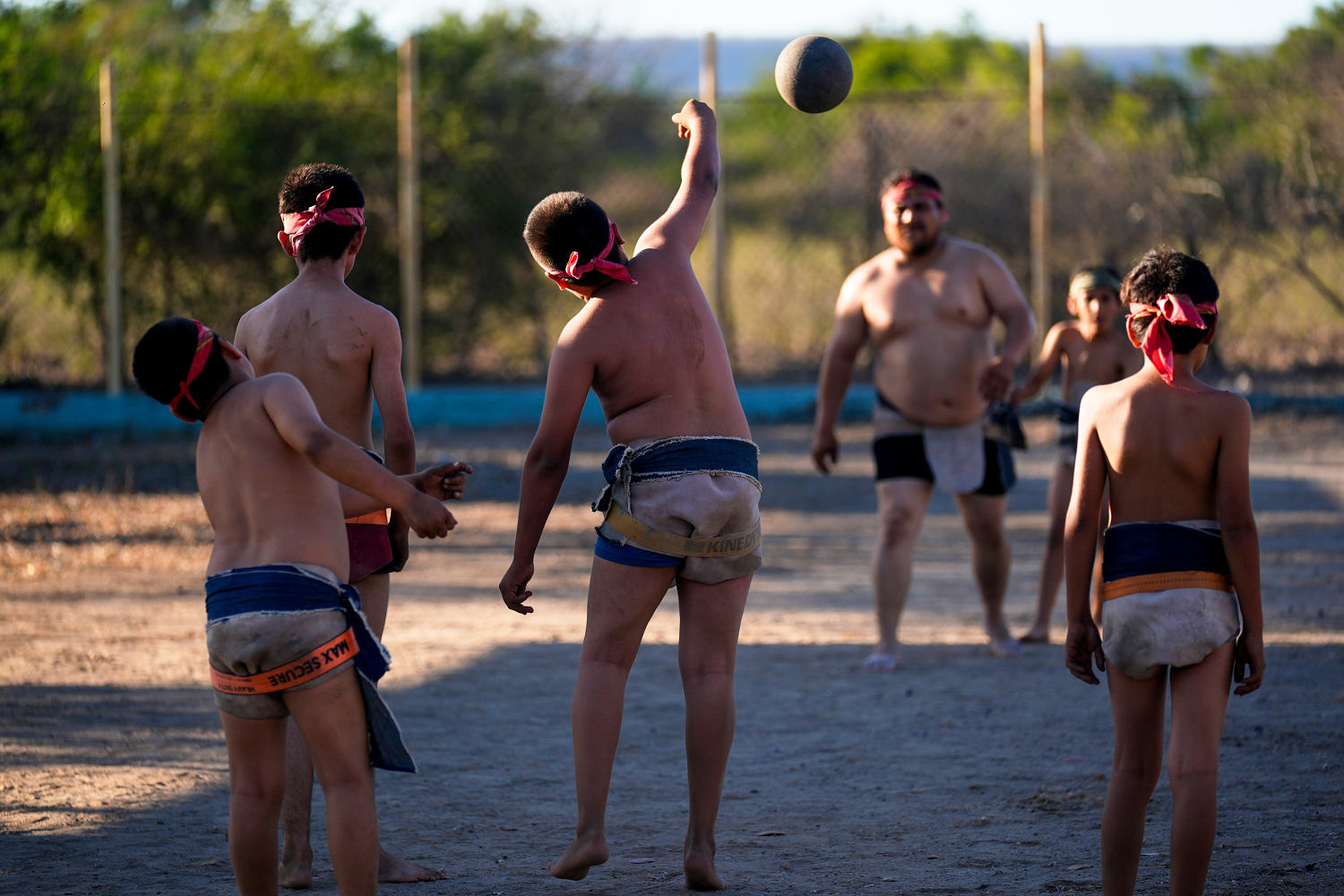
The survival of Ulama—the modern iteration of the Mesoamerican rubber ballgame—functions as a biological anomaly in the sociology of sport. While contemporary global sports rely on centralized governance, standardized commercial monetization, and digital distribution to maintain relevance, Ulama has persisted for 3,400 years through a decentralized, high-friction model of cultural transmission. This endurance is not a product of luck; it is the result of a specific socio-economic feedback loop that prioritizes communal identity over individual profit.
Understanding why this game survives requires a deconstruction of three specific vectors: the material science of the vulcanized rubber ball, the territorial logic of the "taste" (the court), and the high-risk physical mechanics that prevent the sport's dilution for mass consumption.
The Material Constraint as a Barrier to Entry
Ulama cannot be commodified because its primary equipment—the solid rubber ball—resists industrial mass production. Each ball, weighing between three and four kilograms, is hand-crafted using prehistoric chemical processes. This creates a supply chain bottleneck that fundamentally dictates the sport's growth rate.
The Vulcanization Feedback Loop
The production process involves harvesting latex from Castilla elastica trees and mixing it with the juice of Ipomoea alba (morning glory vine). The sulfur in the morning glory juice facilitates a cross-linking of polymer chains, converting the sticky sap into a resilient, high-bounce solid.
- Scarcity of Expertise: The knowledge required to balance the density and elasticity of the ball is held by a diminishing number of artisans.
- Production Cost: A single ball requires several days of labor and a significant volume of raw latex.
- Replacement Friction: Unlike a manufactured soccer ball, a lost or damaged Ulama ball represents a non-trivial loss of communal capital.
This material scarcity prevents the sport from scaling into a casual hobby. Participation requires a deliberate, high-effort commitment to maintaining the physical infrastructure of the game, which in turn ensures that those who play are deeply embedded in the cultural framework.
http://googleusercontent.com/image_content/213
The Kinematic Risks of the Hip Strike
Standardized sports like basketball or tennis utilize distal extremities (hands, feet, rackets) to manipulate objects. Ulama utilizes the hip—specifically the iliac crest and the trochanter of the femur. This choice of striking surface creates a unique set of kinematic constraints and physical hazards that function as a filter for participation.
The physics of a four-kilogram solid rubber ball traveling at high velocity involves significant kinetic energy.
$K = \frac{1}{2}mv^2$
When this energy is transferred to the hip, the risk of internal bruising or bone fracture is high. Players mitigate this through:
- Leather Padding (Chimalis): Essential dampening tools that distribute the force of impact across a wider surface area.
- Specific Body Mechanics: A lunging movement that utilizes the player's entire body mass to counteract the ball's momentum.
The high "cost of failure" in a strike means the game cannot be played casually without rigorous training. This high barrier to entry protects the sport from the "dilution effect" often seen when traditional practices are adapted for tourism or mass entertainment. It remains a specialist's endeavor.
The Territorial Logic of the Taste
The Ulama court, or taste, is a narrow rectangle of packed earth. The rules of the game are defined by territorial gains and losses rather than the simple accumulation of points. This "zero-sum" spatial logic reflects a pre-modern understanding of conflict and resolution.
The Scoring Mechanism
Points (or rayas) are not just added; they can be subtracted. This creates a volatile scoring environment where a team can be on the verge of winning and then find themselves back at zero within a single play cycle.
- Psychological Endurance: The possibility of total loss demands a higher level of mental resilience than fixed-scoring sports.
- Temporal Elasticity: Matches have no set clock. A game ends only when a specific score is reached. This makes the sport incompatible with the rigid broadcasting schedules of modern television, further insulating it from commercial pressures.
Cultural Transmission as a Survival Strategy
The primary reason Ulama has not vanished is its integration into the social hierarchy of the Sinaloa region. In these communities, the sport operates as a mechanism for status and identity. The "cost" of the game—the physical pain, the expensive balls, the time-intensive matches—is the very thing that gives it value.
The Institutional Vacuum
Unlike the NFL or FIFA, Ulama lacks a central regulatory body. This decentralization is its greatest defense. A centralized organization can be corrupted, bankrupt, or banned. A decentralized network of independent villages playing by oral tradition is nearly impossible to eradicate.
The threat to Ulama is not a lack of interest, but the loss of its environmental and social precursors. Urbanization reduces the availability of space for a taste, and the migration of youth to industrial centers breaks the intergenerational chain of knowledge.
The Modern Economic Paradox
Ulama currently exists in a state of "Prestige Survival." It is supported by local pride and increasingly by academic interest, but it lacks a self-sustaining commercial engine. For the sport to survive the next century, it faces a strategic fork in the road:
- The Museum Model: Accepting state subsidies and performing for tourists. This guarantees financial survival but strips the game of its competitive authenticity, turning it into a "living history" exhibit.
- The Niche League Model: Establishing a formal, yet local, competitive structure that attracts sponsors without changing the core mechanics. This requires a level of organization that may conflict with the sport's traditional, informal nature.
The structural integrity of Ulama is currently maintained by a small cadre of dedicated practitioners who prioritize the "ritual" over the "spectacle." The moment the game is optimized for the viewer rather than the player, the 3,400-year-old feedback loop will break.
The strategic imperative for the preservation of Ulama is the protection of the Castilla elastica habitats and the formalization of "Apprentice Ball-Maker" programs. Without the ball, the mechanics of the hip strike and the logic of the court are irrelevant. The survival of the game is fundamentally a materials science and supply chain challenge. Organizations seeking to support the sport should pivot away from "cultural awareness" campaigns and toward the direct subsidization of raw material processing and specialized medical support for players.
Success is measured not by the number of spectators in a stadium, but by the number of active tastes in rural Sinaloa. Expansion is a secondary goal; the primary objective is the maintenance of the high-friction, high-cost environment that has made the sport resilient enough to outlast the empires that birthed it.