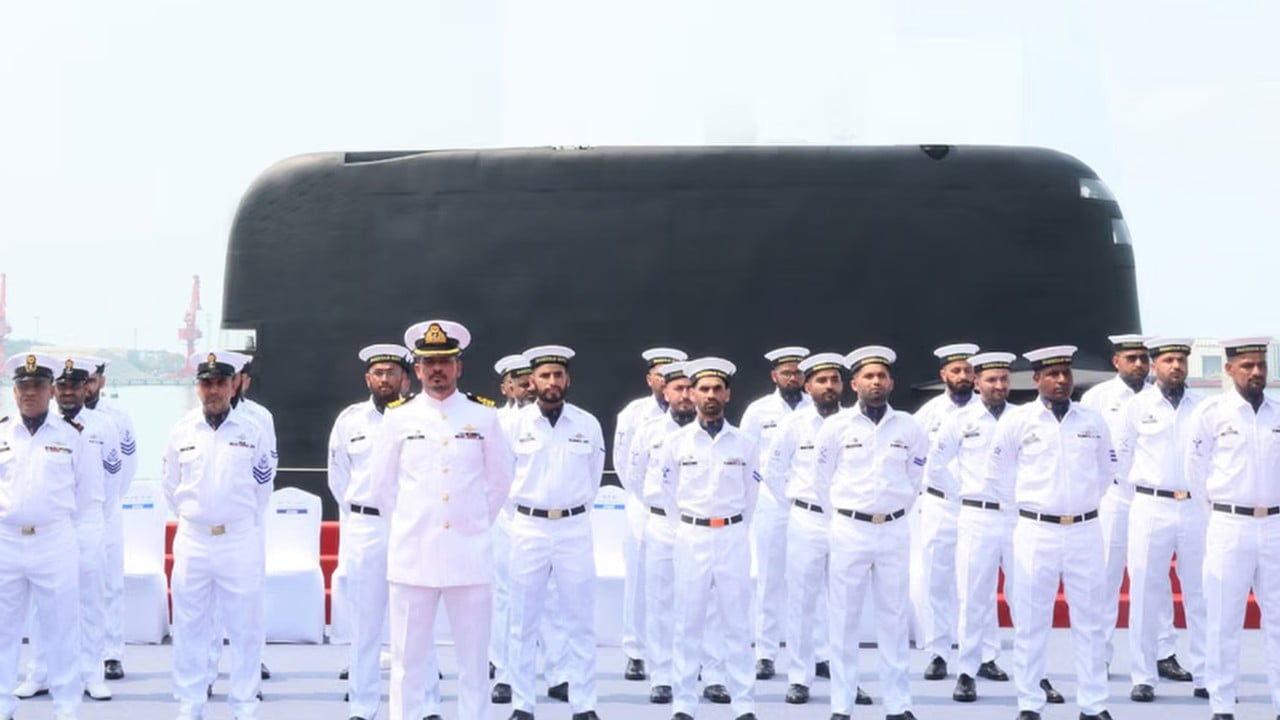
The commissioning of the first Hangor-class submarine, a derivative of the Chinese Type 039B Yuan-class, represents a fundamental transition in Pakistan’s naval doctrine from reactive coastal defense to a proactive, credible second-strike capability. This acquisition is not merely a quantitative increase in hull count; it is a qualitative integration of Air-Independent Propulsion (AIP) technology that redefines the acoustic signature and operational endurance of Pakistan's underwater fleet. By 2028, the scheduled completion of eight Hangor-class vessels will provide the Pakistan Navy (PN) with a high-availability sub-surface fleet capable of contesting sea lines of communication (SLOCs) and enforcing a continuous maritime nuclear deterrent.
The Technical Architecture of the Hangor Class
To understand the strategic utility of the Hangor-class, one must deconstruct the specific technical advantages of the Type 039B export variant. The primary value driver is the Stirling-cycle AIP system. Conventional diesel-electric submarines (SSKs) are limited by the "snort" cycle, where the vessel must surface or use a snorkel to take in oxygen for its diesel engines to recharge batteries. This period of high indiscretion makes the vessel vulnerable to modern Inverse Synthetic Aperture Radar (ISAR) and Magnetic Anomaly Detectors (MAD).
The AIP system allows the Hangor-class to remain submerged for up to 21 days without snorkeling, compared to the 4 to 6 days typical of non-AIP vessels. This extended submerged endurance creates a persistent threat in the Arabian Sea, forcing adversaries to commit disproportionate Anti-Submarine Warfare (ASW) resources to locate a single quiet target.
Acoustic Masking and Hydrodynamics
The hull design utilizes teardrop geometry and anechoic tiling to minimize the target strength against active sonar.
- Anechoic Coatings: These rubberized tiles absorb incoming sonar pulses rather than reflecting them, significantly reducing the detection range of enemy surface combatants.
- Vibration Isolation: Unlike older Agosta-90B platforms, the Hangor-class incorporates suspended internal decks and dampened machinery mounts to isolate engine noise from the hull.
- Propeller Cavitation Management: The use of a skewed seven-blade propeller reduces cavitation at higher speeds, allowing for a higher "quiet speed" threshold before the vessel becomes acoustically prominent.
The Logic of Sea Denial and Strategic Depth
Pakistan’s naval strategy operates on the principle of "Sea Denial." Rather than attempting to control the entire Northern Indian Ocean—a feat requiring multiple carrier strike groups—the PN focuses on preventing an adversary from using these waters freely. The Hangor-class serves as the primary tool for this objective through three distinct operational vectors.
Vector I: Geographic Chokepoint Interdiction
The proximity of Karachi and Gwadar to the Strait of Hormuz places Pakistani submarines in a position to monitor and, if necessary, disrupt global energy flows. The Hangor-class, equipped with Yu-6 heavy-weight torpedoes and YJ-82 anti-ship cruise missiles, can operate in the shallow, acoustically complex waters of the Persian Gulf approach. These "littoral environments" favor small, quiet diesel-electric boats over larger nuclear-powered attack submarines (SSNs), which often struggle with bottom-bounce sonar interference and thermal layers common in the Arabian Sea.
Vector II: Counter-Carrier Operations
The primary threat to Pakistani coastal infrastructure is the Indian Navy’s Carrier Battle Groups (CBGs). The Hangor-class is designed as a "carrier killer" platform. By utilizing a "wolf pack" approach or stationary ambushes along predicted transit corridors, these submarines force enemy carriers to stay further offshore, effectively neutralizing their short-range strike aircraft and limiting their ability to enforce a naval blockade.
Vector III: The Nuclear Underlay
The most critical strategic shift is the integration of the Babur-3 submarine-launched cruise missile (SLCM). The Babur-3 provides Pakistan with a survivable second-strike capability. In a high-intensity conflict where land-based silos or mobile launchers might be neutralized, a submerged Hangor-class submarine in a "bastion" patrol area ensures that a credible deterrent remains. This creates a "stability-instability paradox": while it may prevent total war, it encourages lower-level maritime skirmishes as both sides test the limits of these new underwater boundaries.
The Sino-Pakistani Industrial Ecosystem
The Hangor project is divided into two phases: four units built in China at the Wuchang Shipbuilding Industry Group and four units built locally at Karachi Shipyard & Engineering Works (KS&EW). This bifurcated approach addresses two long-term Pakistani objectives: immediate capability acquisition and indigenous technological sovereignty.
Technology Transfer and Maintenance Cycles
Local construction facilitates a deep "Design-to-Build" understanding. Submarines are notoriously difficult to maintain; having the infrastructure to perform Mid-Life Upgrades (MLU) and deep-maintenance cycles in Karachi reduces the operational downtime of the fleet. This localized expertise minimizes dependence on foreign technicians during periods of geopolitical friction.
Interoperability and Data Linking
Using Chinese-origin platforms allows for seamless data integration with Pakistan's existing Zulfiquar-class frigates and Azmat-class missile boats, which also utilize Chinese combat management systems. This creates a "network-centric" maritime force where a submarine can remain silent, receiving target coordinates from a high-altitude Long Endurance (HALE) UAV or a surface ship via encrypted acoustic data links before launching a stand-off strike.
Comparative Constraints and Operational Risks
While the Hangor-class represents a leap forward, it is not an absolute solution to Pakistan’s maritime challenges. Analysis of the platform reveals several bottlenecks that could be exploited.
- Topographical Predictability: The deep-water trenches in the Arabian Sea are limited. Sophisticated ASW networks using seafloor sensors (similar to the US SOSUS network) can monitor these "highways" that submarines must use to transit from Karachi to deeper patrol zones.
- The AIP Power Gap: While AIP is excellent for low-speed loitering, it does not provide the high-speed dash capabilities of a nuclear submarine. If a Hangor-class vessel is detected, it lacks the sustained speed to outrun modern anti-submarine torpedoes or maintain pace with a fast-moving carrier group.
- Training and Human Capital: Operating a sophisticated Stirling-cycle engine and advanced sonar suites requires a highly specialized crew. The rapid expansion of the submarine arm (from five to thirteen hulls) will put immense pressure on the PN’s training pipeline, potentially leading to a temporary dip in operational proficiency per vessel.
Strategic Forecast: The Shift Toward Bastion Defense
The arrival of the Hangor-class marks the end of the era of "defensive coastal patrolling" for Pakistan. We are seeing the emergence of a "Bastion Strategy" similar to that employed by the Soviet Union during the Cold War. In this model, Pakistan will likely designate specific areas of the Arabian Sea—protected by land-based air cover and surface assets—where its Hangor submarines can operate with relative impunity.
The primary function of these bastions will be to house the Babur-3 SLCM-equipped boats. This forces the Indian Navy to transition from a "Sea Control" posture to a "Search and Destroy" posture, a significantly more expensive and resource-intensive mode of operation. Every dollar Pakistan spends on a Hangor-class submarine necessitates a five-to-tenfold increase in spending by its adversary on ASW helicopters, P-8I Neptune aircraft, and sonar-equipped destroyers.
The strategic play for Pakistan is the systematic exploitation of this cost-asymmetry. By saturating the Northern Indian Ocean with quiet, AIP-equipped hulls, the PN achieves a state of "Permanent Presence." The goal is not to win a decisive Trafalgar-style naval battle, but to ensure that the cost of maritime intervention against Pakistan is prohibitively high. The Hangor-class is the technical instrument of this economic and military attrition strategy. Operational deployment of the first four units by 2026 will provide the first real-world test of this doctrine, likely triggering a corresponding acceleration in regional ASW procurement and seafloor surveillance infrastructure.


