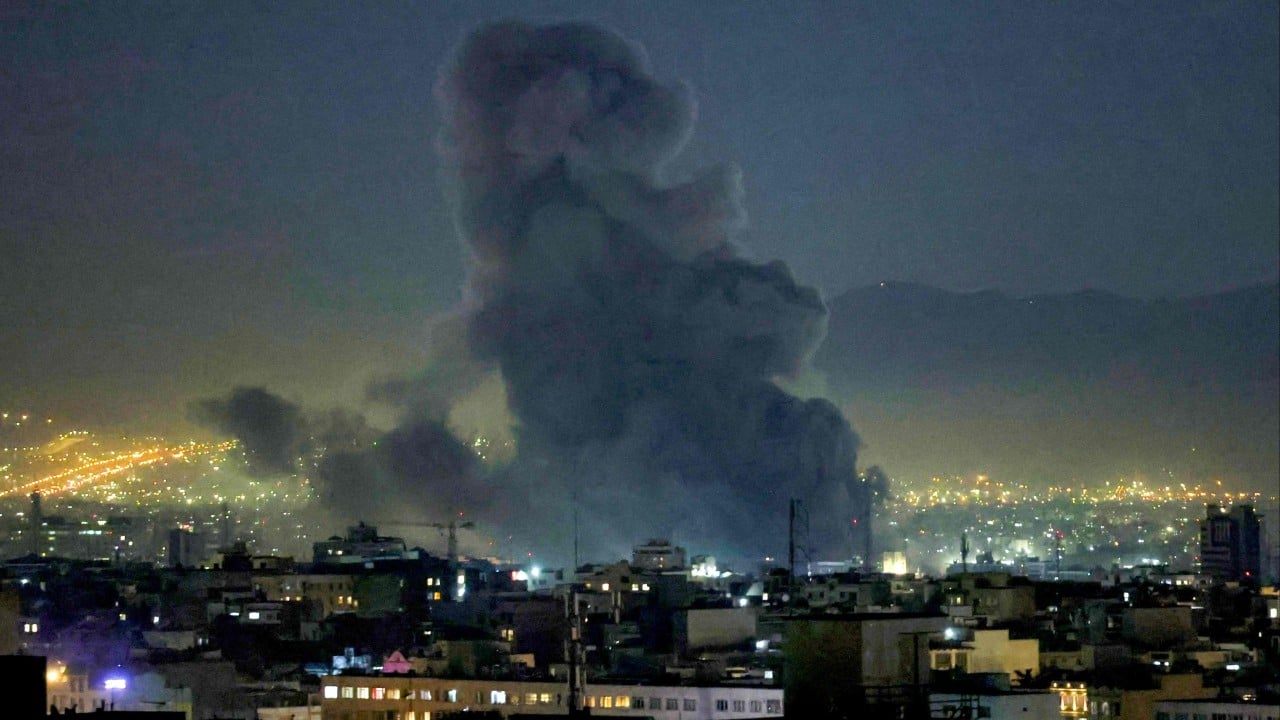
The death of Ayatollah Ali Khamenei on February 28, 2026, did not just create a vacancy in Tehran; it detonated the central pillar of a forty-year geopolitical architecture. As US and Israeli strikes hit high-security compounds in the capital, the immediate question of who survives has been replaced by a more clinical, more dangerous calculation. The Islamic Republic is now operating under an interim "Guidance Council" led by President Masoud Pezeshkian and Judiciary Chief Gholamhossein Mohseni Ejei, but the real movement is happening in the shadows of the Islamic Revolutionary Guard Corps (IRGC) and the secretive Assembly of Experts.
This is not a simple transfer of power. It is a desperate race to prevent systemic collapse while the country is under active bombardment.
The Myth of the Smooth Succession
For decades, analysts pointed to the 88-member Assembly of Experts as the constitutional safety net that would ensure a professional transition. That theory is currently being shredded by the reality of a multi-front war. While Ayatollah Alireza Arafi has been named interim Supreme Leader to project a facade of continuity, the IRGC is reportedly moving to bypass the assembly’s slow-moving clerical deliberations.
The list of potential permanent successors has narrowed to a handful of figures, each representing a different survival strategy for the regime:
- Mojtaba Khamenei: The second son of the late leader. He carries the "Khamenei" brand but lacks the clerical seniority traditionally required. His rise would signal a shift toward a dynastic, military-backed autocracy.
- Alireza Arafi: The institutionalist. As the current interim head, he represents the "safe" choice for the clerical establishment, though he lacks an independent power base within the security services.
- Hassan Khomeini: The grandson of the revolution’s founder. He remains a wild card, potentially serving as a bridge to more moderate factions, though he has been sidelined by hardliners for years.
The tension is no longer about ideology; it is about physical survival. Sources indicate that IRGC commanders are prioritizing "battlefield legitimacy" over theological credentials. If the Assembly of Experts cannot produce a name within days, we are likely to see the formalization of a military junta that uses the office of the Supreme Leader as a mere rubber stamp.
China’s Myanmar Dilemma Reaches a Breaking Point
While the Middle East burns, a quieter but equally significant crisis is reaching a crescendo on China’s southern flank. Five years after the 2021 coup, Myanmar has become a graveyard for Beijing’s "Pauk-Phaw" (kinsfolk) diplomacy. The Chinese Communist Party (CCP) is currently trapped in a predatory loop, forced to back a failing military junta in Naypyidaw that it neither likes nor trusts.
The dilemma is simple and brutal. If Beijing allows the junta to collapse, it risks a chaotic, pro-Western democracy on its border. If it continues to prop up Senior General Min Aung Hlaing, it remains the primary target of a deeply angry, armed Burmese population.
The False Stability of the 2026 Elections
The recent sham elections in Myanmar were designed to give China a "civilian" hook to hang its diplomacy on. Instead, they have intensified the civil war. The Arakan Army (AA) now controls nearly the entire border with Bangladesh, and the Three Brotherhood Alliance has severed the main trade arteries to the Chinese province of Yunnan.
Beijing’s response has been a masterclass in cynicism:
- Drones for the Junta: Shipping counter-drone technology and surveillance kits to Naypyidaw to prevent the total overrunning of major cities.
- Ceasefires for the Rebels: Pressuring ethnic armed groups—who are often dependent on Chinese cross-border trade—to halt offensives just long enough to keep the oil and gas pipelines from exploding.
This "multi-engagement" strategy is failing because it assumes China can control all players simultaneously. The capture of Lashio by rebel forces was a wake-up call. It proved that the resistance is no longer a collection of disparate guerrillas but a coordinated military force that can ignore Beijing’s "suggestions" when victory is in sight.
The Tech of the New Conflict
We are seeing a radical shift in the tools of regional destabilization. In Iran, the use of AI-driven voice cloning and deepfakes—such as the "Habibi" model that unites Arabic dialects—is being used to seed disinformation among proxy groups. Meanwhile, the Pentagon’s reported use of AI-optimized strike packages in the February 28 attacks marks a point of no return for "ethical AI" in warfare.
In Myanmar, the war is being won with $500 hobbyist drones modified with 3D-printed release mechanisms. The junta, despite its billion-dollar Russian and Chinese jets, is losing ground to an insurgency that operates like a decentralized tech startup. China’s "Great Firewall" tactics are being exported to the junta to stifle this digital resistance, but the encryption used by the National Unity Government (NUG) has remained stubbornly resilient.
The Economic Aftermath
The global markets are reacting to the Iran strikes with predictable volatility. Brent crude spiked to $71 per barrel within hours of the confirmation of Khamenei's death. But the real story is in the Strait of Hormuz. If the IRGC, in its succession-induced panic, decides to close the strait, 20% of the world's oil supply goes dark.
For India, this is a nightmare. With 40% of its LNG coming through the strait and a nine-million-strong diaspora in the Gulf, New Delhi is looking at an economic shock that could derail its 2026 growth targets. The Chabahar Port project, India’s strategic bridge to Central Asia, is effectively frozen as the "interim" government in Tehran prioritizes internal purges over external trade.
The Collapse of the Old Guard
The simultaneous crises in Iran and Myanmar reveal a broader truth about the 2026 global order: the "buffer states" are gone. For decades, the West and China relied on stable, if odious, autocrats to keep regional conflicts contained.
In Iran, the "Gray Eminence" strategy of Ali Khamenei—holding together a fractious coalition of clerics and soldiers—died with him. In Myanmar, the "Pauk-Phaw" illusion of a managed neighbor has been replaced by a chaotic, multi-polar civil war that China can only influence, not control.
The world is not waiting for a new "Great Game." The game has already changed, and the rules are being written in real-time by drone operators in the jungles of Rakhine and IRGC colonels in the bunkers of Tehran. The era of the predictable autocrat is over.
Would you like me to analyze the specific IRGC factional leaders currently vying for control of the Guidance Council?