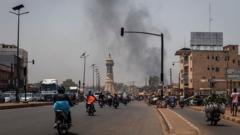
The dust in Bamako has a specific weight. It settles on everything—the windshields of idling taxis, the plastic chairs outside roadside maquis, and the fine linen of a diplomat’s collar. For years, the French community in Mali’s capital treated this dust as a nuisance, a part of the local color. They built lives here. They opened bakeries that smelled of sourdough and yeast, managed telecommunications firms, and raised children who spoke a melodic blend of Parisian French and Bambara.
That sense of permanence evaporated in a single afternoon.
When the French Ministry for Europe and Foreign Affairs issued its urgent directive for all French nationals to leave the country, it wasn't just a change in travel advisory status. It was the sound of a door slamming shut on a decade of history. The "Red Zone" on the map had finally bled over the edges, swallowing the last pockets of perceived safety.
The Warning in the Static
Imagine a man named Jean-Pierre. He isn't real, but he represents a very real demographic currently navigating the chaos of the Bamako airport. Jean-Pierre has lived in Mali for twelve years. He owns a small logistics firm. He survived the 2012 coup, the 2020 upheaval, and the 2021 transition. He considered himself "Mali-hardened." He believed he knew how to read the winds.
Then came the rebel attacks.
These weren't the distant skirmishes of the north, the kind of far-off thunder that people in the capital had learned to tune out. The violence moved closer. It became surgical. When insurgent groups began targeting strategic locations closer to the heart of power, the calculus for the French government shifted from "caution" to "evacuation."
The official statement was dry, as all government cables are. It cited a "high risk of attack" and the "unpredictability of the security situation." But for those on the ground, the news arrived as a cold knot in the stomach. It meant looking at a home—a garden where the bougainvillea is just starting to bloom—and realizing it is now a liability.
Safety is a fragile architecture. It relies on the belief that the person standing guard shares your interest in peace. In Mali, that belief has been eroded by a complex shift in alliances. The departure of French military forces from Operation Barkhane left a vacuum, and as Russian Wagner Group mercenaries moved in to fill the void, the traditional security umbrellas for European citizens folded up.
The Logistics of a Life Interrupted
Leaving a country on short notice is not a simple matter of booking a flight. It is an exercise in grief and high-speed accounting.
Consider the mechanics of a sudden exit. You have forty-eight hours. What do you pack? You cannot take the mahogany desk you bought in Mopti. You cannot take the community you built at the weekend football matches. You take your passport, your hard drives, and perhaps a handful of photographs.
The French embassy’s warning wasn't a suggestion; it was an admission of powerlessness. When a nuclear-armed Western power tells its citizens it can no longer guarantee their safety, the subtext is clear: If you stay, you are on your own.
This is the invisible stake of the geopolitical divorce between Paris and Bamako. It isn't just about troop movements or uranium rights. It is about the thousands of individual threads—business partnerships, marriages, friendships—that are being snapped by the tension of international diplomacy.
The streets of Bamako remain vibrant, but for the French expat, the vibrancy now feels like a fever. Every motorcycle engine that backfires is a question mark. Every prolonged gaze from a stranger feels like an assessment. This is the psychological toll of being declared persona non grata by proxy. You aren't being hunted, necessarily, but you are no longer welcome to hide in plain sight.
Why This Time is Different
In the past, these warnings were often ignored by the "old hands" who had seen it all before. But the current landscape is unrecognizable. The rise of Al-Qaeda-linked groups and Islamic State affiliates in the Sahel has created a decentralized threat. There is no front line. There is no one to negotiate with.
Logic dictates that when the risk becomes asymmetrical, the only winning move is to leave the board.
The rebels have proven their ability to strike at the infrastructure of the state. They aren't just fighting for territory anymore; they are fighting for the narrative of total instability. By forcing the departure of foreign nationals, they achieve a symbolic victory. They demonstrate that the current government, despite its new international partners, cannot protect the very people who help fuel the local economy.
Wait.
The economic fallout will be the second wave of this disaster. When the French businesses pull out, they take more than just their managers. They take the salaries that support thousands of Malian families. They take the technical expertise and the international connections. The "Red Zone" doesn't just keep people out; it traps the people who remain in a shrinking room.
The Long Shadow of the Sahel
The tragedy of the situation lies in its inevitability. The friction between the Malian military junta and the French government has been sparks on dry tinder for months. The expulsion of the French ambassador was a sign. The suspension of Air France flights was a sign. The rebel attacks were simply the match.
Now, the airport in Bamako is a theater of the surreal.
People who two weeks ago were arguing about the quality of the wine at a dinner party are now sitting on their suitcases, eyes glued to the departure screens. They are trading tips on which routes to the airport are still clear of checkpoints. They are saying goodbye to Malian friends with a handshake that feels too brief, too hollow.
"We'll be back in six months," someone says.
No one believes them.
The geopolitical shift in West Africa is tectonic. We are witnessing the end of an era of European influence that has lasted, in various forms, for over a century. It is messy. It is violent. And it is being written in the frantic packing of bags and the sudden silence of abandoned villas.
The sun sets over the Niger River, casting long, golden shadows across the water. It is a beautiful view, the kind of view people move across the world to see. But tonight, nobody is looking at the river. They are looking at the clock. They are looking at the gate. They are waiting for the heavy wheels of a jet to lift them away from a place they loved, but can no longer trust.
The dust continues to fall. It covers the tracks of the cars heading toward the terminal. It covers the signs for businesses that will be closed by Monday. It covers the memory of a cooperation that turned into a conflict.
A suitcase sits by a door in a quiet suburb of Bamako. It is packed. It is heavy. It is the only thing left of a decade-long life.
The door locks. The key is left with a neighbor who doesn't know when, or if, the owner will return. The taxi pulls away, kicking up a final cloud of that heavy, red dust, leaving the street to the rising heat and the uncertain silence of the night.