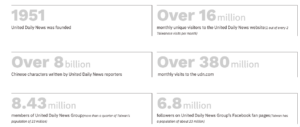
Traditional media died a slow death while the world watched, but in Taipei, one of the region’s oldest news organizations decided to stop mourning its lost printing presses. United Daily News Group (UDN) didn't just survive the transition to digital; it weaponized its first-party data to claw back advertising revenue from the duopoly of Google and Meta. By treating its readership not as a mass audience, but as a high-velocity data stream, UDN transformed from a legacy publisher into a sophisticated identity graph.
The shift was born of necessity. For decades, publishers relied on the "spray and pray" method of advertising, where volume was the only metric that mattered. When the programmatic era arrived, that volume was devalued. Advertisers realized they could find the same person reading a premium UDN investigation on a cheaper, low-quality site for a fraction of the cost. To win, UDN had to prove that its environment and its understanding of the reader provided a tangible, measurable uplift that a blind programmatic buy could not match.
The Architecture of First Party Intelligence
The core of the UDN strategy rests on its Data Management Platform (DMP), which it began building years before the industry started panicking about the end of third-party cookies. This wasn't a superficial project. It involved breaking down the silos between different departments—editorial, circulation, and marketing—to create a unified view of the user.
When a reader clicks an article about real estate trends in Xinyi District, the system doesn't just log a page view. It cross-references that action with previous searches for mortgage rates, clicks on home decor galleries, and even offline event registrations. This creates a "gold profile." UDN can then sell this specific, high-intent audience to banks or developers at a premium price. They are no longer selling pixels; they are selling a direct line to a qualified buyer.
Breaking the Reliance on Global Tech
Most publishers are addicted to the crumbs that fall from the tables of Big Tech. They install trackers that send their valuable reader data back to the very platforms that are cannibalizing their ad sales. UDN took a different path by focusing on Identity Resolution.
By encouraging logins through newsletters, member-only content, and interactive features, they moved away from anonymous "cookies" toward known "users." This allows for cross-device tracking that remains accurate even when a user moves from a desktop at work to a smartphone on the subway. For an advertiser, this consistency is the difference between a wasted impression and a successful conversion.
Machine Learning as a Revenue Driver
The integration of artificial intelligence at UDN is often discussed in terms of editorial efficiency, but its most profound impact is on the bottom line. The group uses predictive modeling to determine the "propensity" of a reader.
If the algorithm predicts a reader is likely to churn or stop visiting, it triggers personalized content recommendations or specific subscription offers to keep them in the ecosystem. On the advertising side, Lookalike Modeling allows UDN to take a small group of high-value converters and find similar profiles across their entire network of millions of monthly unique visitors.
Consider a hypothetical scenario where a luxury car brand wants to reach potential buyers. Instead of showing an ad to everyone, UDN’s AI identifies users whose reading patterns—perhaps an interest in golf, high-end travel, and financial news—match the digital footprint of existing luxury car owners. The ad is shown only to them. This increases the Click-Through Rate (CTR) and, more importantly, the Return on Ad Spend (ROAS) for the client.
The Friction Between Editorial and Commercial Data
This level of tracking often raises eyebrows in newsrooms. Investigative journalists tend to view their readers as citizens, while the data team views them as data points. UDN had to navigate this cultural minefield.
The compromise was a "privacy-first" framework that anonymized data for advertising purposes while using the aggregate insights to help editors understand what topics actually drive engagement. They discovered that long-form, deeply researched pieces often have a longer "data tail" than breaking news. A piece of investigative journalism might not get a million hits in an hour, but it attracts a high-value audience that stays on the page for ten minutes. That "time on page" is a metric that high-end advertisers are increasingly willing to pay for.
Beyond the Banner Ad
The real victory for UDN hasn't been in making better banner ads, but in moving beyond them entirely. They have used their data insights to build a Full-Stack Marketing Service.
- Content Marketing: Using data to identify trending topics before they peak, allowing brands to commission "native" content that feels organic to the reader's journey.
- Event Integration: Identifying clusters of readers in specific geographic areas with specific interests to launch targeted offline events.
- Direct E-commerce: Using reader preferences to curate products that the audience actually wants to buy, creating a new revenue stream that is independent of the traditional ad market.
This diversification is the only way a regional publisher can withstand the volatility of the global economy. If the display ad market dips, the e-commerce or events division picks up the slack.
The Cost of the Data Arms Race
It would be a mistake to suggest this transition was easy or cheap. UDN had to hire data scientists, engineers, and analysts who command salaries far higher than the average journalist. They had to overhaul their legacy IT infrastructure, moving away from fragmented systems to a centralized cloud environment.
Many publishers try to shortcut this by buying "off-the-shelf" AI tools. These rarely work because they aren't tuned to the specific nuances of the local language or the unique cultural context of the Taiwanese market. UDN’s decision to build and customize their own stack gave them an "informational moat" that competitors find difficult to cross.
The Problem with Precision
There is a risk in being too precise. If a publisher only shows readers what they are already interested in, they create an echo chamber. From a business perspective, if you only show ads to the "perfect" customer, you limit your reach and eventually exhaust that audience.
UDN has had to experiment with "discovery" algorithms—systems that intentionally introduce a small percentage of randomized or tangential content to see if the reader's interests have evolved. This prevents the data profiles from becoming stagnant. It’s a delicate balance between giving people what they want and showing them what they didn't know they needed.
The Local Advantage in a Global Market
Google knows what you search for, and Facebook knows who your friends are, but a local publisher like UDN knows the "context" of your life in Taiwan. They understand the local nuances of the political cycle, the specific timing of the Lunar New Year shopping rush, and the regional loyalties that a global algorithm might miss.
By layering this local context over their raw data, UDN provides a level of "cultural relevance" that global platforms cannot replicate. This is why local advertisers are returning to the fold. They have realized that while Google offers scale, UDN offers resonance.
Hard Truths for the Industry
The UDN model isn't a "template" that can be copied by any struggling newspaper. It requires a level of capital investment and a willingness to cannibalize one’s own traditional business model that most legacy boards simply cannot stomach.
Success in this space requires a brutal realization: you are no longer in the newspaper business. You are in the Attention and Identity business. If you cannot identify who is reading your content, and you cannot capture their attention long enough to build a profile, you have nothing to sell but cheap impressions in a race to the bottom.
The future of media revenue isn't found in a better paywall or a more intrusive ad unit. It is found in the ability to turn a casual reader into a known entity. UDN proved that even a legacy giant can learn to speak the language of the algorithm, provided they are willing to trade their old printing presses for a data warehouse.
Publishers who fail to build their own first-party data infrastructure today are essentially outsourcing their future to companies that view them as a rounding error. The choice is binary: become a data-driven powerhouse or become a ghost in someone else's machine.