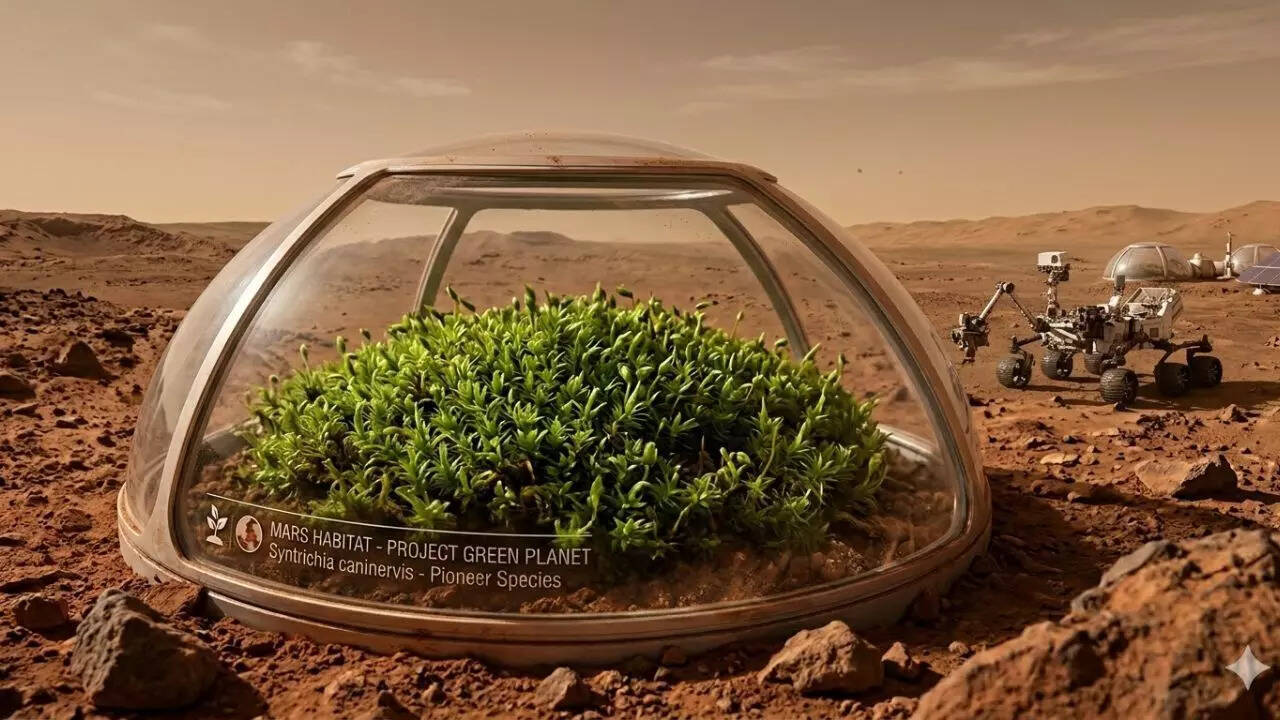
The viability of long-term human presence on Mars hinges on the transition from high-cost logistical dependency to localized biological production. Current aerospace paradigms prioritize mechanical life-support systems, yet these systems possess inherent failure points and lack the regenerative capacity of a biological biosphere. The desert moss Syntrichia caninervis represents the first documented organism capable of surviving the combined stressors of the Martian environment—extreme desiccation, sub-zero temperatures, and high-intensity ionizing radiation—without artificial shielding. This species does not merely survive; it maintains the metabolic plasticity required for recovery, positioning it as the foundational substrate for a planetary-scale terraforming sequence.
The Stress Tolerance Framework of Syntrichia Caninervis
Traditional botanical research focuses on yield and growth rates under optimized conditions. In contrast, the analysis of S. caninervis requires a framework built on "extreme-tolerance benchmarks." This moss, primarily found in the Mojave Desert and the Tibetan Plateau, has evolved cellular mechanisms that decouple survival from active metabolic states.
The Mechanism of Desiccation Tolerance
Unlike most vegetation that suffers irreversible cellular collapse when water content drops below a specific threshold, S. caninervis enters a state of programmed physiological suspension.
- Sugar-Based Vitrification: During rapid dehydration, the plant accumulates non-reducing sugars—specifically sucrose and trehalose—which convert the cytoplasm into a "glassy" state. This prevents the crystallization of proteins and maintains the integrity of the phospholipid bilayer.
- Rehydration Recovery Velocity: Upon the introduction of liquid water, the organism resumes chlorophyll fluorescence and photosynthetic activity within seconds to minutes. This minimizes the energy-intensive lag phase that typically kills less resilient species.
Cryogenic Resilience and Thermal Inertia
Mars maintains an average surface temperature of approximately -62°C, with nocturnal plunges that would shatter standard plant cells through ice crystal formation. S. caninervis demonstrated survival after storage in ultra-low temperature freezers (-80°C) for five years and in liquid nitrogen (-196°C) for one month. The survival is attributed to anti-freeze proteins that inhibit ice recrystallization, ensuring that while the plant may freeze, the internal structural damage remains negligible.
Quantifying the Martian Environmental Barrier
To move beyond the vague concept of "potential," we must map the specific environmental variables of Mars against the known limits of S. caninervis. The challenge is not a single stressor but the synergistic effect of three primary vectors.
Ionizing Radiation and DNA Repair
The Martian surface is bombarded by galactic cosmic rays and solar particle events due to the lack of a global magnetic field and a thin atmosphere. Research indicates that S. caninervis can withstand gamma radiation doses up to 500 Gray (Gy). For context, a dose of 10 Gy is lethal to humans. The plant’s resilience suggests a highly efficient DNA repair mechanism that functions during the rehydration phase, scanning and repairing double-strand breaks before cellular replication begins.
Atmospheric Pressure and Composition
The Martian atmosphere is 95% $CO_2$ with a surface pressure roughly 1% of Earth's. While S. caninervis requires $CO_2$ for photosynthesis, the low pressure creates a massive transpiration gradient, potentially sucking moisture out of any hydrated tissue instantly. This creates a functional bottleneck: the moss can survive the exterior conditions in a dormant state, but active growth likely requires a pressurized "low-dome" environment or integration into the Martian regolith to create a micro-climate of higher humidity.
The Three Pillars of Biological Terraforming Strategy
If S. caninervis is the primary biological asset, its deployment must follow a rigorous logic of succession. We cannot jump to "Green Planet" status without establishing the intervening stages of environmental modification.
1. Regolith Stabilization and Pedogenesis
Martian regolith is not soil; it is a sterile, toxic mixture of crushed rock and perchlorates.
- Toxin Mitigation: Future synthetic biology applications may allow S. caninervis to be engineered to metabolize perchlorates, cleaning the ground for more sensitive species.
- Organic Carbon Sequestration: As the moss cycles through growth and dormancy, it deposits organic matter into the regolith. This increases the Cation Exchange Capacity (CEC) of the "soil," allowing it to retain nutrients and water for future vascular plants.
2. Albedo Modification and Thermal Capture
Large-scale carpets of dark-colored moss can theoretically alter the planetary albedo. By reducing the amount of solar radiation reflected back into space, biological mats increase localized surface temperatures. This creates a positive feedback loop: higher temperatures lead to more liquid water availability, which leads to expanded biological growth.
3. Atmospheric Oxygen Enrichment
While the oxygen output of a moss layer is marginal compared to the scale of the Martian atmosphere, its role is structural. It serves as a localized oxygen concentrator for microbial life and insects (the next stage of the trophic pyramid) within contained or semi-contained biomes.
Critical Bottlenecks and Failure Vectors
A rigorous analysis must acknowledge the limitations of current data. There are several variables where the "Green Planet" hypothesis encounters significant friction.
- The Phosphorus and Nitrogen Gap: While Mars has iron and magnesium, bio-available nitrogen is scarce. S. caninervis is not a nitrogen-fixer. A colonization strategy relying solely on this moss without a companion diazotrophic (nitrogen-fixing) bacteria or cyanobacteria will result in nutrient-starved, stagnant growth.
- The Perchlorate Barrier: Laboratory tests often use "simulated" regolith. The actual concentration of perchlorates on Mars varies by region. If the concentration exceeds the plant's threshold for oxidative stress, the biological expansion stalls before it begins.
- The Seasonality of Liquid Water: Photosynthesis requires liquid water. On Mars, water typically exists as ice or vapor. Even if the moss survives the cold, it cannot grow without a seasonal or artificial melt cycle. This necessitates a "hybrid" terraforming approach where orbital mirrors or localized heaters provide the thermal energy required to trigger the plant's active state.
The Cost Function of Biological vs. Mechanical Life Support
From a strategic consulting perspective, the "value" of S. caninervis is measured in the reduction of "Mass-to-Orbit" costs.
- Mechanical Approach: Requires shipping oxygen generators, spare parts, and energy sources. Every kilogram costs thousands of dollars in fuel and risk.
- Biological Approach: Requires a localized "seed" kit. Once established, the system is self-replicating and self-repairing.
The primary risk in the biological model is the lack of "off" switches. Once an extremophile like S. caninervis is introduced to the Martian environment, it may be impossible to eradicate, leading to permanent forward contamination. This creates a conflict between the "Scientific Preservation" school of thought and the "Pro-Colonization" school.
Strategic Implementation Roadmap
To utilize S. caninervis effectively, the following sequence is required:
- In-Situ Stress Testing: Deploy "CubeSat" sized biological reactors to the Martian surface containing S. caninervis samples to observe real-time metabolic recovery under actual (not simulated) Martian UV and pressure conditions.
- Genetic Optimization: Use CRISPR-Cas9 to enhance the plant’s existing antioxidant pathways and integrate perchlorate-reductase genes from extremophile bacteria.
- Micro-Biome Bundling: Do not send the moss alone. Develop a "biological crust" kit that includes S. caninervis, nitrogen-fixing cyanobacteria (such as Nostoc), and mycorrhizal fungi to create a closed-loop nutrient cycle.
The transition to a Martian biosphere is not a matter of simply planting seeds; it is an exercise in engineering a self-sustaining thermodynamic system. Syntrichia caninervis provides the hardware (cellular resilience), but the software (the ecological interactions) must be meticulously designed to ensure the biological load does not exceed the planet’s current energetic capacity. The first move is the deployment of localized "Bio-Centrals"—semi-sheltered areas where regolith is pre-treated and seeded to serve as the nursery for a planetary-scale expansion.