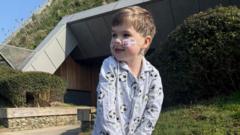
The air inside a hospital room has a specific, synthetic weight. It is filtered, pressurized, and scrubbed of the world until it feels less like oxygen and more like a clinical preservation fluid. For Leo, a boy whose entire five-year history could be measured in surgical scars and the rhythmic hum of a bedside monitor, this was the only air he knew.
To a healthy adult, the front door of a house is a utility. To Leo, it was a border wall.
His heart, a muscle no larger than a plum, had been born with a map that led nowhere. In the world of pediatric cardiology, they call it a congenital defect. In the world of a mother watching her son’s fingernails turn a haunting shade of twilight blue, it is a slow-motion catastrophe. For 1,825 days, Leo’s existence was defined by what he couldn’t touch: the dirt in the garden, the chaotic gust of a passing storm, the simple, invisible bacteria that live on a grocery cart.
He was a prisoner of safety.
The Architecture of a Broken Pump
The human heart is an engineering marvel that manages to move about 2,000 gallons of blood every single day. It does this through a series of four chambers and four valves, a synchronized dance of pressure and release. When Leo was born, that choreography was a mess of missed steps.
Blood that should have been rushing to his lungs to grab oxygen was instead swirling back into chambers it had already left. His body was effectively starving for air while his lungs were wide open. It is a physiological paradox. You can take the deepest breath of your life, but if the pump doesn't deliver the goods to the rest of the machine, you are still suffocating.
This is the "invisible stake" that families of cardiac children live with every second. It isn't just the fear of a sudden stop; it is the constant, grinding erosion of a childhood. While other children were learning to skin their knees on asphalt, Leo was learning the names of anticoagulants.
He lived in a bubble constructed of high-efficiency particulate air (HEPA) filters and hand sanitizer. His parents became amateur epidemiologists, tracking the local flu variants like they were preparing for a literal invasion. They had to. A common cold for a neighbor’s child was a week of sniffles; for Leo, it was a potential three-week stint in the ICU where his heart might finally decide it had done enough.
The Longest Winter
The surgery that changed everything wasn't a single event. It was the culmination of a decade of medical evolution, a procedure that involved stopping Leo’s heart entirely.
There is a moment in the operating theater where a human being is technically neither alive nor dead in the traditional sense. The bypass machine whirs, taking over the duties of the lungs and the heart, while a surgeon works with needles thinner than a human hair to reroute the plumbing of a life.
For the six hours Leo was under, his mother sat in a plastic chair in a waiting room that smelled of burnt coffee and anxiety. This is where the statistics stop being numbers and start being a physical weight in the chest. You don't think about the 92% success rate. You think about the 8% hole in the universe.
When he finally came out, he was a forest of tubes. He looked less like a boy and more like a science experiment gone wrong. But the color was different. That twilight blue was gone, replaced by a flush of pink that looked almost neon against the white hospital sheets.
Recovery is not a linear path. It is two steps forward and a terrifying slide back. There were nights of unexplained fevers and days where his pulse raced like a trapped bird. But slowly, the "safe" numbers on the monitor became the "normal" numbers.
The doctors finally gave the word. The internal plumbing was holding. The pressure was equalized. The heart was, for the first time, singing in tune.
The Sound of a Latched Gate
The day Leo went outside wasn't marked by a parade. There were no cameras from the local news, no ribbons to cut. There was just a heavy oak door and a small hand reaching for a brass knob.
His mother stood behind him, her hands hovering near his shoulders, an instinctive reflex born from five years of guarding a fragile thing. She had spent half a decade telling him "no." No, you can't go to the park. No, you can't play in the rain. No, you can't touch that.
Leo stopped at the threshold.
The sun was hitting the porch at a sharp angle, illuminating the dust motes dancing in the air. To a child who has lived in a sterile environment, the world looks incredibly busy. The grass was moving. A neighbor’s dog was barking three houses down. The wind was carrying the scent of cut cedar and impending rain.
He took a step.
The first thing he noticed wasn't the vastness of the sky, but the temperature of the air on his skin. Indoor air is stagnant; it has no soul. Outside air has a bite. It moves. It has a texture.
He walked onto the grass. He didn't run. He didn't shout. He stood there, his bare feet sinking into the damp earth of early spring.
Think about the sensory overload of that moment. For five years, his world was composed of linoleum, drywall, and cotton blends. Now, he was standing in the middle of a biological riot. Every blade of grass was a new texture. Every gust of wind was a conversation.
The Burden of Being Normal
There is a misconception that once a child survives a major operation, the story is over. "The Boy Who Was Saved."
The truth is more complicated. The "saved" boy now has to learn how to be a "real" boy. Leo didn't know how to play in the dirt because he had been taught that dirt was a vector for infection. He didn't know how to exert himself because he had been taught that a high heart rate was a warning sign of a looming crisis.
Watching him navigate the backyard was like watching a lunar explorer take his first steps on the moon. He was cautious. He kept looking back at the door, checking to see if the safety of the HEPA filters was still there.
But then, he saw a beetle.
It was a small, iridescent thing, crawling over a decayed leaf. Leo knelt. His heart—that reconstructed, reinforced, miraculous pump—did exactly what it was supposed to do. It sped up slightly to accommodate the movement. It pushed oxygenated, crimson blood to his brain and his fingertips.
He didn't turn blue. He didn't gasp.
He reached out and let the insect crawl onto his thumb.
In that moment, the medical bills, the sleepless nights in the ICU, the agonizing debates over surgical risks, and the isolation of the last five years didn't disappear, but they were finally paid in full.
The boy wasn't just surviving anymore. He was participating.
Beyond the Sterile Shield
We often take the "outside" for granted. We complain about the heat, the humidity, or the pollen. We treat the transition from our homes to the world as a chore.
But for a subset of the population, the outside is a hard-won prize. It is a destination that requires a literal restructuring of their anatomy to reach.
Leo’s story isn't just about a medical miracle. It’s a reminder of the sheer, terrifying fragility of the baseline we call "health." We are all just a few millimeters of tissue or a single valve failure away from being trapped behind the glass.
As the sun began to dip below the fence line, Leo didn't want to go back in. He was dirty. His shins were stained green from the grass. He had a small scratch on his elbow from a rogue rosebush branch.
His mother didn't reach for the antiseptic immediately. She didn't panic at the sight of the broken skin. She simply watched him.
A scratch is a sign of a life lived. A bruise is evidence of an adventure.
Leo stood in the middle of the yard, tilted his head back, and took a breath. It was a deep, ragged, beautiful breath that traveled through his brand-new heart and reached every corner of his body.
He was five years old, and for the very first time, he was finally standing in the wind.
The door remained open behind him, but for the first time in his life, he wasn't looking back.