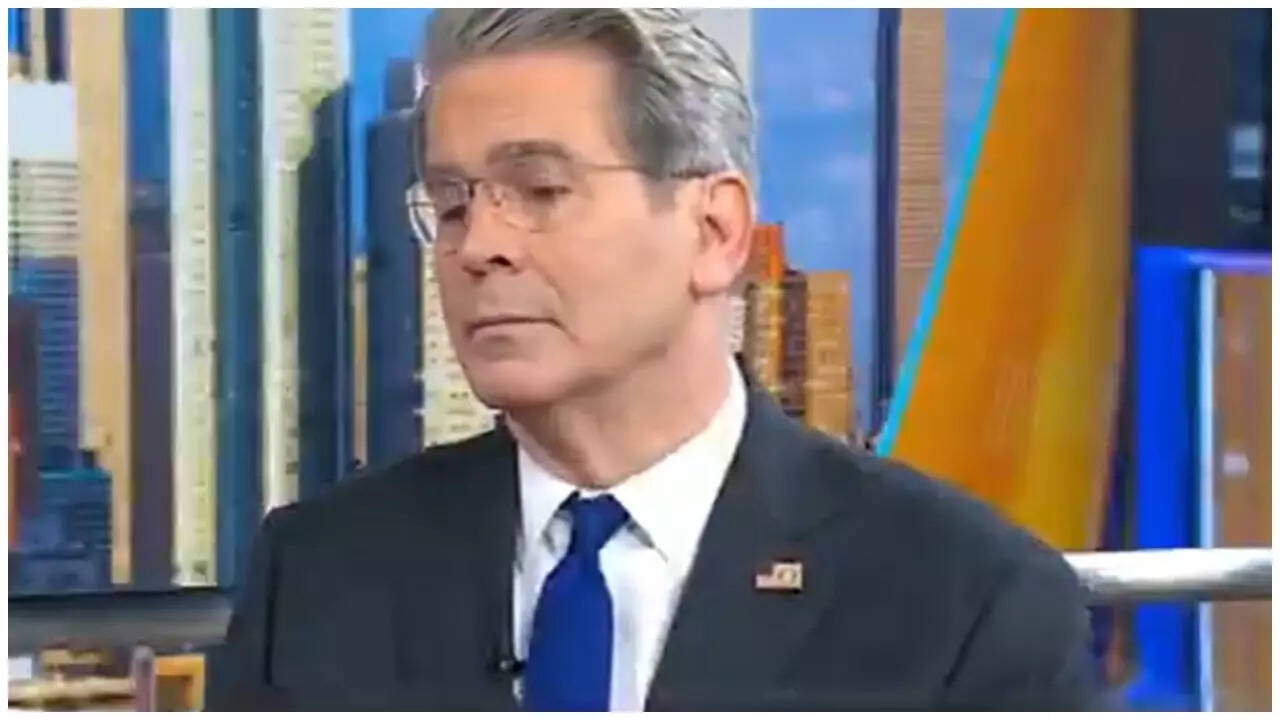
The camera was rolling and the interview was in full swing when the mood shifted instantly. Treasury Secretary Scott Bessent was in the middle of a live broadcast, discussing the finer points of the administration’s economic strategy, when an off-camera signal changed everything. "The president wants you right away," came the word. It wasn't a suggestion. It was a command that overrode a national television appearance.
Bessent didn't hesitate. He stood up, but the departure wasn't exactly smooth. Viewers watching the live feed immediately picked up on a change in his demeanor. His voice sounded thin, almost shaken, as he made his quick apologies to the host and the audience. When a high-ranking cabinet member gets yanked from a live set on behalf of the Commander-in-Chief, people notice. They notice the sweat, the hesitation, and the sudden tension that fills the room. It’s the kind of moment that makes the markets hold their breath.
Why a sudden summons from the president matters for the economy
In Washington, timing is a currency. A scheduled meeting is one thing, but a sudden interruption of a televised press circuit suggests an urgent shift in priorities or a breaking crisis. Scott Bessent isn't just a face on a screen; he's the guy holding the keys to the nation's checkbook. When he's told to drop everything and get to the Oval Office, it triggers a wave of speculation that can ripple through Wall Street in seconds.
The immediate reaction from the public wasn't about the policy he was discussing. It was about the "shaken" tone. In the high-stakes world of global finance, confidence is everything. If the person in charge of that confidence looks rattled, the narrative shifts from "business as usual" to "what’s going wrong?" We’ve seen this play out before during geopolitical flares or sudden bank collapses. A nervous Treasury Secretary is rarely a sign of good news.
The psychology of a live broadcast interruption
There’s a specific kind of pressure that comes with being on live TV. You’re performing. You have a script, or at least a set of talking points, designed to project calm and competence. When that fourth wall is broken by a staffer telling you the president is on the line, the mask slips. Bessent's reaction—that slight tremor in the voice—is a human response to an intense situation.
Some analysts argue we're overthinking it. They say it’s just the stress of a busy schedule. But let’s be real. These officials are trained to handle stress. For that training to fail, even for a second, implies the message he received was significant. It wasn't a "hey, when you’re done here" kind of note. It was a "get here now" moment.
Breaking down the market impact of political instability
Investors hate surprises. They’ll take bad news they can plan for over a mystery any day of the week. The moment the clip of Bessent leaving the set hit social media, the chatter started. Was it a foreign policy blowup? A sudden change in interest rate projections? Or just a president who doesn't care about media windows?
The Treasury Secretary is the primary liaison between the administration and the financial sector. His job is to be the "adult in the room" when things get rocky. If the adult in the room looks like he just saw a ghost, the markets react accordingly. We saw minor fluctuations in bond yields almost immediately following the broadcast. It’s a testament to how closely every twitch of a cabinet member is monitored in 2026.
Comparing this to previous cabinet exits
History has a few examples of these "walk-offs." Usually, they happen during wartime or during the 2008 financial crisis. Seeing it happen now feels jarring because we aren't currently in a declared total economic meltdown. It creates a vacuum of information. And in Washington, a vacuum is always filled with the worst-case scenario.
Compare this to the way previous secretaries handled interruptions. Most would offer a polished, "I've been called away on urgent business," with a smile. Bessent’s lack of polish in that moment is what’s driving the "shaken" narrative. It felt unscripted. In a world of highly curated political PR, something unscripted feels like the truth.
What happens behind the doors of the Oval Office after a summons
When a secretary arrives at the White House after being pulled from a set, they aren't going in for a chat. They’re going in for a briefing or to execute a decision that can't wait thirty minutes for a commercial break. The urgency suggests that whatever was happening required Bessent’s direct input or his signature on a directive immediately.
Think about the logistical chain. For a staffer to interrupt a live TV hit, the Chief of Staff or the President himself had to authorize the disruption. They knew it would look weird. They knew it would cause a stir. They did it anyway. That tells you the internal clock at the White House was moving much faster than the media’s clock.
The role of the Treasury in 2026
The Treasury Department today is dealing with a unique set of headaches. We’re navigating a post-digital currency shift and a heavily fragmented global trade system. Bessent has been the architect of a "stability first" approach. If he's the one being summoned, the issue is likely fiscal. It’s about the debt, the dollar, or a major international trade partner hitting a wall.
Experts like those at the Brookings Institution often point out that the Treasury Secretary is often the last person to know about a political scandal but the first to know about a systemic failure. The "shaken" voice might not be fear. It might be the weight of a massive responsibility hitting all at once.
Public perception and the era of instant replays
We live in a world where a five-second clip of a voice cracking can be looped a million times before the person even gets into their car. This is the reality Bessent faced. By the time he reached the White House, the internet had already decided he was panicked.
This creates a secondary problem for the administration. Now they don't just have to handle the "urgent matter" that caused the summons; they also have to manage the "optics" of a nervous Treasury Secretary. It’s a double-edged sword. Transparency is great, but watching the gears of government grind in real-time can be terrifying for the average taxpayer.
Reality check on the shaken voice reports
It’s worth asking if he was actually "shaken" or just out of breath. He had to stand up, unclip a mic, and move quickly while being stared at by a crew. Anyone’s voice might sound a bit different under those conditions. However, the consensus from those who watch these briefings daily was that this was different. It wasn't physical exertion; it was tone.
Social media sentiment analysis showed a sharp spike in words like "nervous," "emergency," and "crisis" within ten minutes of the clip airing. This is how modern bank runs can start. Not with a bankruptcy filing, but with a vibe shift during a CNBC or Bloomberg hit.
How you should interpret these high level disruptions
Don't panic, but pay attention. When you see this kind of movement, look at the underlying data. Check the 10-year Treasury notes. Look at the currency pairs for the Euro and the Yen. If the pros are scared, they'll show it in the numbers before the White House Press Secretary says a word.
The takeaway here isn't that the sky is falling. The takeaway is that the "everything is fine" facade in Washington is thinner than it looks. You need to keep your own finances flexible. Don't over-leverage yourself based on the calm words of a televised interview, because as Scott Bessent just showed us, those interviews can end in a heartbeat when the real world calls.
Keep a close eye on the official Treasury press releases over the next 48 hours. If they put out a mundane statement about "routine meetings," you know they're trying to cover up the tension. If they announce a major policy shift or an international deal, then you have your answer. Either way, the "shaken" voice is a signal that something real is going on behind the scenes.