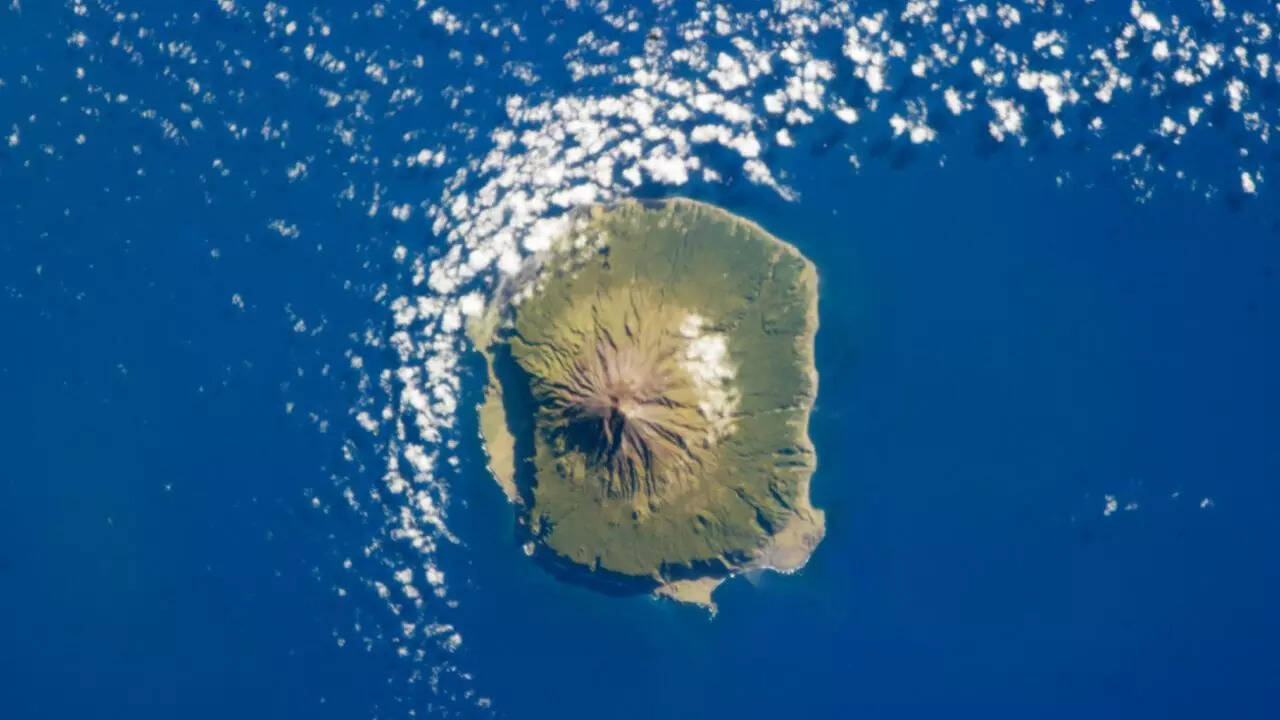
Travel writers love a good "lost world" narrative. They parachute into the South Atlantic—metaphorically, since there’s no airstrip—and start scribbling about "stark isolation" and "pioneer spirit." They look at the 242 residents of Tristan da Cunha and see a romantic relic of a bygone era. They see a community "cut off from civilization."
They are dead wrong.
Tristan da Cunha isn't a refuge from the modern world; it is a hyper-managed, micro-scale corporate state. If you want to see the future of extreme resource management and social engineering, don't look at Silicon Valley's "smart cities." Look at Edinburgh of the Seven Seas. This isn't a story about 242 people surviving against the odds. It’s a story about a closed-loop economy that makes a Soviet collective look like a chaotic flea market.
The Isolation Illusion
The competitor rags want you to believe that distance equals disconnection. That’s a fundamental misunderstanding of how 21st-century power works.
Tristan is roughly 1,500 miles from South Africa and 2,300 miles from South America. In the 1800s, that meant something. Today, it means the island is a captive market. When every single calorie, liter of fuel, and medical supply is funneled through a single shipping line—the Ovenstone Agencies—you aren't "isolated." You are a subsidiary.
The island’s economy is built on a single, fragile pillar: the Tristan Rock Lobster (Jasus tristani). It’s an MSC-certified luxury product sold to high-end diners in the US, Europe, and Japan. This isn't "subsistence." It's a high-stakes global commodity play. The islanders aren't rugged individualists carving a life out of the volcanic rock; they are shareholders and employees in a singular, state-run enterprise.
The "Egalitarian" Trap
Journalists swoon over the fact that all land on Tristan is communally owned. They frame it as a socialist utopia.
"No one is allowed to settle on Tristan from outside... all resident families are equal."
This sounds lovely on a postcard. In practice, it is the ultimate form of protectionism and social stagnation. By banning outside settlement and strictly controlling the population, the island has created a genetic and intellectual bottleneck. When you have only seven surnames—Glass, Green, Hagan, Lavarello, Repetto, Rogers, and Swain—you haven't built a utopia. You've built a gated community where the gate is 1,500 miles of ocean.
Total equality of outcome, enforced by geography, kills the very thing that makes human civilizations thrive: friction. Without the influx of "outsiders" or the ability for individuals to accumulate divergent forms of capital, the island remains frozen. It is a museum of 19th-century British maritime values kept on life support by modern logistics.
The Real Cost of "Remote" Survival
Let’s talk about the math of "surviving." The competitor article mentions the lack of an airport as if it’s a charming quirk. It’s actually a massive logistical failure that the British Overseas Territory office masks with "heritage" branding.
Consider the healthcare reality:
- The Hospital: Camogli Hospital is modern for its size, but it cannot handle major surgery.
- The Evacuation: If you have a burst appendix and the ship isn't in port, you wait. You wait for a fishing vessel to divert. You wait for a six-day trek to Cape Town across the roughest seas on the planet.
- The Subsidy: The UK government pours millions into maintaining this "remote" outpost.
We aren't watching a community survive "cut off" from civilization. We are watching a community being subsidized by it to maintain a geopolitical footprint in the South Atlantic. If the lobster market crashed tomorrow or the UK stopped the shipping subsidies, "tradition" wouldn't save them.
The False Narrative of Self-Sufficiency
The most irritating claim in these travel pieces is that Tristanians are "largely self-sufficient."
They grow potatoes. Great. They have some cattle. Wonderful.
But they don't manufacture the tractors. They don't refine the diesel that runs the generators for the town's electricity. They don't produce the antibiotics in the clinic or the fiber-optic cables that provide their (admittedly slow) internet.
True self-sufficiency is a myth in the globalized era. By pretending Tristan is an example of it, we ignore the reality: these 242 people are more dependent on global supply chains than someone living in a London flat. If a Londoner’s grocery store closes, they walk to another. If the MV SA Agulhas II misses its window, the island runs out of fresh fruit, spare parts, and hope.
Why You Don’t Actually Want to Go There
The "People Also Ask" section of the internet is filled with queries about how to move to Tristan. "Can I buy a house there?" "Can I get a job?"
The answer is a blunt no. And you wouldn't want to anyway.
The romanticism of the "simple life" ignores the psychological weight of a 242-person social circle. Imagine every mistake you've ever made being known by every single person in your country. Imagine never meeting a stranger. The anonymity of the city is a gift that Tristanians can never afford.
This isn't a community; it's a family dinner that has lasted 200 years.
The High-Value Truth
If you want to understand Tristan da Cunha, stop looking at it as a travel destination. Start looking at it as a stress test for human habitation.
It is a data point for how humans behave in a closed, resource-constrained environment. It’s more similar to a hypothetical Martian colony than it is to a village in Cornwall.
- Strict Resource Rationing: You can't just buy more cattle; the grazing land is strictly divided.
- Mandatory Labor: Everyone has a role. You aren't just a plumber; you are the guy who fixes the pipes for the entire nation.
- Social Policing: Conflict isn't resolved by moving away. You have to live with your enemy until one of you dies.
Stop Fixating on the Map
We need to stop praising places just because they are hard to reach. Being hard to reach is a logistical hurdle, not a moral virtue.
The competitor's piece wants you to feel a sense of awe at their "survival." I want you to feel a sense of clarity about their precariousness. Tristan da Cunha is a miracle of British stubbornness and corporate lobster logistics. It is a fascinating, fragile, and deeply weird experiment in human geography.
But it is not an escape. There is no such thing as an escape anymore. The satellite dishes on the roofs of Edinburgh of the Seven Seas are proof of that. The lobster on a plate in Tokyo is proof of that.
The world isn't getting bigger. The "remote" corners are just the most expensive parts of the global machine to keep running.
Next time you read about the "world's most remote island," don't think about the distance from the mainland. Think about the length of the leash.
Stop romanticizing the cage just because it's in the middle of the ocean.