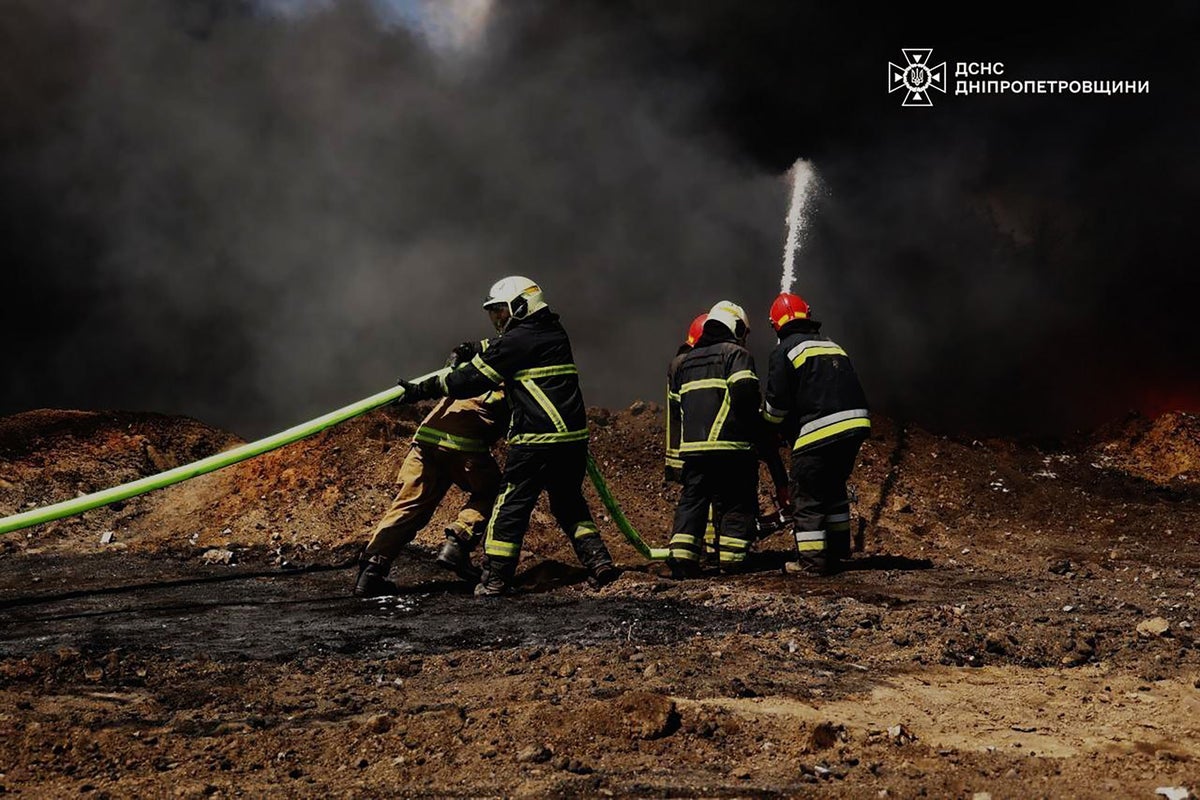
Donald Trump says the end of the war in Ukraine is "getting very close." He told reporters this on Tuesday while heading to Beijing, sounding confident that a deal is right around the corner. But while the words "peace" and "ceasefire" are floating around Washington and Moscow, the sky over Ukraine tells a much darker story. On Wednesday, May 13, 2026, Russia didn't just ignore the talk of peace—it buried it under 800 drones.
This wasn't your typical nighttime raid. This was a massive, sustained daytime barrage that lasted for hours, stretching the air defense systems of 20 different regions to their absolute breaking point. While politicians are busy predicting the end of the conflict, the people on the ground in Kyiv, Lviv, and Odesa are still running for subways and basements as the sirens wail in the middle of the afternoon. Honestly, it’s hard to reconcile "peace is close" with the reality of six dead civilians and dozens more wounded, including children.
The disconnect between rhetoric and reality
We've seen this play before. On one hand, you've got Trump and Putin both suggesting—without much evidence—that things are winding down. Trump’s belief that a deal is imminent seems to be based on his personal brand of "shuttle diplomacy." Putin, too, gave a speech last weekend hinting that the invasion might be "coming to an end." But look at the fine print.
The Kremlin's terms haven't budged an inch. Dmitry Peskov, Putin's spokesman, made it clear today that Russia still expects Ukraine to hand over four major regions—Donetsk, Luhansk, Kherson, and Zaporizhzhia—before they even think about a ceasefire. That’s not a negotiation; it’s a demand for surrender. President Volodymyr Zelenskyy isn't having it. He's vowing to keep the pressure on, using his own long-range capabilities to hit Russian oil terminals and military sites.
So, why the massive drone attack now? It’s likely a tactical move to "spoil the atmosphere." By launching such a heavy, visible attack while Trump is visiting China and talking about peace, Moscow is signaling that it still controls the pace of this war. They’re trying to overload the air defenses and cause as much "grief and pain" as possible to force a better seat at the table.
Breaking down the daytime drone tactics
Usually, these attacks happen at night to hide the drones from visual detection. Switching to a daytime strategy is a deliberate attempt to cause psychological terror and disrupt the daily life of a country trying to function.
- Saturation strategy: Firing 800 drones isn't about precision; it's about numbers. If you send enough targets, some will get through because the defense runs out of interceptors.
- Daytime chaos: Strikes at 11:00 a.m. hit people at work, in schools, and on the move. In the Rivne region, three people were killed when a drone hit civilian infrastructure during the morning rush.
- Infrastructure focus: This wasn't just about terror. Russia targeted gas pipelines in Dnipropetrovsk and railway infrastructure in Zdolbuniv, damaging locomotives and depots.
Zelenskyy’s warning is clear: these drone waves are often just the setup. Intelligence suggests that Russia uses these swarms to map out where the defense batteries are located, only to follow up with cruise and ballistic missiles once the defenders are exhausted and exposed.
Can a ceasefire actually hold
Trump recently tried to mediate a three-day ceasefire for the Victory Day holiday. It didn't work. Zelenskyy pointed out that Russian forces were still conducting assault operations in key sectors, barely even pretending to comply with the pause. It shows that words spoken in a press briefing don't always translate to a commander's order on the front line.
The Institute for the Study of War (ISW) notes that while Russia is losing massive amounts of manpower for tiny gains, they aren't stopping. Ukraine, meanwhile, has managed to reclaim some tactical initiative in certain areas. This isn't the behavior of two sides ready to lay down their arms. It’s the behavior of two sides trying to land one last knockout blow before they're forced to talk.
What this means for you
If you’re watching this from the outside, don't get caught up in the headlines about "deals" and "ends" just yet. The war is entering its fifth year, and the intensity is actually ramping up.
- Watch the terminology: When leaders say "peace is close," check what they’re asking the other side to give up. If the demands are still total land cessions, the fighting won't stop.
- Monitor the equipment: The shift to massive drone swarms means the war has become a battle of industrial production. Whoever can build—and shoot down—drones faster has the upper hand.
- Stay skeptical of timelines: Peace deals in this region have a history of being "close" for months before collapsing.
The reality is that as long as 800 drones are flying over Ukrainian cities in broad daylight, the "close" end of the war is still miles away. Expect more volatility in the coming weeks as both sides try to use the talk of peace as a weapon on the battlefield.
Russia launches 800 drones in daytime attack
This video provides a direct look at the scale of the drone barrage and the aftermath of the strikes on Ukrainian infrastructure.