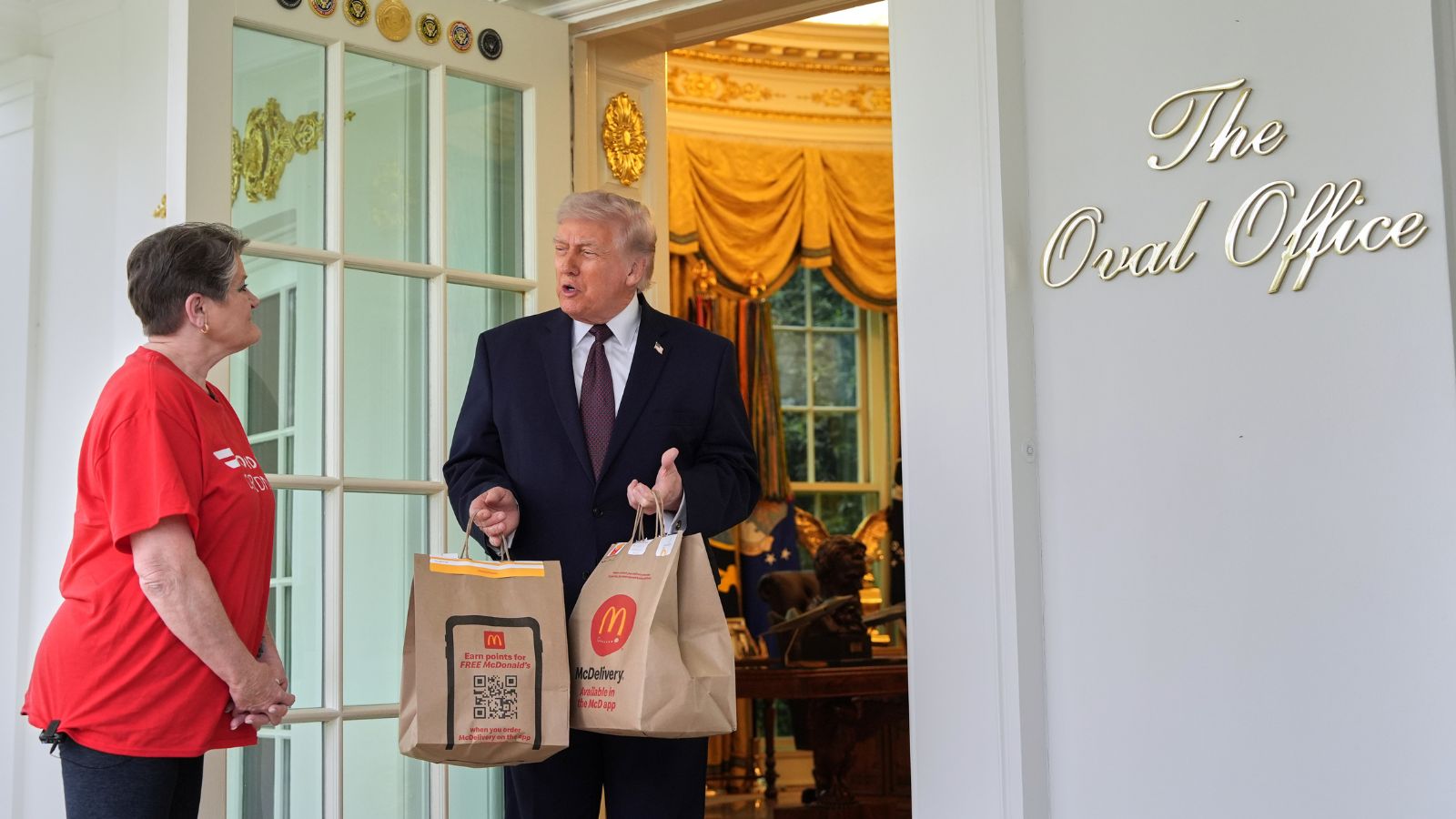
Donald Trump just turned a routine McDonald’s run into a national policy stage. On Monday, April 13, 2026, the President welcomed a delivery driver—affectionately known as the "DoorDash Grandma"—right into the Oval Office. He didn’t just take his bags of burgers and fries; he handed her a crisp $100 bill. While the cameras caught every second of the smile on Sharon Simmons’ face, this wasn't just about a generous tip. It was a calculated, high-stakes move to shout about his "No Tax on Tips" law right before Tax Day.
You’ve seen the clips by now. Trump pops out of the door, looks at the press, and asks with a wink, "This doesn't look staged, does it?" Of course it was. Getting a delivery driver past Secret Service and into the most famous office in the world doesn't happen by accident. But beneath the theater, there’s a real shift in how millions of service workers are looking at their paychecks this year.
How the No Tax on Tips Law Actually Works
If you’re a bartender, a hair stylist, or a delivery driver like Simmons, you’ve probably heard the hype. But the math is what counts. Under the "One Big Beautiful Bill" (OBBB) signed back in July 2025, the rules for tipped income changed. It's not a total free-for-all, but it’s a massive break for the average worker.
Basically, you can now deduct up to $25,000 in tipped income from your federal taxes. This applies to "voluntary" tips—the ones people choose to give you—not mandatory service charges. If you’re a server in the 22% tax bracket making $20,000 in tips, you’re looking at roughly $4,400 staying in your pocket instead of going to the IRS. For someone living paycheck to paycheck, that isn't just "extra" money. It’s rent. It's a car payment.
There are catches, though. The benefit starts to disappear if you make too much money elsewhere. If you’re a single filer and your total adjusted gross income hits $150,000, the deduction begins to phase out. By the time you’re making $400,000, it’s gone. It’s designed for the "DoorDash Grandmas" of the world, not high-end consultants trying to rebrand their fees as "gratuities."
The Gig Economy Gets a Seat at the Table
By choosing a DoorDash driver for this Oval Office photo op, Trump sent a clear message to the gig economy. For years, drivers for apps like Uber, Lyft, and DoorDash have felt like they were in a legal gray area—not quite employees, but not quite traditional small business owners either.
The IRS has now officially cleared nearly 70 types of jobs for this deduction. We’re talking about:
- Food and Beverage: Bartenders, baristas, and servers.
- Transportation: Rideshare and delivery drivers.
- Personal Services: Tutors, childcare providers, and salon workers.
- Hospitality: Porters and housekeepers.
Honestly, the inclusion of gig workers is a huge deal. It validates their work as a "customary tipped occupation." For years, these workers struggled with the tax burden of being independent contractors. Now, they have a dedicated tax break that acknowledges the reality of how they earn their living.
Why Some People Are Still Skeptical
Don't think everyone is cheering. Critics from groups like the Economic Policy Institute argue that this policy could have a weird side effect. If tips aren't taxed, will employers stop raising base wages? There's a fear that businesses will tell workers, "Hey, we don't need to give you a raise because the government is already giving you a tax break on your tips."
There's also the "Denny’s vs. The Steakhouse" problem. A server at a high-end restaurant pulling in $60,000 in tips gets a much bigger tax break than a waitress at a local diner who only makes $5,000 in tips. Since the deduction is more valuable the higher your tax bracket is, the system inherently rewards those who are already doing better.
Then there’s the sheer confusion of Tax Day. This is the first year people are filing under these rules. The IRS reports that over 3.5 million people have already claimed the deduction, with an average cut of about $1,300. That’s a lot of data for one season, and the "staged" McDonald’s delivery was clearly meant to remind the remaining millions to grab their slice before the April 15 deadline.
Making the Most of the Tip Deduction
If you’re working a tipped job, don't just leave money on the table because the paperwork looks intimidating. Here’s the reality of how you handle this right now.
First, check your eligibility. If your job "regularly and customarily" received tips before 2025, you’re likely in the clear. You don't even have to itemize your deductions to get this; you can take the standard deduction and still claim the tip exemption.
Second, keep your records straight. The IRS is looking for tips reported on W-2s or 1099s. If you’re pocketing cash and not reporting it, you can’t exactly claim a deduction on it. The law actually gives you a reason to be honest about your earnings because the tax hit is gone anyway.
Lastly, look at your withholding for the rest of 2026. Starting this year, many employers are supposed to adjust their withholding tables so you see the tax break in every paycheck, rather than waiting for a big refund next spring. If your check looks the same as it did in 2024, talk to your payroll person.
Trump’s $100 tip was a show. It was flashy, it was loud, and it involved a Big Mac. But for the millions of people who actually live on those tips, the policy behind the theater is the real story. Get your records in order, check the IRS list of eligible occupations, and make sure you aren't paying the government money that belongs in your own pocket.