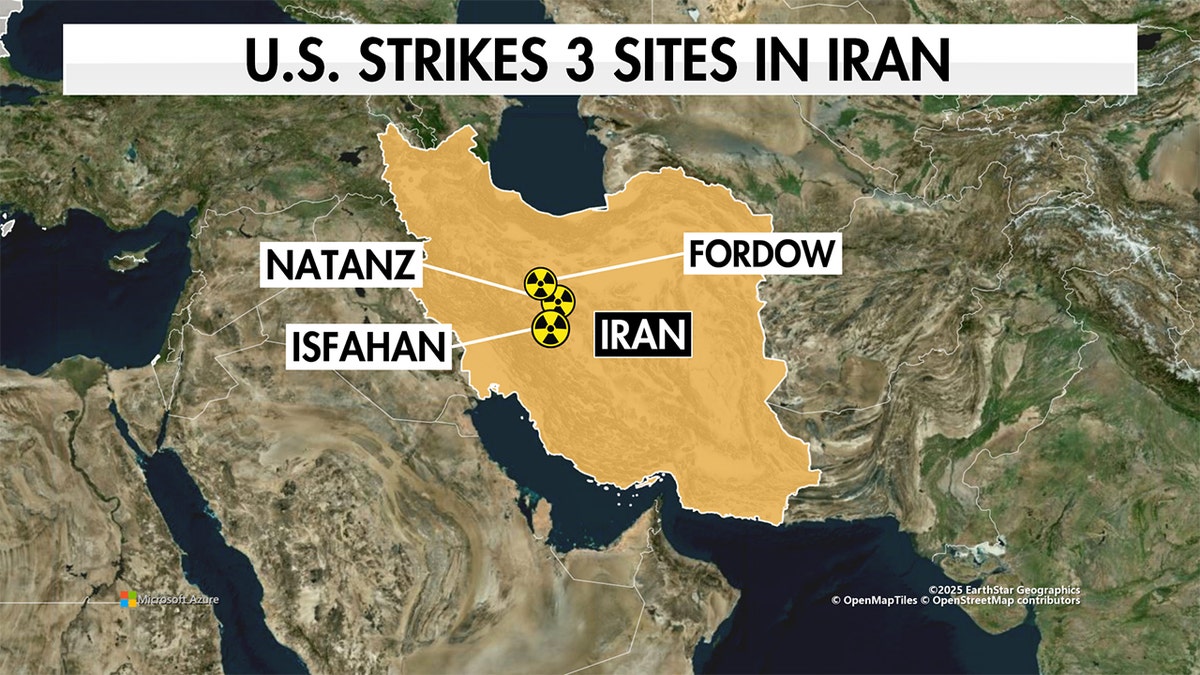
The headlines are predictable. The "security experts" on cable news are reading from a twenty-year-old script. They tell you that kinetic action against Tehran is a desperate scramble to reset the nuclear clock or a surgical strike to dismantle missile silos. They are wrong. They are looking at a 20th-century geopolitical map while the actual conflict has migrated into the digital and industrial bedrock of the next decade.
To suggest that a few sorties of F-35s or a barrage of Tomahawks can "thwart" a nuclear program in 2026 is a fundamental misunderstanding of how modern proliferation works. You don't "blow up" a nuclear program anymore. Not really. You can break the centrifuges, sure. You can collapse a few tunnels at Fordow. But you cannot bomb the physics out of a scientist’s brain, and you cannot erase the localized supply chains that have been hardened by forty years of sanctions.
Donald Trump isn't striking Iran to stop a bomb that they’ve already figured out how to build. He’s striking Iran to break the spine of a middle-market power that has figured out how to use cheap, asymmetric technology to make trillion-dollar carrier groups look like floating targets.
The Nuclear Red Herring
The "nuclear threat" is the most effective marketing tool in the history of the military-industrial complex. It provides a clean, moral binary for the public. It’s easy to sell. But if you’ve spent any time in the defense intelligence space, you know that the "dash to a breakout" is a managed constant.
Iran has had the technical capability to reach 90% enrichment for years. The delay isn't due to a lack of hardware; it’s a calculated diplomatic lever. By framing these strikes as a "nuclear deterrent," the administration is using the only language the median voter understands to justify an operation that is actually about something much more existential: The end of Western hardware dominance.
When you look at the target list, the "nuclear" sites are often the decoys. The real targets are the manufacturing hubs for the Shahed-series drones and the solid-fuel mixing plants. Why? Because a nuclear weapon is a "never-use" tool. A drone that costs $20,000 and can sink a $2 billion destroyer is an "every-day-use" tool. That is the disruption the Pentagon is actually terrified of.
The Myth of the Surgical Strike
We love the phrase "surgical strike." It implies precision. It implies we can reach into a sovereign nation, pluck out the "bad" parts, and leave the rest intact.
I have seen the aftermath of these "surgical" operations. There is no such thing as a clean cut in a country with a decentralized command structure. When you strike a missile facility in Isfahan, you aren't just hitting steel. You are triggering a cascading failure of regional stability that we are nowhere near prepared to manage.
The competitor’s narrative suggests that these strikes "reset" the board. In reality, they accelerate the very thing they claim to stop.
- Indigenous Redundancy: Every time a foreign power bombs a facility, the IRGC (Islamic Revolutionary Guard Corps) moves the next iteration deeper underground or scatters it into civilian infrastructure.
- The Martyrdom Subsidy: Kinetic strikes are the best recruitment tool the hardliners in Tehran have. They validate the regime’s "resistance" narrative, silencing the internal opposition that was actually doing more to destabilize the government than any Maverick missile ever could.
- The Data Loop: Iran uses these strikes as a live-fire laboratory. They watch our electronic warfare signatures. They analyze our loitering munitions. Every "successful" US strike provides Iran with the data they need to harden their next generation of defenses.
The Asymmetric Trap
The lazy consensus says that the US is the "heavyweight" and Iran is the "lightweight." This is a dangerous categorical error. We are playing two different games.
The United States is playing a game of Power Projection. We want to maintain the status quo, keep the shipping lanes open, and protect the petrodollar. Iran is playing a game of Denial. They don't need to win a war; they just need to make it too expensive for us to stay.
Imagine a scenario where a $50 million F-35 is forced to return to base because a swarm of $500 hobbyist drones with 3D-printed explosive housings has compromised the flight deck of its carrier. That isn't a "thought experiment"—it’s the current reality of the Persian Gulf.
By striking now, Trump is attempting to decapitate this asymmetric capability before it scales. But here is the truth nobody admits: You cannot bomb a supply chain that lives on Telegram and in small-scale workshops.
The Intelligence Failure of "Maximum Pressure"
We keep hearing that "Maximum Pressure" works because the Iranian Rial is in the gutter. Economics 101 says that a collapsing currency leads to regime change. But that ignores the "Grey Market" expertise the IRGC has cultivated.
I’ve sat in rooms with analysts who were baffled that Iran could still produce sophisticated fiber-optics and guidance systems while under total embargo. The answer is simple: The West no longer has a monopoly on high-end manufacturing. Between Chinese dual-use technology and the Russian "defense bridge," the idea that we can isolate Iran into submission is a fantasy from the 1990s. These strikes aren't a sign of strength; they are an admission that our sanctions have failed to stop the flow of technology. When you can't stop the signal, you try to break the antenna.
The Logistics of Escalation
Let’s talk about the math that the "pro-strike" crowd ignores.
- Intercept Ratio: It costs the US roughly $2 million to fire a standard interceptor missile to down a drone that costs less than a used Honda Civic.
- The Strait of Hormuz: 20% of the world’s oil passes through a chokepoint that Iran can mine with "dumb" tech in less than 24 hours.
- The Cyber Backlash: Iran’s cyber capabilities are not top-tier, but they are "good enough" to cause chaos in provincial power grids or water treatment plants in the US interior.
When Trump says he ordered these strikes to "thwart" the program, he is failing to mention the inevitable counter-cost. This isn't a one-way street. It’s a trade. We trade a few Iranian warehouses for a permanent increase in global insurance premiums and a heightened risk of domestic infrastructure "glitches."
Stop Asking if the Strikes Worked
The media asks: "Did we hit the targets?"
The military asks: "Was there collateral damage?"
The only question that matters is: "Did this make the US safer?"
If the goal is to stop a nuclear-armed Iran, the answer is a resounding no. These strikes drive the program further into the shadows where international inspectors (what's left of them) can't see a thing. If the goal was to "restore deterrence," you have to ask yourself why every strike in the last decade has only resulted in more advanced missile tests and more aggressive maritime harassment.
The status quo is a feedback loop of failure. We bomb because we don't know what else to do with a $800 billion defense budget. We call it "strategy" because "desperate reaction" doesn't poll well.
The reality is that we are witnessing the death throes of a specific kind of American hegemony—the kind that believes kinetic force can solve an information-age problem. Iran has realized that they don't need a nuke to break the US; they just need to keep us engaged in a high-cost, low-reward cycle of "deterrence" until we eventually go bankrupt or go home.
Stop looking at the explosions. Look at the ledger. We are spending our future to delay an inevitable shift in regional power, and no amount of "ordered strikes" will change the fact that the tools of war have been democratized beyond our control.
Get comfortable with the chaos. The era of the "surgical" solution is over.