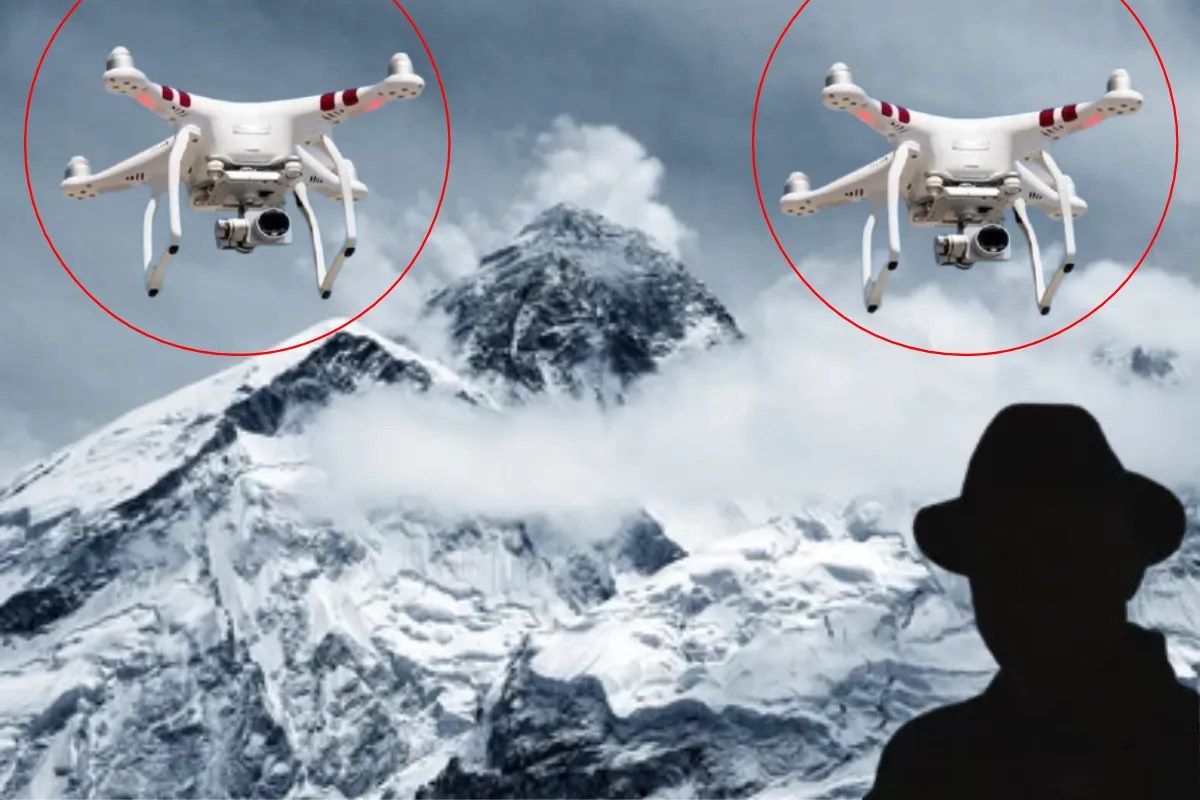
Drones usually rely on radio waves to talk to their pilots. It's a system we've accepted for decades, but it's fundamentally broken in a modern war zone. If you can see a signal, you can jam it. If you can jam it, the drone falls out of the sky or flies aimlessly into a tree. That's why the sudden rise of fibre optic drones isn't just a niche hardware update. It’s a complete pivot in how we think about unmanned flight.
These drones don't use Wi-Fi, GPS, or radio frequencies. Instead, they trail a thin, hair-like strand of glass behind them as they fly. Think of it like a high-tech fishing reel. You’re literally physically connected to the aircraft. While that might sound clunky or "old school," it makes the drone completely invisible to electronic warfare (EW) systems that are currently dominating battlefields in Ukraine and elsewhere.
Why the physical link beats the invisible signal
Radio frequency (RF) drones are loud. Not just with their motors, but with their electromagnetic footprint. An EW technician with the right gear can "see" a standard drone the second the pilot powers it up. They can trace that signal back to the pilot's location or just flood the area with noise to sever the connection.
Fibre optic drones don't care about your jammer. You could park a high-powered electronic frequency disruptor right next to the pilot, and the drone would keep flying. The data—the video feed and the control commands—travels through pulses of light inside the glass cable. Since the cable is non-conductive and doesn't emit a signal, there’s nothing for an enemy to intercept or block.
It’s the ultimate "phantom." It doesn't show up on a spectrum analyzer. It doesn't drop connection when it flies behind a hill or inside a concrete building. For a pilot, it feels like a hardwired connection because it is one. You get 4K video with zero latency. No lag. No digital artifacts. No "Signal Low" warnings.
The engineering behind the spool
You’re probably wondering how a drone can drag miles of cable without getting snagged or weighed down. The secret lies in the spooling mechanism. On a standard fibre optic drone, the spool is mounted on the drone itself, not the ground station. As the drone flies, the cable just falls away, resting gently on the ground or over obstacles.
The cable is incredibly light. We’re talking about a strand that can be 10 kilometers long but weighs less than a couple of kilograms. It’s thinner than a fishing line but strong enough to withstand the tension of a drone moving at 100 kilometers per hour.
Overcoming the snag factor
I've seen people claim these drones are useless in forests or urban areas because the wire will catch on a branch. That's a misunderstanding of the physics. Because the wire is being "poured" out of the back of the drone rather than pulled from the start point, there’s almost zero tension on the line. It drapes over branches. It settles on rooftops. Unless someone physically walks up and snips it with scissors, the connection stays live.
The brutal reality of latency and bandwidth
In the world of FPV (First Person View) racing or combat, latency is the enemy. Even the best digital radio systems have a few milliseconds of delay. In a high-speed chase or a tight maneuver through a window, that delay results in a crash.
Fibre optics move data at the speed of light. The "feeling" of flying a wired drone is vastly different from a wireless one. It’s instantaneous. Furthermore, the bandwidth is massive. While a wireless drone has to compress its video feed to fit through a narrow radio band, a fibre drone can send raw, uncompressed data. This allows for computer vision and AI processing to happen at the ground station where there's more power, rather than on the drone's limited onboard processor.
Where this technology actually fails
It isn't all perfect. I'm not going to tell you that every drone will be wired by 2027. There are massive trade-offs.
- One-way trips: Usually, these are used for one-way missions. If the drone flies out 5 kilometers and then tries to fly back, it risks tangling in its own discarded line. It’s technically possible to fly back, but it's a nightmare for the pilot.
- Limited range: You’re limited by the physical length of the spool. You can't just "go a bit further" if you see something interesting. When you hit the end of the line, that's it.
- Payload weight: Even though the wire is light, the spooling mechanism takes up space and weight that could otherwise be used for a larger battery or a bigger camera.
- Cost: Fibre optic cable isn't cheap, especially the high-tensile stuff required for high-speed flight. You’re essentially throwing away several hundred dollars of cable every time you fly.
Tactical shifts in modern conflict
We're seeing a massive surge in this tech specifically because electronic warfare has become so effective. In some sectors of modern fronts, the average lifespan of a standard wireless drone is less than a day. Jammers like the Russian Pole-21 or various portable "drone guns" have made the skies hostile for anything using 2.4GHz or 5.8GHz.
Fibre optic drones are the response to that environment. They are being used for surgical strikes on high-value targets where you cannot afford a signal drop. If you have to fly into a reinforced bunker or a basement, a radio signal will die the moment you go underground. The wire doesn't.
The psychological impact
There’s a certain level of dread associated with a drone you can't jam. Usually, soldiers feel somewhat protected if they have a localized jammer active. Seeing a fibre optic drone fly right through a jamming bubble creates a "nowhere to hide" scenario. It’s a technical evolution that forces the other side to move back toward kinetic defenses—basically trying to shoot it down with a shotgun or a net—because their expensive electronic shields are now useless.
The DIY kits and the future of the tech
Interestingly, this isn't just for big defense contractors anymore. We're seeing "fibre conversion kits" popping up in the hobbyist and commercial sectors. Small startups are 3D-printing spools that can be bolted onto a standard 7-inch FPV frame.
The setups usually involve a specialized optical-to-electrical converter on both ends. You plug your goggles into the ground station, the ground station converts your stick movements into light pulses, and the drone converts those pulses back into motor commands. It’s surprisingly simple once you solve the mechanical issue of the spool.
Assessing the shift
If you’re looking to get into this or understand where the industry is going, look at the cable specs. The current gold standard is G.657.A2 "bend-insensitive" fibre. Regular fibre snaps if you bend it too tightly. This specific type can be wrapped around a pencil and still transmit data. That's the tech making this possible.
Don't expect your hobby drone to have a wire anytime soon unless you're flying in a heavy interference zone. For most people, the freedom of wireless is worth the risk of interference. But for industrial inspections inside steel tanks or high-stakes military reconnaissance, the wire is becoming the only way to fly.
If you're building or buying, focus on the spool's exit guide. If the guide isn't perfectly smooth, the friction at high speeds will melt the cable's jacket and cause a snap. It’s a mechanical problem, not an electronic one.
The "phantom" is real, it’s wired, and it’s effectively unstoppable by any means other than a physical hit. Expect to see more glass in the sky.