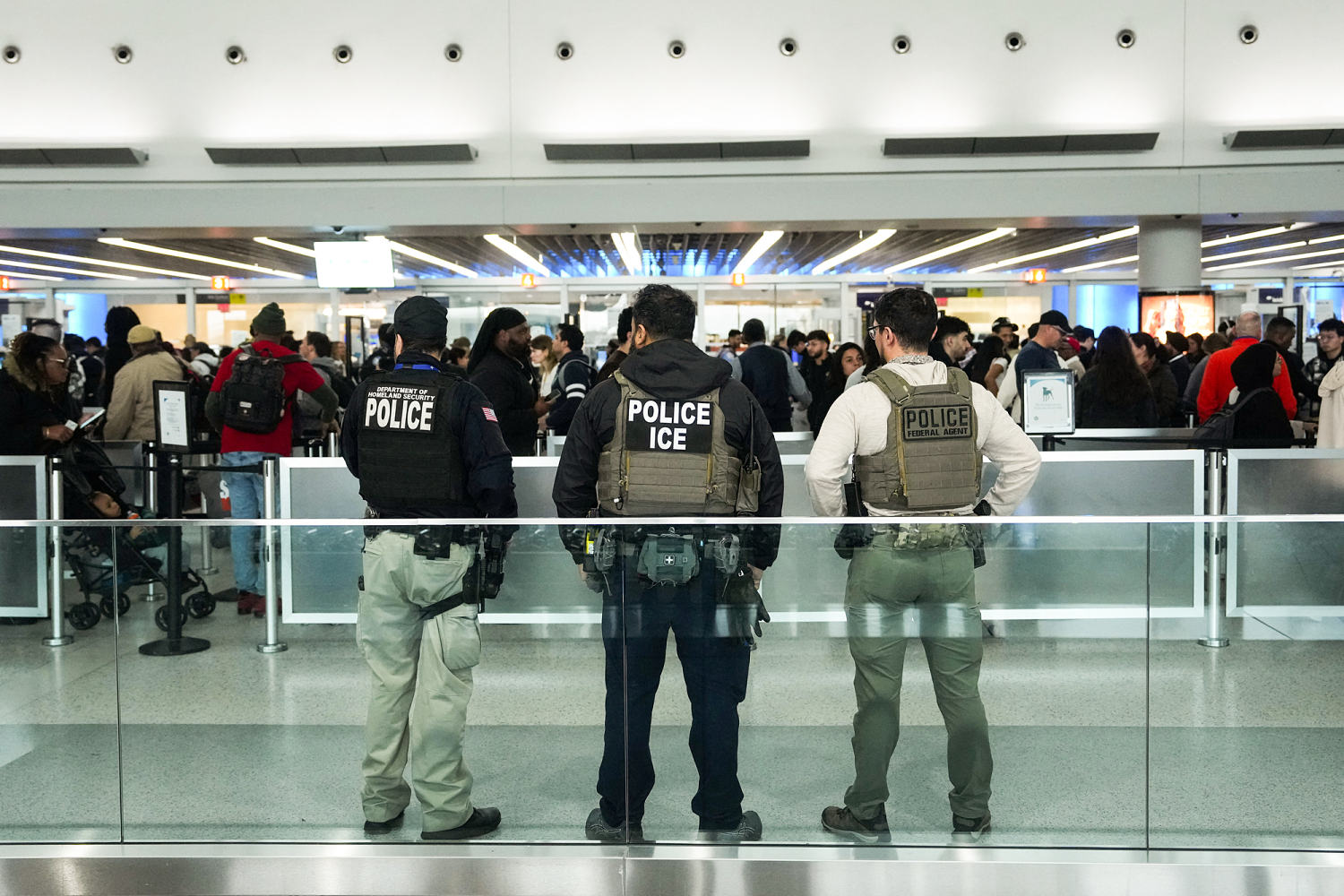
The federal government is currently conducting a high-stakes experiment in kinetic theater at your local airport. Since the Department of Homeland Security (DHS) funding expired on January 31, 2026, the Transportation Security Administration has been bleeding personnel, leaving travelers to endure three-hour lines that snake into subway stations and parking garages. The White House response arrived Monday morning in the form of armed U.S. Immigration and Customs Enforcement (ICE) agents standing at security checkpoints in Atlanta, Newark, and Houston.
This is not a simple staffing fix. It is a fundamental shift in how the American government views the domestic traveler. By deploying Enforcement and Removal Operations (ERO) personnel—officers trained specifically for the detention and deportation of non-citizens—to perform the administrative functions of airport screeners, the administration has turned the transit hub into a jurisdictional gray zone. While the White House characterizes these agents as a "force multiplier" intended to "relieve pressure," the reality is a volatile mix of untrained personnel, unpaid federal workers, and an increasingly desperate flying public.
The Paycheck Gap at the Periphery
To understand why an ICE agent is now checking your boarding pass, you have to look at the books. The current partial shutdown is surgically targeted at DHS, but it has not affected every agency equally. Thanks to the 2025 budget reconciliation bill—widely known as the "Big Beautiful Bill"—ICE and Customs and Border Protection (CBP) are currently flush with cash that is legally insulated from the standard appropriations process.
ICE agents are getting paid. TSA officers are not.
As of late March, more than 50,000 TSA workers have gone nearly two months without a paycheck. The attrition is catastrophic. Internal DHS data indicates that over 400 TSA employees have resigned since the February 14th mark, and daily call-out rates are hovering near 10% at major hubs like Hartsfield-Jackson and JFK. When a TSA officer stops showing up because they can no longer afford the gas to drive to work, the "essential" designation becomes a hollow legalism.
The administration’s "workaround" is to take paid immigration officers and drop them into a landscape they do not understand. Border czar Tom Homan has been candid about the limitations, noting that ICE agents will not be operating X-ray machines because they lack the specific technical certification. Instead, they are being used for "static security"—guarding exit lanes and managing crowds. This creates a bizarre hierarchy at the checkpoint where the person managing the line makes a full salary while the person actually performing the safety-critical screening is technically working for free.
Mission Creep and the Somali Target
If this were merely a logistics play, the agents might be wearing civilian vests or "DHS Support" identifiers. They are not. President Trump has explicitly ordered ICE personnel to remain in uniform and, as of Monday, instructed them to remove the face masks that had been a point of contention with congressional Democrats.
The investigative reality is that this deployment serves a dual purpose. While Homan speaks of "moving the lines," the President’s social media activity has highlighted a much more aggressive intent. Over the weekend, the administration signaled that ICE agents at airports would focus on identifying and arresting undocumented immigrants, specifically mentioning those from Somalia.
This turns the airport security line into an active enforcement dragnet. Under normal operations, TSA is a regulatory agency focused on prohibited items—guns, bombs, and oversized liquids. By injecting ICE into the physical space of the checkpoint, the administration is effectively merging administrative travel screening with criminal and administrative immigration enforcement.
The Problem with 287g Logic
The administration appears to be utilizing a modified version of the 287(g) program logic. Traditionally, this program allows the federal government to deputize local police to perform immigration functions. Here, the logic is inverted: immigration agents are being deputized to perform domestic security functions.
The legal friction is significant.
- Training Gaps: TSA officers undergo weeks of specialized training at the Federal Law Enforcement Training Center (FLETC) focused on behavioral detection and technical screening. ICE agents are trained in tactical entry, detention management, and fugitive operations.
- Liability: If an ICE agent, acting as a "line manager," uses force against a passenger for a non-immigration matter, the legal framework for their protection is murky. They are operating outside their primary statutory mandate.
- Public Trust: For travelers from immigrant communities, the airport has shifted from a place of transit to a place of high-risk exposure.
The Chaos at the Gate
The scene on the ground is less "force multiplier" and more "managed chaos." At JFK, TSA supervisors have been forced to use megaphones to prevent crowds from surging through checkpoints. The presence of armed ICE agents near these flashpoints has, predictably, increased the tension.
Everett Kelley, president of the American Federation of Government Employees, has called the move "cheap theater." His argument is grounded in the logistical reality that you cannot simply replace a trained screener with a guy holding a gun. If an ICE agent is guarding an exit, yes, it frees up one TSA officer to man a lane. But that TSA officer is exhausted, demoralized, and financially insolvent.
The "fix" isn't more uniforms; it's the restoration of the payroll. However, the political deadlock in Washington suggests that the shutdown is being used as leverage to force a permanent change in how immigration agencies operate. Democrats are demanding a "code of conduct" and the removal of masks for ICE agents as a condition for funding. The President has responded by putting those very agents in the most visible public positions possible.
The Future of the Checkpoint
What we are witnessing is the erosion of the boundary between travel facilitation and border enforcement. If this model holds, the "temporary" presence of ICE at domestic gates could become a permanent fixture of the American travel experience.
For the average traveler, the takeaway is concrete and uncomfortable. You are no longer just being screened for safety; you are being processed by an agency whose primary mission is removal. The lines will likely remain long, not because there aren't enough people in uniforms, but because the people in the uniforms are busy playing a part in a larger political drama.
Before your next flight, check the "wait time" apps, but also recognize that the person checking your ID might be looking for more than just a matching name. They are looking for a reason to justify their presence in a terminal where they were never meant to be.
Check your flight status four hours early, and keep your documentation in hand. The airport is now a front line.