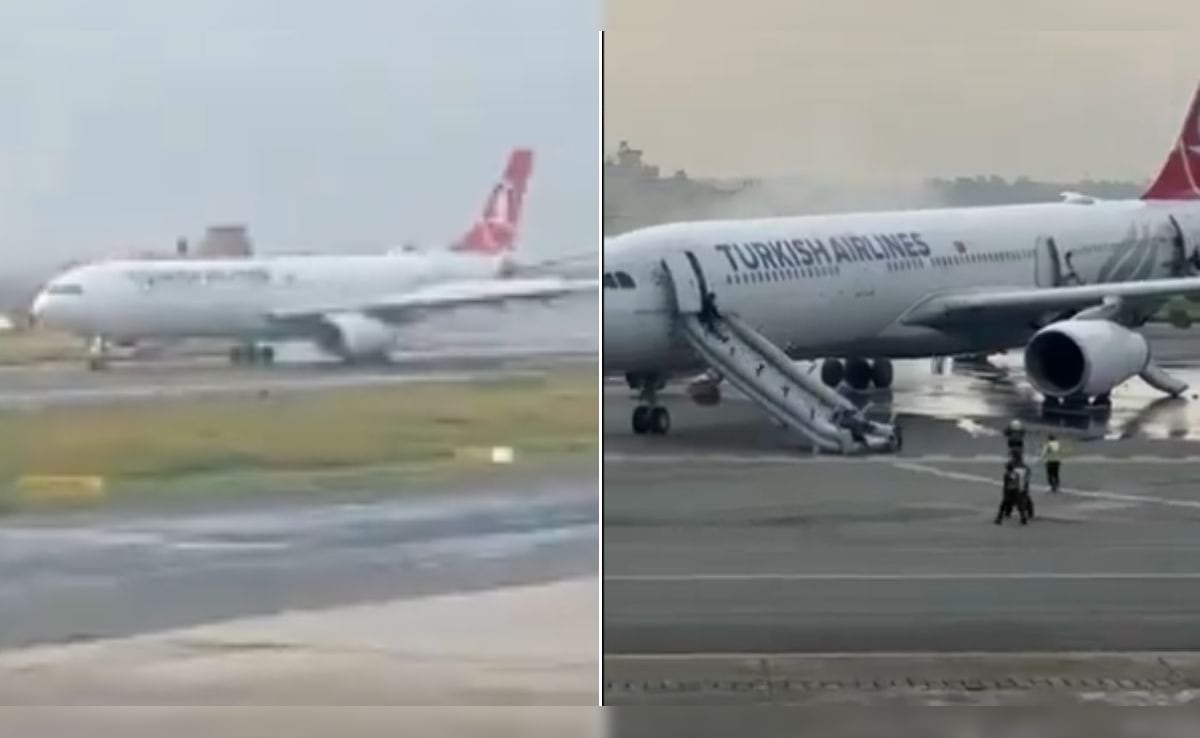
Fear is a natural reaction when you see thick black smoke billowing from under a massive jet. That’s exactly what happened at Kathmandu’s Tribhuvan International Airport when a Turkish Airlines plane tyre caught fire after touching down. Passengers saw the smoke. Ground crews scrambled. Social media went into a frenzy. But if you think this was a near-death experience for everyone on board, you’re missing how modern aviation actually works.
The incident involved a Turkish Airlines flight arriving from Istanbul. As the wheels hit the tarmac in the thin air of the Himalayas, one of the tyres suffered a massive failure and ignited. It looked terrifying on video. Fire trucks rushed out, dousing the landing gear in foam while the plane sat paralyzed on the runway. People were shaken, yet everyone walked away.
Grounding a flight isn't just about the fire itself. It’s about the physics of stopping a hundred-ton machine in a high-altitude bowl like Kathmandu. This wasn't a freak accident. It was a mechanical failure that the aviation industry prepares for every single day.
The Reality of Landing Gear Fires
Most people assume a fire on a plane means an explosion is imminent. That’s movie logic. On a real runway, a tyre fire is usually the result of intense friction or a hydraulic leak hitting a hot brake assembly. Aircraft brakes are designed to operate at staggering temperatures. We're talking hundreds of degrees. When a tyre blows or a brake seizes, that energy has to go somewhere.
At Tribhuvan International Airport, the altitude complicates things. The air is thinner. Pilots have to land faster to maintain lift. Higher landing speeds mean more work for the brakes. More work means more heat. If a tyre is slightly under-inflated or there's a minor defect in the rubber, the stress of a high-speed Kathmandu landing will find that weakness.
You’ve probably seen the footage by now. The smoke is dark and heavy because it’s burning rubber and chemical-laden hydraulic fluid. It’s acrid. It’s scary. But notice how the fire stayed contained to the gear well. Engineers build these areas to withstand incredible heat specifically so a wheel fire doesn't turn into a wing fire.
Why Kathmandu is a Pilot’s Worst Nightmare
Tribhuvan isn't your average airport. It’s a "tabletop" style runway surrounded by jagged peaks. There’s no room for error. If something goes wrong on the roll-out, like a tyre catching fire, the entire airport shuts down. Kathmandu has a single runway. When that Turkish Airlines jet got stuck, the country’s only international gateway effectively ceased to exist for hours.
International flights were diverted to India or sent back to their origins. This creates a massive logistical headache. But safety always trumps the schedule. The reason the airport stayed closed wasn't just to put out the fire; it was to inspect the runway for "FOD" or Foreign Object Debris. Shards of rubber or metal from a disintegrated tyre can be sucked into the engine of the next plane taking off. That’s how the Concorde crashed. Ground crews have to be meticulous.
I’ve talked to pilots who describe landing in Nepal as a "precision event." You don't just "drop in." You manage energy. When a mechanical failure like a seized brake occurs here, the stakes feel higher because there’s nowhere else to go.
What Happens Inside the Cockpit During a Tyre Fire
You might wonder if the pilots were panicking. They weren't. They have checklists for this. The moment the cockpit receives a "BRAKE TEMP" or "FIRE GEAR" warning, they follow a scripted set of actions.
- Stop the aircraft safely on the centerline.
- Alert the tower for emergency services.
- Order the "discretionary evacuation" or keep passengers on board.
In this Turkish Airlines case, the crew chose to keep people on the plane initially while the fire was extinguished. This is often safer than blowing the emergency slides. Jumping down a slide carries a high risk of broken bones and injuries, especially for elderly passengers or children. If the fire is external and being handled by professionals, staying in the "metal tube" is actually the smart move.
Lessons from Previous Turkish Airlines Incidents in Nepal
This isn't the first time Turkish Airlines has had a rough go in Kathmandu. Back in 2015, an Airbus A330 skidded off the same runway in dense fog. The plane was a total loss. That incident highlighted the massive limitations of the airport’s infrastructure.
When this recent tyre fire happened, local authorities were understandably on edge. They’ve seen what happens when a Turkish jet blocks their only lifeline to the outside world. The recovery of the 2015 aircraft took days because the airport lacked the heavy equipment to move a disabled wide-body jet. Luckily, a tyre fire is a much faster fix, but the "heart attack" it gives the local aviation authority is very real.
How to Stay Calm When Things Look Gritty
If you’re a nervous flyer, seeing a tyre on fire is your ultimate "I told you so" moment. But look at the outcome. The systems worked. The fire bottles or the ground crews did their job. The fuselage remained intact.
Tyres blow out. It happens. It’s why planes have multiple wheels on each strut. A Boeing or Airbus can land safely with several blown tyres. The fire is the dramatic part, but it’s rarely the fatal part.
Next time you’re flying into a high-altitude or challenging airport, pay attention to the landing. You’ll feel the pilots "slam" the plane down sometimes. That’s intentional. They want to plant the wheels to trigger the spoilers and autobrakes immediately. It’s better to have a firm landing than a smooth one that eats up too much runway.
If you find yourself on a flight where smoke appears:
- Listen to the flight attendants, not the guy filming on his phone.
- Keep your shoes on until you’re at the gate.
- Leave your luggage. If there is an evacuation, people dying because someone wanted their laptop is a tragic, avoidable reality.
Check your flight status through the airline's official app rather than third-party trackers during an incident. Carriers like Turkish Airlines update their internal manifests and rebooking options faster than a news site can report a fire. If you’re ever caught in a diversion caused by a runway closure, get to the customer service desk or get on the phone immediately. Don't wait for the announcement. Success in travel belongs to the proactive.