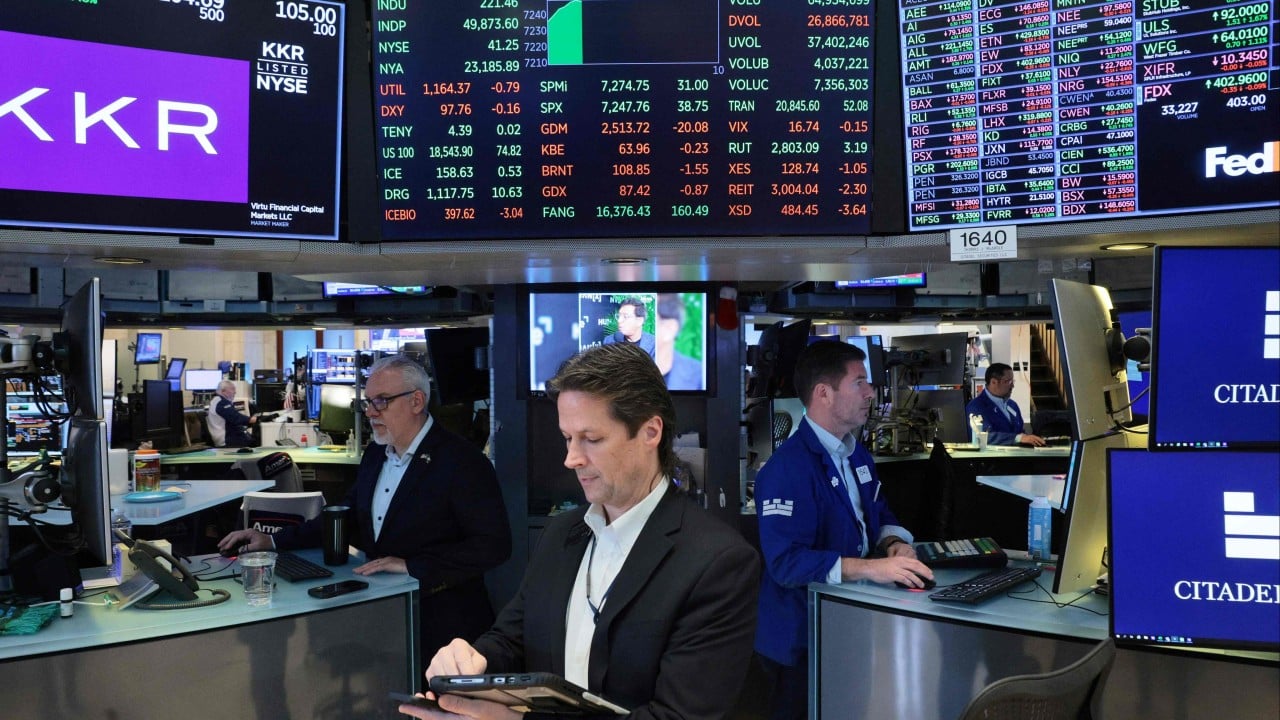
The air inside the New York Stock Exchange doesn't smell like money. It smells like recycled oxygen and high-voltage electricity. On a Tuesday morning, the digital tickers crawl across the walls in a neon green blur, but if you look closely at the faces on the floor, the color is draining away. Traders aren't looking at quarterly earnings or tech IPOs today. They are staring at a jagged blue line on a map five thousand miles away.
That line is the Strait of Hormuz.
It is a narrow throat of water, a maritime choke point where the world’s industrial ambition meets its geographic vulnerability. At its skinniest, it is only twenty-one miles wide. To a hedge fund manager in Manhattan, those twenty-one miles represent the difference between a profitable quarter and a systemic collapse. To a truck driver in Ohio, they represent the difference between an affordable commute and a choice between gasoline and groceries.
Oil is the ghost in our machines. We pretend we have moved past it, whispering about renewables and solid-state batteries, but the global economy still breathes through a combustion engine. When that breath is threatened, the world holds its own.
The Captain and the Choke Point
Imagine a man named Elias. He is the captain of an ultra-large crude carrier (ULCC), a vessel so massive it displaces more water than an aircraft carrier. He is currently standing on his bridge, eyes fixed on the horizon where the Gulf of Oman meets the Persian Gulf.
Elias knows that nearly thirty percent of the world’s seaborne oil passes through this specific corridor. He feels the weight of two million barrels of crude beneath his feet. He also feels the invisible tension of geopolitical chess. One wrong move, one "unidentified projectile," or one naval blockade, and his ship becomes a floating liability.
When news breaks that tensions in the Strait have spiked, the reaction is instantaneous. It doesn't travel at the speed of a ship; it travels at the speed of light.
In London and New York, the "risk premium" is applied. This isn't some abstract mathematical formula—it is a fear tax. Investors start buying oil futures not because they need the oil, but because they are terrified of not having it. This surge in demand drives the price per barrel upward. The ticker turns red.
Wall Street hesitates.
The hesitation isn't a lack of movement; it’s a frantic, paralyzed sort of motion. It’s the sound of a thousand algorithms recalibrating for a worst-case scenario. If the Strait closes, the supply chain doesn't just slow down. It breaks.
The Ghost of 1973
History isn't a straight line; it's a circle. The older traders on the floor remember the stories of the 70s—the long lines at gas stations, the rationing, the sudden realization that the American Dream was tethered to a pipeline in a desert.
We like to think we are more resilient now. We point to US shale production and strategic reserves. But the market is a psychological animal. It doesn't react to what is happening right now; it reacts to what might happen in six weeks.
Uncertainty is the one thing a market cannot price accurately. A disaster is manageable because it is a known quantity. Uncertainty is a void. And right now, the Strait of Hormuz is a void.
When oil prices rise, it’s a domino effect. It starts with the barrel. Then the refinery. Then the shipping company that has to pay a "bunker adjustment factor" to move goods across the ocean. By the time that ripples to your local supermarket, the price of a head of lettuce has climbed because the diesel used to transport it just became ten percent more expensive.
The Invisible Stakes
Why does the market tremble at a few miles of water? Because there is no "Plan B" for the Strait of Hormuz. Unlike other trade routes, there are few viable bypasses. Pipelines exist, but they can only carry a fraction of the volume that tankers handle.
If you are an institutional investor managing a pension fund, you aren't just looking at the price of oil. You are looking at the stability of the entire global order. A spike in energy costs is a spike in inflation. Inflation forces central banks to keep interest rates high. High interest rates make it harder for businesses to borrow and grow.
It is a feedback loop of anxiety.
Consider the "paper barrels." For every physical barrel of oil floating on Elias’s ship, there are dozens, sometimes hundreds, of contracts being traded in the financial markets. This is the world of derivatives, where fortunes are made on the volatility of the commodity. When the Strait is threatened, the volatility goes off the charts.
The small-time investor sees the news and thinks about their gas tank. The master of the universe on Wall Street sees the news and thinks about the margin calls. Both are right to be worried.
The Fragility of the Status Quo
We live in a "just-in-time" world. We have optimized our civilization for efficiency, not for resilience. We have trimmed the fat until there is nothing left but the nerve.
This efficiency works beautifully when the seas are calm. It allows for cheap electronics, fresh fruit in winter, and global travel. But it assumes that the twenty-one miles of the Strait will always be open. It assumes that the geopolitical tensions of the Middle East will remain a background noise rather than a frontal assault on the global ledger.
The current rise in oil prices is a warning shot. It is a reminder that the digital world—the world of apps, AI, and high-frequency trading—is still anchored to the physical world of tankers and narrow waterways.
The hesitation on Wall Street isn't just about money. It’s a moment of profound realization. Even in 2026, with all our technological prowess, we are still beholden to the geography of the ancient world.
The Human Toll of the Ticker
Back in Ohio, a woman named Sarah pulls her SUV into a gas station. She looks at the glowing numbers on the pump. They have climbed fifteen cents since yesterday. She doesn't know about the Strait of Hormuz. She doesn't know about Elias or the risk premium or the hedge fund algorithms.
She only knows that her budget is tighter. She feels a low-grade hum of stress, a feeling that things are becoming less predictable, less stable.
That stress is the real-world manifestation of the ticker on Wall Street. The numbers on the screen are just an abstraction of Sarah’s anxiety. When the market hesitates, it is reflecting a collective loss of confidence in the future.
The price of oil is more than a metric. It is a pulse. And right now, that pulse is racing.
Investors are currently "de-risking." This is a polite way of saying they are running for the exits. They are moving money into gold, into government bonds, into anything that feels solid. They are waiting for a sign that the tension will break, that the Strait will remain a passage rather than a wall.
But the sign doesn't come.
Instead, there are more reports of naval exercises. More diplomatic statements that say a lot without saying anything at all. More satellite imagery of tankers lingering in the gulf, waiting for the all-clear.
Elias stands on his bridge. He can see the lights of other ships in the distance, a constellation of steel and crude oil. He waits. The world waits with him.
The sun sets over the water, casting long, dark shadows across the waves. In Manhattan, the lights of the skyscrapers stay on late into the night. The computers keep humming. The jagged blue line remains on the screens.
Twenty-one miles.
It is a distance most of us could run in a few hours. It is the length of a long commute. And yet, it is the most important distance on the planet. If those miles narrow any further, the world as we know it will have to learn how to breathe all over again.
The blue line on the map doesn't move. It just sits there, a silent, watery gatekeeper, reminding us that for all our progress, we are never more than one narrow passage away from the dark.