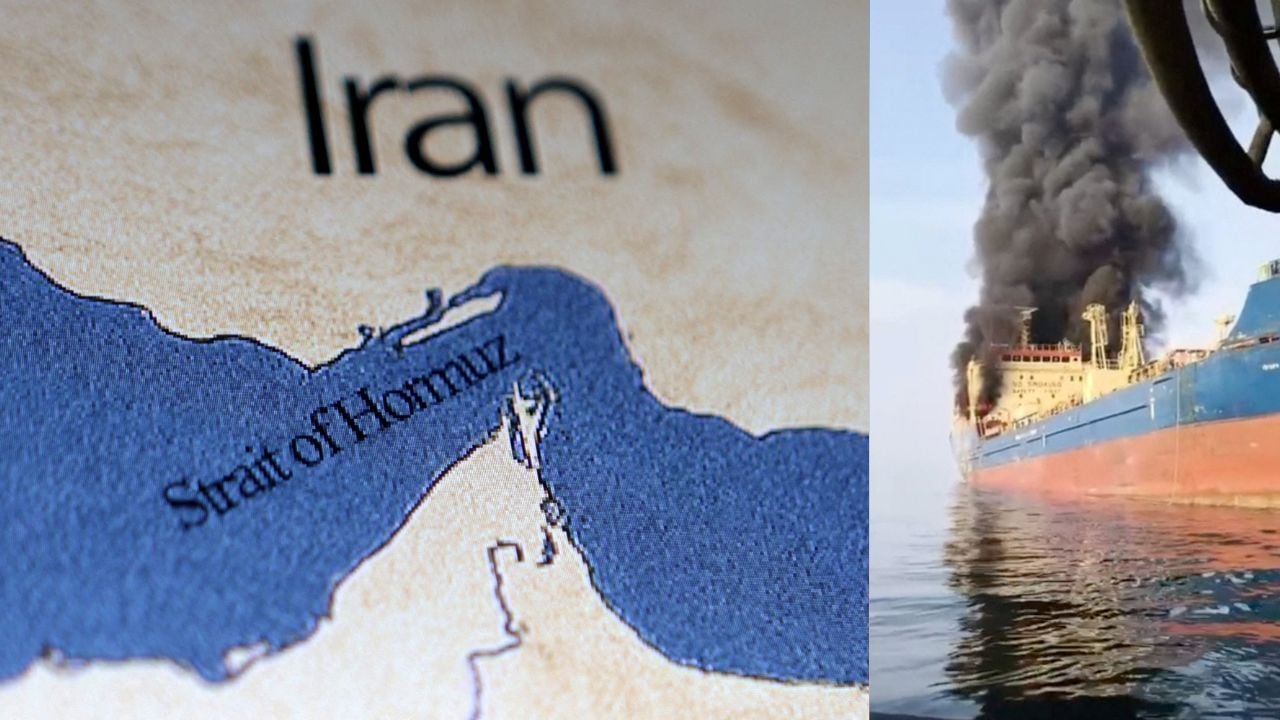
Imagine a narrow hallway where every fifth person in the building must pass to get their lunch. Now imagine that hallway is controlled by a door that can be slammed shut at any moment by a disgruntled neighbor. This isn’t a hypothetical office dispute. This is the Strait of Hormuz.
Roughly 21 million barrels of oil flow through that specific stretch of water every single day. If you drive a car, heat your home, or buy goods shipped across an ocean, you are tethered to that narrow passage between Oman and Iran. Fatih Birol, the head of the International Energy Agency, isn't a man known for poetic flourishes or alarmist rhetoric. He deals in the cold, hard math of global stability. When he stands up to speak about the necessity of the Iraq-Turkey pipeline, he isn't just talking about steel tubes and transit fees. He is talking about a pressure valve for a world that is currently holding its breath.
The problem with a single point of failure is that it invites chaos. Geopolitics is often a game of leverage, and the Strait of Hormuz is the ultimate lever.
The Ghost in the Machine
Consider a small business owner in a suburb of Munich or a commuter in Seoul. They don't wake up thinking about the maritime boundaries of the Persian Gulf. But their lives are dictated by them. When tensions rise in the Middle East, the "risk premium" on a barrel of oil spikes. It’s an invisible tax on existence.
For years, the world has looked for an exit strategy. The Iraq-Turkey pipeline (ITP) represents that rare thing in international energy: a shovel-ready solution to a looming catastrophe. The infrastructure exists. It stretches from the northern oil fields of Iraq, through the rugged terrain of the Kurdistan region, and ends at the Turkish port of Ceyhan. It has the capacity to move nearly half a million barrels of oil a day.
Currently, that pipe is dry.
It was shut down in early 2023 following a complex legal battle over who has the right to sell the oil and who gets the cut. While lawyers in Paris and Baghdad argued over contract clauses, the physical world suffered. Birol’s recent push to reopen this artery is a recognition that we can no longer afford the luxury of bureaucratic pride. The world needs that half-million barrels. Not because we are running out of oil, but because we are running out of safety margins.
The Geography of Fear
To understand the stakes, you have to look at a map from the perspective of a tanker captain. To get out of the Persian Gulf, you must pass through a gap that, at its narrowest, is only 21 miles wide. It is the most vital chokepoint in the global energy supply.
When a drone is launched or a tanker is seized, the shockwaves travel at the speed of light through the trading floors of London and New York. Prices jump. Insurance rates for shipping vessels skyrocket. The Iraq-Turkey pipeline offers a bypass. It takes the oil from the ground and sends it north, overland, away from the vulnerable waters of the South.
It is a literal shortcut to stability.
But the narrative of energy is rarely about the shortest distance between two points. It is about the friction between sovereign nations. Iraq sits on some of the world’s most significant reserves, yet it is a country that has been defined by its inability to fully capitalize on its own wealth due to internal friction and external pressure. The ITP is caught in the middle of a three-way tug-of-war between the federal government in Baghdad, the regional government in Erbil, and the leadership in Ankara.
The Human Cost of a Closed Valve
We often talk about "output" and "capacity" as if they are abstract numbers on a spreadsheet. They aren't. They represent the ability of a nation to rebuild. For Iraq, every day the pipeline remains closed is a day of lost revenue that could have gone toward schools, hospitals, and basic infrastructure.
The figures are staggering. Estimates suggest that the closure has cost billions of dollars in lost revenue. For a country trying to emerge from decades of conflict, that isn't just a fiscal deficit. It’s a human one. It’s the difference between a generation of children having modern classrooms or studying in the ruins of the past.
Turkey, too, has a stake that goes beyond simple transit fees. As a bridge between East and West, Turkey wants to be more than just a consumer; it wants to be the indispensable hub. By hosting the terminus of the Iraqi pipeline, Turkey solidifies its position as the gatekeeper of European energy security.
Fatih Birol’s intervention is a signal that the adults in the room are losing patience. The IEA is essentially saying that the internal squabbles of regional players are now a threat to global equilibrium. When the head of the IEA pitches this bypass, he is looking at the volatility of the Strait of Hormuz and the fragility of the global economy and realizing that we are one bad day away from a crisis we can't manage.
The Irony of the Transition
There is a certain irony in the fact that, as we discuss the "green transition" and the move toward renewables, we are more obsessed than ever with the security of fossil fuel routes. We are in a messy, middle-ground era. We want to be done with oil, but we aren't yet. And in this transition phase, the world is actually more sensitive to supply shocks, not less.
If the Iraq-Turkey pipeline reopens, it won't solve the climate crisis. It won't end the reliance on carbon. But it will provide a buffer. It will mean that if a conflict breaks out in the Gulf, the world doesn't immediately go into a tailspin.
Think of it as a redundant power supply for a hospital. You hope you never need to rely on it solely, but you’re a fool if you don't make sure it's plugged in and ready to go.
The Friction of Sovereignty
The real obstacle isn't the engineering. It’s not that the pipes are broken or the pumps are rusted. It is the invisible borders. The dispute centers on who controls the exports. Baghdad insists on its sovereign right to manage all national resources. The Kurdistan Regional Government (KRG) argues for the autonomy it was promised. Turkey wants to ensure it isn't legally liable for past agreements.
It is a mess of paperwork and pride.
Birol’s genius lies in framing this not as a legal dispute, but as a strategic necessity. He is moving the goalposts. He is telling the participants that their local arguments are starting to have global consequences. It’s a polite way of saying: "Your bickering is making the rest of the world unsafe."
The Iraqi oil fields are vast, silent reservoirs of potential energy. Above them, the political landscape is loud, fractured, and slow. The pipeline is the bridge between that potential and the reality of a world that needs to keep moving.
A Choice of Paths
We are standing at a crossroads of geography and intent. We can continue to funnel the majority of the world's energy through a single, 21-mile-wide target. We can leave ourselves vulnerable to the whims of regional actors and the threat of asymmetric warfare.
Or, we can embrace the redundancy.
The Iraq-Turkey pipeline isn't a silver bullet. It won't fix the complex web of Middle Eastern politics. But it will do something far more practical. It will decouple the survival of the global economy from a single stretch of water. It will give us a choice.
In the high-stakes world of energy security, a choice is the only thing that looks like freedom.
The pipe sits there, a long, silent line of steel stretching across the desert and over the mountains. It is ready to work. It is ready to carry the lifeblood of modern civilization to the ports of the Mediterranean. All that is missing is the political will to turn the valve.
Every day that the valve remains shut, the world remains a little more fragile, the commute a little more expensive, and the shadow of the Strait of Hormuz a little longer. We are waiting for the sound of the oil beginning to flow—the sound of a world finally choosing the long way around because the short way is far too dangerous.
The silence of the pipeline is the loudest warning we have.