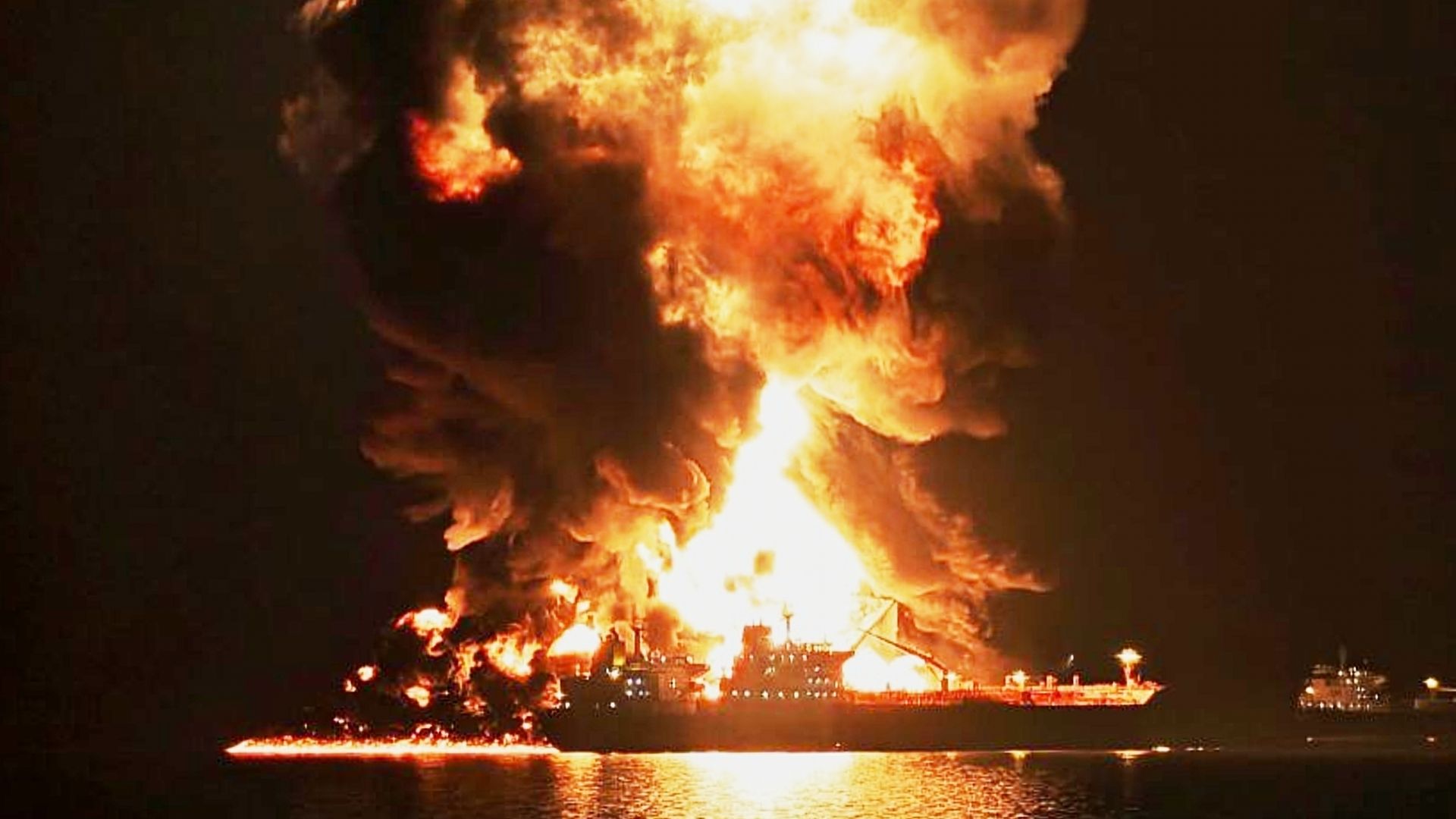
A rust-streaked tanker named the Fortune Star sits low in the water, her belly heavy with two million barrels of crude oil. Below the bridge, the vibration of the massive diesel engines is a constant, reassuring hum. But for the captain peering through binoculars at the shimmering horizon of the Strait of Hormuz, the silence of the Gulf is a lie. He knows that at its narrowest point, this waterway—the jugular vein of the global economy—is only twenty-one miles wide.
Twenty-one miles. That is the distance of a morning marathon. It is all that separates the Arabian Peninsula from the jagged coastline of Iran.
Through this narrow gap, a third of the world’s liquified natural gas and twenty percent of its oil pass every single day. If you are reading this under an LED bulb in London, driving a car in Tokyo, or heating a home in Seoul, you are tethered to this strip of blue water by an invisible, high-stakes umbilical cord.
The threat isn't a massive, Soviet-style armada. It isn't a fleet of gleaming destroyers or nuclear-powered carriers. Instead, the danger is small. It is fast. It is terrifyingly cheap. Iran has spent decades perfecting the art of the "mosquito fleet," a strategy designed to turn the Strait into a graveyard for giants through the use of midget submarines and explosive drone boats.
The Ghosts in the Shallows
Imagine being a sonar operator on a billion-dollar American destroyer. You are trained to find monsters—large, steel hulls that displace thousands of tons. But the Iranian Ghadir-class submarine is not a monster. It is a ghost.
At roughly 29 meters long, these midget subs are tiny. They are cramped, uncomfortable, and primitive by Western standards. Yet, in the shallow, cluttered, and salt-heavy waters of the Persian Gulf, their size is their greatest weapon. They can "sit on the bottom," resting their hulls on the seafloor with their engines killed, becoming virtually indistinguishable from a submerged rock or a patch of reef.
They wait.
When a tanker passes overhead, the Ghadir doesn't need a sophisticated long-range ballistic missile. It just needs a heavy-weight torpedo or a few well-placed mines. By the time the acoustic signature of a launch is detected, the distance is so short that the target has no time to maneuver. This is asymmetrical warfare in its purest form: a $20 million submarine capable of crippled a $200 million tanker and sending shockwaves through a $100 trillion global economy.
The Swarm That Thinks for Itself
The sea surface holds a different kind of terror. For years, the Iranian Revolutionary Guard Corps (IRGC) utilized fast-attack craft—manned speedboats armed with machine guns and rocket launchers—to harass shipping. It was a dangerous game of chicken. But the game has changed. The pilots are being replaced by processors.
The rise of the kamikaze drone boat, or Unmanned Surface Vessel (USV), has turned the Strait into a laboratory for autonomous violence. These aren't just remote-controlled toys. They are packed with hundreds of pounds of high explosives and equipped with GPS guidance and optical sensors.
Consider a hypothetical but high-probability scenario: a "swarm" attack.
A single drone boat is a nuisance. Fifty drone boats, attacking simultaneously from 360 degrees, are a catastrophe. A ship’s defensive systems, like the Phalanx CIWS—a rapid-fire Gatling gun designed to shred incoming threats—can only track and engage a few targets at a time. While the sensors lock onto the first five drones, the other forty-five are closing the gap at forty knots.
The math is brutal. It costs Iran a few thousand dollars to build a disposable drone boat. It costs the international community billions to defend against them. This is the "cost-imposition" strategy. Iran doesn't have to win a naval battle in the traditional sense; they only have to make the cost of passage so high that insurance premiums skyrocket, shipping companies refuse to sail, and the price of oil jumps $20 a barrel overnight.
The Invisible Minefields
Then there are the mines. They are the most patient hunters in the IRGC arsenal.
The Strait of Hormuz is shallow enough that simple "moored" mines—spiked spheres anchored to the seabed—can be devastating. But the technology has evolved into "influence" mines. These don't require a ship to actually hit them. Instead, they listen. They feel. They sense the magnetic signature of a massive steel hull or the specific acoustic frequency of a propeller.
When the criteria are met, they detonate.
In the late 1980s, during the so-called "Tanker War," a single Iranian mine nearly sank the USS Samuel B. Roberts, a ship worth ninety-six times the cost of the mine that hit it. Today, the mines are smarter, stealthier, and harder to sweep. In a narrow channel, the mere suspicion of mines is enough to halt traffic. You don't even have to sink a ship to win. You just have to create a doubt that no captain is willing to gamble their life on.
The Human Cost of a Blown Fuse
It is easy to get lost in the specs of torpedoes and the battery life of drones. But the real stakes are measured in heartbeats.
On the bridge of the Fortune Star, the crew isn't thinking about geopolitical chess. They are thinking about their families in Manila or Mumbai. They are watching the radar for a "pop-up" contact—a small blip that wasn't there thirty seconds ago. They know that if a drone boat strikes the engine room, they won't just be dealing with a fire. they will be at the center of an environmental and economic apocalypse.
If the Strait closes, the world stops.
Factories in Germany go dark because the energy costs become unsustainable. Gas stations in the American Midwest see prices double in a week. The fragile stability of developing nations, reliant on affordable fuel for transport and agriculture, begins to crumble. We like to think of our modern world as a digital, ethereal thing, but it is actually built on a foundation of heavy oil moving through a twenty-one-mile-wide door.
Iran knows this. They don't need to defeat the U.S. Navy. They don't need to invade a neighbor. They only need to hold their hand over the windpipe of the world.
The Geometry of Tension
The strategy is one of "calculated ambiguity." Iran rarely claims responsibility for the "limpet mines" that mysteriously appear on tanker hulls. They deny involvement in drone strikes while showcasing the very drones used in the attacks at military parades in Tehran.
This ambiguity is the point. It creates a permanent state of high-tension "gray zone" warfare. It is a psychological siege. By utilizing midget subs and autonomous boats, they minimize their own "human" footprint while maximizing the potential for chaos.
We often view military power through the lens of the biggest, loudest, and most expensive equipment. We look at aircraft carriers as the ultimate expression of dominance. But the Strait of Hormuz teaches a different lesson. It teaches us that in the right environment, the small can devour the large. It tells us that the future of conflict isn't just about who has the most firepower, but who can make the environment too "expensive" for the other side to exist in.
The sun begins to set over the jagged Musandam Peninsula. The Fortune Star clears the narrowest point of the Strait, moving out into the wider waters of the Arabian Sea. The captain exhales, a tension he didn't realize he was holding finally leaving his shoulders. He has made it through.
But behind him, beneath the dark, salty waves and hidden in the coves of the Iranian coastline, the ghosts are still there. They aren't going anywhere. They are waiting for the next hull to hum, the next magnetic signature to trigger a sensor, and the next time the world forgets how fragile the thread is that holds everything together.
The water looks still, but the trap is always set.