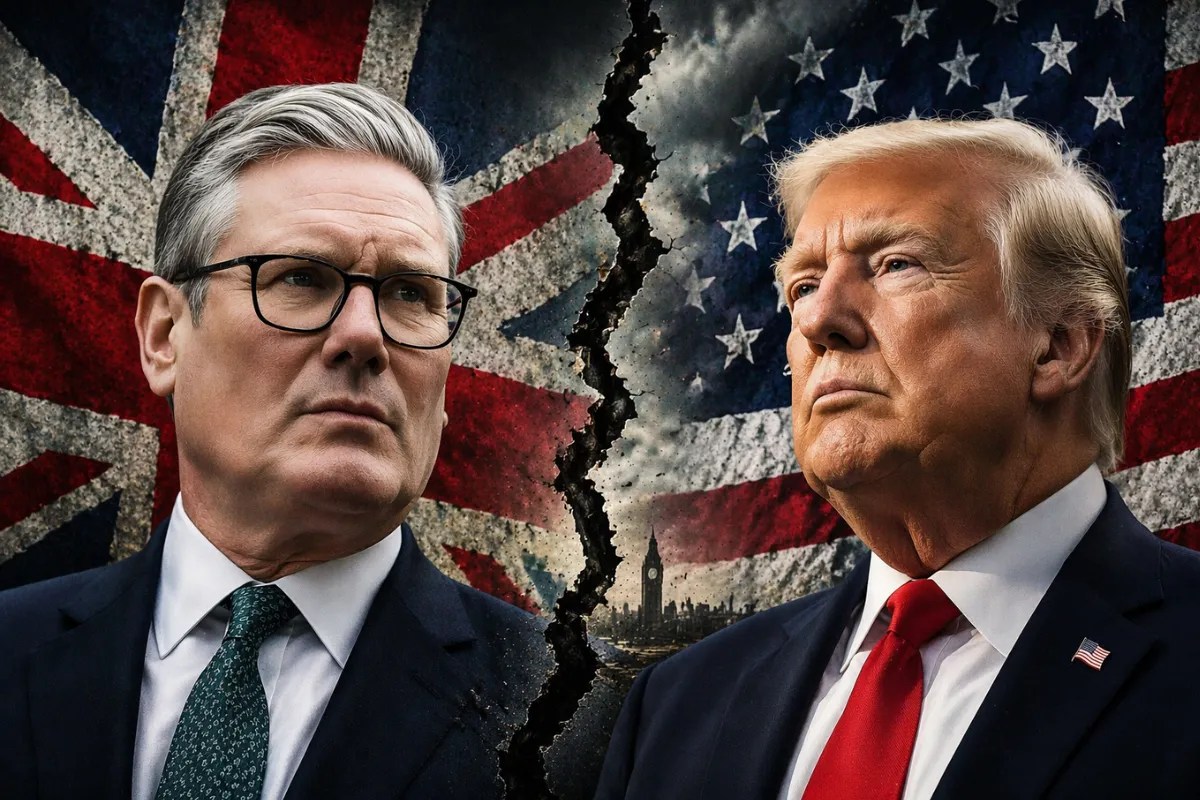
The media loves a good "clash of titans" narrative. When Keir Starmer stands tall and declares he won't "bow down" to Donald Trump’s trade war threats, the headlines practically write themselves. They paint a picture of a principled British Prime Minister defending national sovereignty against an erratic American bully. It is a comforting, patriotic, and entirely delusional fairy tale.
The "Special Relationship" isn't in a state of friction. It’s in a state of decomposition. While the press obsesses over the optics of Starmer’s "defiance," they are missing the brutal economic reality: The UK has zero leverage, a hollowed-out industrial base, and a leader who is bringing a butter knife to a nuclear silo fight. You might also find this similar article interesting: The trillion dollar question the White House won't answer about the Iran war.
The Sovereignty Myth
The competitor narrative suggests that Starmer’s refusal to engage in Trump’s proposed tariff regime is a sign of strength. In reality, it’s a sign of paralysis.
When Trump talks about a universal baseline tariff—likely between 10% and 20%—he isn't looking for a "war" with Britain. He doesn't think about Britain enough to want a war with it. To the current MAGA doctrine, the UK is simply collateral damage in a broader strategy to de-globalize the American supply chain. As discussed in recent articles by Al Jazeera, the implications are widespread.
Starmer’s "I won't flinch" routine is a performance for a domestic audience that still thinks the British Empire is a relevant economic bloc. Here is the cold truth: If the US imposes a 20% tariff on British scotch, cars, and aerospace parts, the UK economy doesn't just "shiver." It breaks. The US is the UK’s largest single trading partner. You don't "stand up" to your biggest customer when you have no other shop to sell your goods in.
The EU Fallacy
The "lazy consensus" among London’s elite is that if Trump freezes the UK out, Starmer can simply "pivot back" to Europe. This ignores the tectonic shifts in European politics.
Germany is in a structural recession. France is a political powderkeg. The EU is currently sharpening its own protectionist tools to survive the US-China crossfire. They aren't going to offer the UK a "sweetheart deal" out of the goodness of their hearts. They will demand total alignment with EU regulations, which effectively turns the UK into a rule-taker with no seat at the table.
By pretending he can play both sides, Starmer is actually choosing neither. He is marooning the UK on an island of its own making, too far from Washington to be a partner and too stubborn for Brussels to be a member.
Why Trade Wars Actually Work for the Aggressor
Pundits scream that "tariffs are a tax on the consumer." They cite 101-level economics to prove Trump is "wrong."
I have spent two decades watching trade negotiations from the inside. Here is what the textbooks get wrong: Tariffs aren't about consumer prices in the short term. They are about capital reallocation.
When a 20% tariff makes it impossible for a British firm to compete in the US market, that firm doesn't just pay the tax. It moves its factory to Ohio. Trump isn't trying to make British goods more expensive; he’s trying to make British manufacturing extinct by forcing it to relocate to American soil.
Starmer calling this a "threat" he won't succumb to is like a man standing in front of a tidal wave and telling it to stop. The wave doesn't care about his principles.
The Fallacy of "Shared Values"
The most irritating part of this diplomatic theater is the constant invocation of "shared values."
- "We share a history."
- "We share a language."
- "We share an intelligence-sharing network (Five Eyes)."
None of that matters in a transactional administration. In a world of Realpolitik, shared values are what you talk about when you don't have a better price. Trump’s "America First" isn't a slogan; it’s a literal instruction manual. If the UK provides no strategic utility to the US industrial revival, the "Special Relationship" is worth exactly as much as the paper the 1941 Atlantic Charter was written on.
The Actionable Reality: The UK Must Pick a Side
The UK’s current strategy is "strategic ambiguity." It’s a fancy term for "hoping for the best."
If Starmer actually wanted to lead, he would stop the tough-guy rhetoric and make a Choice (with a capital C).
- The 51st State Option: Fully align with US trade policy, adopt American standards, and accept the role of a junior partner in an anti-China trade bloc. This kills the relationship with Europe but secures the US market.
- The European Fortress Option: Rejoin the Single Market or Customs Union. This stabilizes the economy but makes a US trade deal impossible because the US will not accept EU agricultural standards.
Trying to do both results in the current "Starmer Stagnation." You get the tariffs from the US and the red tape from the EU.
The Thought Experiment: The 0% Solution
Imagine a scenario where Starmer didn't "react" to Trump’s threat with defiance, but with a counter-offer: A total, 0% tariff bilateral trade agreement that excludes the EU entirely.
To do this, the UK would have to scrap its environmental and food safety regulations overnight to match US standards. It would be political suicide for a Labour PM. But it would be an economic masterstroke.
Instead, Starmer chooses the middle path—the path of least resistance and most certain decline. He uses words like "pragmatism" to mask a total lack of vision. He thinks he’s being a statesman. He’s actually being a custodian of a sinking ship.
Stop Asking if the Relationship is Strained
The media asks: "Can the relationship be saved?"
The real question is: "Why do we want to save a relationship that relies on us being a subservient client state?"
The UK needs to stop acting like a jilted lover waiting for a call from Washington. Trump’s trade war isn't an "insult" to Britain; it’s a data point. It’s a signal that the era of global cooperation is over.
Starmer’s "anger" is a mask for his inadequacy. He doesn't have a plan for a high-tariff world. He has a plan for a world that ended in 2015. He is fighting a war of words while the US is fighting a war of supply chains.
The "Special Relationship" wasn't killed by Trump’s rhetoric or Starmer’s defiance. It was killed by the UK’s refusal to realize it is no longer a global power, but a mid-sized economy with a massive ego and a shrinking list of friends.
If you're waiting for Starmer to "win" this trade war, you're going to be waiting a long time. You don't win a trade war by being "right" on Twitter. You win by having the biggest market and the most essential technology. The UK has neither.
Stop listening to the "defiance" narrative. Start looking at the trade balance.
The UK isn't standing tall. It's just standing still while the rest of the world moves on.