Ukraine has transformed from a conventional military force into the world’s most significant laboratory for autonomous warfare. This is not merely a story of technical ingenuity or a "David vs. Goliath" narrative fueled by 3D-printed parts and crowdfunding. It is a calculated, desperate bid to shift the very geometry of the front line. By saturating the battlefield with low-cost, expendable systems, Kyiv is attempting to make traditional armored maneuvers obsolete and, more importantly, to ensure that Western allies cannot afford to look away.
The strategic shift is simple. Ukraine cannot match the mass of Russian artillery or the sheer volume of its mobilized infantry. To survive, they have moved the fight into the electromagnetic spectrum.
The Industrialization of the Small
For decades, military procurement was a slow-motion dance of billion-dollar contracts and decade-long development cycles. Ukraine broke that model in six months. They didn't do it by building better jets; they did it by weaponizing the consumer supply chain.
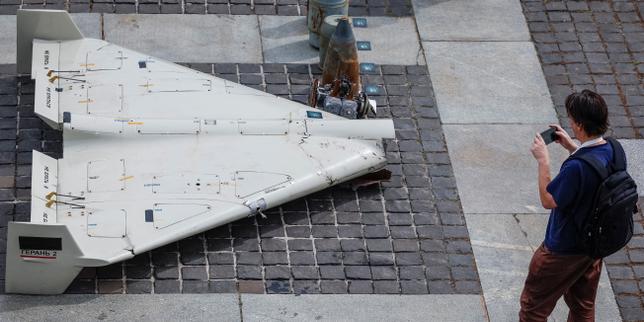
At the heart of this transformation is the First Person View (FPV) drone. These are essentially racing quadcopters strapped with Soviet-era RPG-7 warheads. They cost roughly $500 to assemble. When one of these crafts flies into the open hatch of a $5 million T-90M tank, the return on investment is staggering. This isn't just a tactical win. It is a fundamental disruption of military economics.
The scale is what matters now. Ukraine’s government has set a target of producing over one million drones annually. This isn't being done in massive, centralized factories that serve as easy targets for cruise missiles. Instead, it is a "distributed manufacturing" network. Small workshops, often tucked away in residential basements or nondescript warehouses, 3D-print frames and solder flight controllers.
This fragmentation is a feature, not a bug. It makes the supply chain nearly impossible to decapitate. If one workshop is hit, ten others continue the work. This decentralized approach has forced a realization in NATO capitals: the future of defense might not be a few exquisite platforms, but a massive swarm of "good enough" ones.
The Electronic Warfare Wall
Success in this new era is fleeting. The average lifespan of a drone on the Ukrainian front can be measured in days, or sometimes hours. This is due to the invisible wall of Electronic Warfare (EW).
Russia has historically excelled in EW, deploying systems like the Pole-21 or Zhitel to jam GPS signals and sever the radio links between a pilot and their craft. When the signal dies, the drone becomes a paperweight. To counter this, Ukrainian engineers are locked in a weekly cycle of software updates. They are shifting frequencies, implementing frequency-hopping spread spectrum (FHSS) techniques, and increasingly, turning to Artificial Intelligence (AI).
The Terminal Guidance Pivot
The most significant hurdle for a drone pilot is the "last mile." As a drone nears its target, it often flies low, losing the line-of-sight radio connection or entering a localized jamming bubble. This is where manual control fails.
The solution being deployed now is onboard computer vision. By offloading the "thinking" to a small processor on the drone itself, the craft can identify a tank or a trench line in its final seconds of flight. Once the pilot "locks" the target, the drone goes autonomous. Jamming the radio link at that point is useless because the drone is no longer listening to the pilot; it is looking at the target.
This is a grim milestone. We are seeing the birth of autonomous lethal systems born out of necessity rather than a laboratory. The ethical debates happening in Geneva regarding "killer robots" are being rendered moot by the reality of a trench in Donetsk.
Marine Drones and the Black Sea Gamble
While the aerial fight consumes the headlines, the naval theater provides the clearest example of Ukraine making itself indispensable to modern naval theory. Ukraine effectively has no traditional navy. Yet, they have forced the Russian Black Sea Fleet to retreat from its main base in Sevastopol.
The Magura V5 and Sea Baby surface drones are essentially jet skis filled with high explosives and satellite links. They are low-profile, hard to detect on radar, and can travel hundreds of nautical miles.
The sinking of the Moskva was a traditional missile strike, but the subsequent destruction of various corvettes and landing ships has been a masterclass in "wolf pack" drone tactics. By attacking a ship from multiple angles simultaneously, these drones overwhelm the vessel's point-defense systems.
For the United States and other maritime powers, this is a wake-up call. If a nation without a navy can paralyze a regional power’s fleet, every expensive carrier strike group in the world is suddenly looking a lot more vulnerable. Ukraine is the only entity with real-world data on how to conduct—and defend against—these saturation attacks. That data is the currency Kyiv uses to buy continued Western relevance.
The Cost of Information Supremacy
Western military aid is often viewed through the lens of hardware: HIMARS, Leopards, and ATACMS. But the most vital component is the digital architecture that connects them. Ukraine’s "Delta" system—a situational awareness platform that integrates data from drones, satellites, and human intelligence—is perhaps the most advanced battlefield management tool in existence.
Every time a Ukrainian soldier spots a Russian move on a tablet, a data point is created. This real-time loop reduces the "sensor-to-shooter" time from tens of minutes to seconds.
However, this reliance on tech creates a massive vulnerability: connectivity. The role of Starlink has been publicized, but the deeper issue is the sheer volume of data required to run a modern war. Ukraine is proving that a military without a robust, redundant data network is a blind military. They are also proving that commercial technology is now a primary pillar of national defense.
The Human Factor in a Remote War
There is a common misconception that drones make war "cleaner" or easier. The opposite is true. Drone pilots in Ukraine suffer from a unique form of psychological strain. They see their targets in high-definition, often for minutes before impact. They see the faces of the people they are about to kill.
Furthermore, the "drone-ification" of the front has made the battlefield transparent. It is almost impossible to move troops or equipment during the day without being spotted. This has led to a return to Great War-style subterranean living. Soldiers spend their lives in deep bunkers, only emerging at night or during heavy cloud cover when drone visibility is limited.
This transparency has stalled the conflict into a grueling war of attrition. You cannot mass tanks for a breakthrough if a $500 drone spots the assembly point ten miles away and calls in a precision strike.
The Sovereignty of the Circuit Board
Ukraine's ultimate goal is "technology sovereignty." They realize that being dependent on foreign shipments of ammunition is a precarious way to run a war. By building their own drone industry, they are creating a domestic defense sector that can survive even if political winds shift in Washington or Brussels.
They are also positioning themselves as the future "security consultants" for the democratic world. When this war ends, the veterans of Ukraine’s drone units will be the most sought-after experts in the world. They will be the ones teaching NATO how to survive a swarm, how to jam a suicide boat, and how to build a military-industrial complex in a basement.
The conflict has moved past the era of the "game-changing" single weapon. There is no silver bullet. There is only the relentless, iterative process of coding, flying, dying, and coding again. Ukraine is betting its survival on the idea that they can out-innovate a larger enemy.
The question for the rest of the world is no longer whether drones are effective. The question is whether any modern military can survive without adopting the brutal, fast-paced, and cheap philosophy that Ukraine has been forced to master.
Check your own supply chains for vulnerabilities in microelectronics and sensors before the next crisis begins.