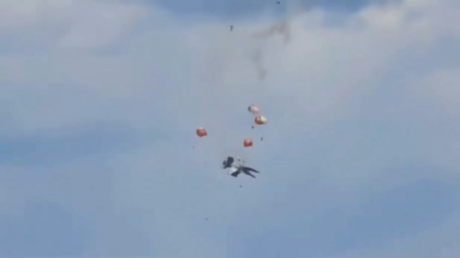
Watching two high-performance jets touch in midair is a nightmare realized. When news broke about US Navy aircraft colliding during an airshow, the internet did what it always does. It flooded with shaky cell phone videos and "miracle" headlines. But if you look past the fireball and the screaming crowds, you find a story about physics, human limits, and the brutal reality of naval aviation. These isn't just a freak accident. It's the result of flying multi-million dollar machines at the absolute edge of their design envelope.
People want to know why this happens. They ask if it's pilot error or mechanical failure. Usually, it's a messy mix of both, seasoned with a bit of bad luck. Naval aviators are some of the most highly trained humans on earth. They land on moving decks in the dark. They fly at supersonic speeds. Yet, even they can't always outrun the laws of aerodynamics when things go south during a low-altitude demonstration.
The Physics of a Midair Strike
Airshow maneuvers look like a choreographed dance. They aren't. They're a series of calculated risks. When two US Navy aircraft collide, it's often during a "cross" or a "join-up." These are moments where the margin for error shrinks to inches.
Think about the wake turbulence. Every jet leaves behind a "dirty" trail of air. If a trailing pilot hits that wake at the wrong angle, the plane can roll or dip violently. It's called "jet wash," and it's invisible. You don't see the air churning; you only feel the plane stop responding to your inputs. In a tight formation, that split second of loss of control means metal hits metal.
Speed is the other killer. At 400 knots, things happen faster than the human brain can process. You're not just flying your plane. You're anticipating where the other guy will be three seconds from now. If he’s off by a foot, and you’re off by a foot, you’ve got a disaster.
Behind the Scenes of Navy Flight Training
The Navy doesn't just hand keys to a Hornet to anyone. The path to an airshow team like the Blue Angels or even a standard fleet demonstration is grueling. Pilots spend years in "the pipeline." They start in T-6 Texan IIs, move to T-45 Goshawks, and finally hit the fleet.
Why Experience Isn't a Shield
You'd think the most experienced pilots would be the safest. That's not always true in the world of high-stakes flying. Complacency is a word that gets tossed around in safety briefings a lot. When you've done a maneuver five hundred times, your brain starts to automate the process. You might miss the subtle cues that the weather has changed or that your wingman is slightly out of position.
Safety officers call this "task saturation." Your brain is so busy managing the engine, the radio, and the flight path that it simply runs out of RAM. You stop "seeing" the big picture. When that happens in a combat zone, you might miss a target. When it happens at an airshow, you hit your lead.
The Hidden Cost of the Airshow Circuit
We love airshows because they're loud and patriotic. For the Navy, they're a massive recruitment tool. But there's a cost that rarely gets discussed in the news. The airframes themselves take a beating.
High-G maneuvers put immense stress on the wings and the fuselage. While these jets are built for it, the constant cycle of airshows can accelerate metal fatigue. This isn't a problem when the planes are new. As the fleet ages, maintaining that level of performance becomes a logistical headache. Mechanics work 20-hour shifts to ensure those planes are "up" for the weekend. One missed bolt or a hairline crack in a hydraulic line can turn a routine loop into a tragedy.
The Role of Technology in Modern Collisions
We have better tech now than we did twenty years ago. We have digital flight control systems and better radar. So why do planes still hit each other?
Actually, the tech can sometimes be part of the problem. Modern fly-by-wire systems translate pilot input into computer commands. If the computer thinks you’re trying to do something dangerous, it might "fight" you. In a normal flight, that’s a safety feature. In a midair emergency where you need every ounce of maneuverability to avoid a collision, that software delay can be fatal.
There's also the "glass cockpit" distraction. Pilots spend more time looking at screens than they do looking out the canopy. In formation flying, your eyes should be glued to a specific point on the lead aircraft. If you glance down at a warning light for a half-second, you’ve traveled the length of a football field.
Survival and the Ejection Seat
When the collision happens, the pilot has a fraction of a second to make a choice. Stay with the plane or pull the handle. The Navy uses the Martin-Baker ejection seat, a piece of engineering that is basically a rocket strapped to a chair.
Ejecting is violent. It's not like the movies. You get hit with 12 to 20 Gs instantly. Pilots often suffer spinal compression or broken limbs. But it’s better than the alternative. The seats are designed to work even at "zero-zero"—zero altitude and zero airspeed. However, in an airshow collision, the planes are often banked or upside down. If you eject while the plane is pointed at the ground, the rocket just drives you into the dirt faster.
What Happens After the Crash
The smoke clears. The video goes viral. Then the real work begins. The Navy sends in a JAGMAN investigation team. They don't just look at the wreckage. They look at the pilot’s sleep logs. They look at the maintenance records from three years ago. They interview every witness.
These investigations take months. They don't care about the news cycle. They care about "The Why." They want to make sure it never happens again. Sometimes they find a systemic issue, like a specific training maneuver that's too risky. Sometimes they find that a pilot was dealing with personal stress that clouded his judgment.
Public Perception vs. Military Reality
The public sees a tragedy. The Navy sees a data point. That sounds cold, but it’s how they stay the best in the world. Every crash is an opportunity to rewrite the manual. If you look at the history of naval aviation, the "Blue Book" of rules is written in blood. Every safety regulation exists because someone, somewhere, died.
We shouldn't stop holding airshows. They inspire the next generation of aviators. But we need to stop pretending they are 100% safe. They aren't. They are controlled chaos. When you see those jets flying six feet apart, remember that the only thing keeping them from a fireball is a human being operating at the peak of their capability.
If you're following these stories, don't just watch the crash reels. Look for the official mishap reports. Read the NTSB or military safety center summaries. You'll learn more about the limits of human performance than any news clip will ever tell you. Stay critical, stay informed, and respect the risk these pilots take every time they "climb the ladder."