The Weight of the Window
Reid Wiseman has a job that most of us spent our childhoods dreaming about, but right now, his world has shrunk to the size of a dinner plate. He is strapped into a seat inside the Orion capsule, a vessel that smells of recycled air and high-grade polymers. Outside, there is nothing but the void.
For decades, we have sent robots to the Moon. We have watched grainy, black-and-white feeds and marveled at high-resolution topographical maps that tell us exactly where the craters are. But data isn't the same as witnessing. When the Artemis II mission clears the grip of Earth's gravity, Wiseman, Victor Glover, Christina Koch, and Jeremy Hansen won't just be checking telemetry. They will be the first humans in over fifty years to look back at our home from the deep porch of the solar system. You might also find this connected article interesting: Newark Students Are Learning to Drive the AI Revolution Before They Can Even Drive a Car.
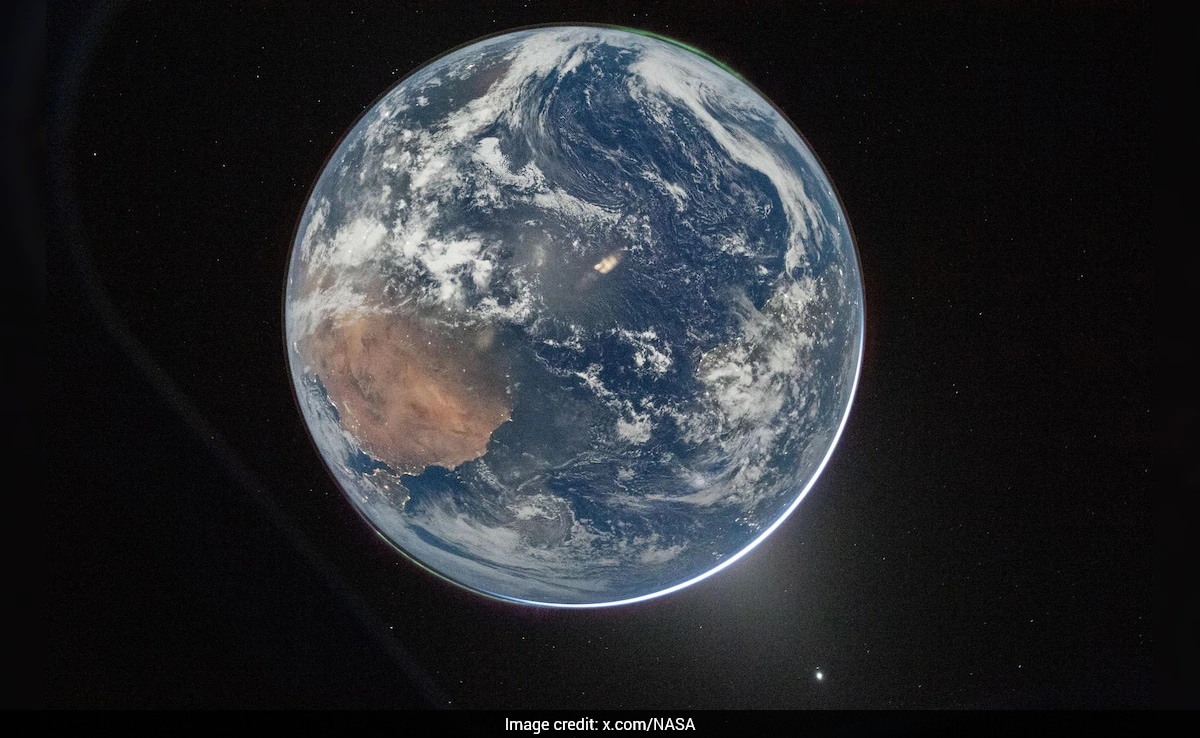
Think about the last time you felt truly small. Maybe it was standing at the foot of a mountain or looking out over the ocean at night. Now, multiply that by a thousand. That is the "Overview Effect." It is a psychological shift so profound it rewritten the brains of almost everyone who has ever experienced it. From the window of Artemis II, the Earth isn't a globe on a desk. It’s a fragile, glowing marble suspended in a basement of infinite shadow.
The Invisible Stakes of a Blue Dot
Most people think of space travel as a series of mechanical triumphs. We talk about the Space Launch System (SLS) rocket, the most powerful ever built, and the $8.8 billion spent to get this specific mission off the ground. We focus on the "how." But the "why" is hidden in the reflections on the astronauts' visors. As discussed in latest reports by MIT Technology Review, the results are widespread.
When the crew looks back, they see a world without borders. They see the thin, shimmering veil of the atmosphere—a layer so delicate it looks like it could be blown away by a stiff breeze. This isn't just a pretty picture. It is a moment of existential clarity. Down there, every war ever fought, every love ever lost, and every achievement of the human race is happening simultaneously on a single, brilliant blue speck.
The Artemis II mission is a rehearsal for a permanent presence on the Moon. It’s a ten-day journey that circles our satellite and flings the crew back home. But the emotional core of this mission isn't the Moon itself. It’s the perspective gained while leaving.
The astronauts are trained to be stoic. They are engineers, pilots, and scientists. Yet, history tells us that when they see the Earth rise over the lunar horizon, the professional veneer cracks. They become poets. They become philosophers. They realize that while they are exploring the "new," they are actually falling more deeply in love with the "old."
The Ghost of Apollo 8
To understand why this matters now, we have to look back to 1968. The world was tearing itself apart. There were riots, an unpopular war, and political assassinations. Then, on Christmas Eve, Bill Anders took a photo. He wasn't supposed to. He was tasked with photographing the lunar surface. But then he saw it: the Earth, rising.
That photo, "Earthrise," is credited with sparking the modern environmental movement. It changed how we saw our place in the universe. It was a mirror held up to a species that had forgotten it lived on a finite island.
Artemis II is our generation’s "Earthrise." We live in a fractured time. We are hyper-connected yet deeply isolated. We argue over lines on maps and ideologies in books. The astronauts on Artemis II carry our collective gaze with them. When they see the brilliant blue beauty of Earth, they are seeing the only place in the known universe where we can breathe without a suit.
The Physics of Perspective
The journey isn't a straight line. It is a complex dance of gravity and velocity. The Orion capsule will travel over 6,400 miles past the far side of the Moon. At that distance, the Earth is small enough to be covered by a thumb held at arm's length.
Imagine the silence in that cabin.
The hum of the life support system is the only thing keeping the vacuum of space at bay. The crew is traveling at speeds that would vaporize any terrestrial vehicle, yet they feel like they are sitting still. They are suspended in a state of "betweenness." They have left the world of people and have not yet reached the world of dust.
In this space, the "Invisible Stakes" become visible. The mission isn't just about testing heat shields that will have to endure temperatures of 5,000 degrees Fahrenheit upon reentry. It’s about the psychological resilience of the human spirit. Can we handle being this far away? Can we look at our home and realize that we are its only guardians?
The astronauts aren't just passengers; they are our proxies. When Victor Glover looks out the window, he isn't just seeing light hitting water. He is seeing the interconnectedness of every weather system, every ocean current, and every forest. He is seeing a closed system.
The Distance Between Us
There is a specific kind of loneliness that comes with deep space travel. It’s not the loneliness of being alone in a room. It’s the loneliness of being the only living things in a desert that stretches for light-years.
When the Artemis II crew captures their images of Earth, they are using state-of-the-art digital sensors, but the impulse is ancient. We have always wanted to see where we came from. We have always wanted to know what we look like from the outside.
The "brilliant blue beauty" mentioned in the headlines isn't just an aesthetic observation. It is a biological one. We are tuned to that blue. It is the color of our survival. The contrast between that vibrant, pulsing sapphire and the dead, monochromatic grey of the Moon is a shock to the system. It is a reminder that while the Moon is a destination, Earth is an organism.
The Return of the Human Element
For years, we’ve been told that humans are the weak link in space exploration. We’re heavy. We need food. We need water. We’re temperamental. Robots are better, cheaper, and more durable. But a robot can’t feel awe. A robot can’t come back and tell us what it felt like to see the sun set through the Earth's atmosphere from 250,000 miles away.
The Artemis II astronauts are there to bring the human element back to the stars. They are there to translate the cold facts of orbital mechanics into the warm language of human experience. They are there to remind us that we are a species of explorers, not just observers.
When they hit the atmosphere on their way back, they will be traveling at 25,000 miles per hour. The capsule will be encased in a ball of plasma. For a few minutes, communication will cut out. They will be alone in the fire.
And then, the parachutes will bloom.
They will splash down in the Pacific Ocean, bobbing in the very water they saw from the heavens. They will be pulled from the capsule, shaky-legged and overwhelmed by the weight of gravity. They will smell the salt air. They will feel the wind. And they will never look at the sky the same way again.
The mission will be hailed as a technical success. The data will be parsed by thousands of scientists. But the real legacy will be the stories told by four people who went to the edge of the world and looked back. They will tell us that the Earth is beautiful. They will tell us it is small.
They will tell us it is the only one we have.
The brilliance of the blue isn't in the light itself, but in the fact that there is someone there to see it. We are the universe’s way of looking at itself. As Orion drifts through the dark, the four figures inside aren't just astronauts. They are the eyes of humanity, blinking in the light of a home they finally understand.