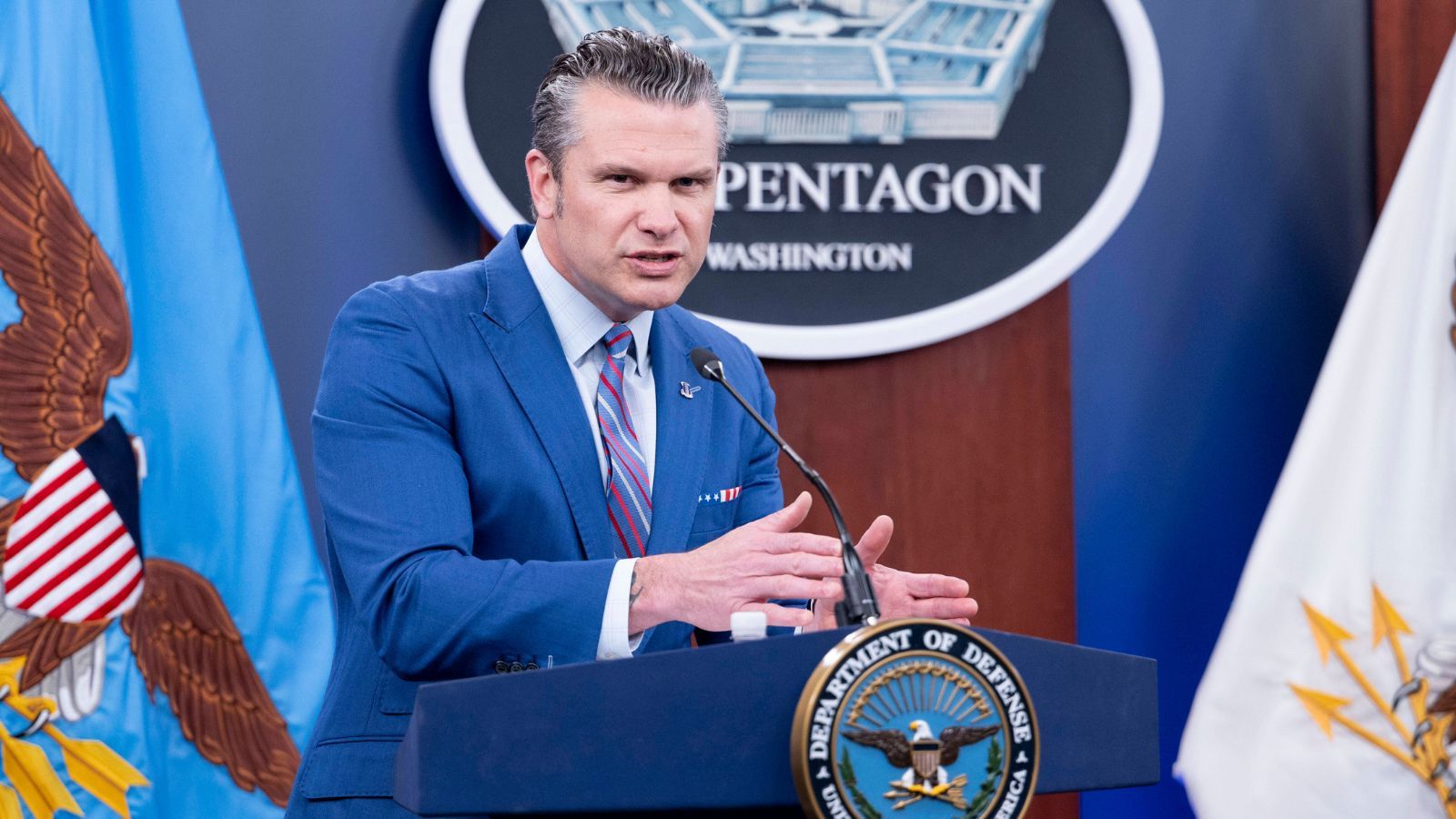
The map in the windowless room at the Pentagon doesn't look like the one in your high school geography class. It isn't a collection of colors and borders. It is a grid of heat, movement, and probability. When Pete Hegseth, the man now steering the world's most sophisticated war machine, looks at that map, he isn't seeing abstract geometry. He is seeing the physics of a promise.
That promise is simple and terrifying. It is the promise of the "highest volume of strikes" ever delivered in a single day.
War has always been a language. For decades, the dialogue between Washington and Tehran was a series of whispers, coded threats, and shadow-boxing in the deserts of third-party nations. But the rhetoric coming out of the Department of Defense has shifted. The whispers are gone. In their place is a megaphone turned to its maximum setting. When the Secretary of Defense speaks about "the highest volume," he is talking about an industrial-scale application of violence designed to do more than just break hardware. It is designed to break the will of a nation.
Imagine a pilot. Let’s call him Elias.
Elias doesn't think about geopolitics when he's strapped into a cockpit five miles above the earth. He thinks about the sequence. He thinks about the precise vibration of the airframe and the way the cockpit lights cast a ghostly green hue over his flight suit. If the order comes to deliver that "highest volume," Elias isn't just dropping a bomb. He is the final link in a chain that starts with a quote in a press briefing and ends with the literal reshaping of a landscape half a world away.
The logistics of such an event are staggering. To deliver the kind of volume Hegseth is signaling, you need a symphony of steel. You need carriers positioned in the North Arabian Sea, their decks a frantic ballet of yellow-vested sailors and screaming engines. You need tankers orbiting in the darkness, trailing fuel lines like umbilical cords to keep the strike packages fed. You need the silent, invisible hand of satellite arrays guiding every single piece of ordinance with a margin of error measured in inches.
But the real story isn't the technology. It’s the silence that follows the noise.
Hegseth’s stance marks a departure from the "proportional response" doctrine that has defined American military engagement for years. Proportionality is a polite way of saying "an eye for an eye." What is being described now is something else entirely. It is a philosophy of overwhelming dominance. The logic is that if you hit hard enough, fast enough, and in enough places at once, the enemy loses the ability to even contemplate a counter-move. It is the military equivalent of a total system reboot.
Think of it like a dam. For years, the water has been seeping through small cracks. Diplomacy, sanctions, and minor skirmishes were the sandbags we used to hold it back. Hegseth is suggesting that the sandbags are useless. He is suggesting that the only way to deal with the pressure is to blow the dam entirely and control where the water goes.
There is a cold, mathematical certainty to this approach. The Pentagon planners have calculated exactly how many sorties it takes to blind a radar network, how many tons of high explosives are required to collapse a command bunker, and how many seconds of sustained bombardment it takes to paralyze a capital city. They call it "kinetic effect."
But there is no word in the military lexicon for the sound of a city holding its breath.
In Tehran, there is a mother named Samira. She doesn't have access to the Pentagon’s heat maps. She has a radio and a window. She hears the news of "highest volume" and she looks at her children. To her, these quotes aren't policy points. They are the sound of the sky falling. The human element of this escalation is found in that gap—the space between the confident assertion of a Secretary of Defense and the quiet terror of a civilian who has no say in the matter.
Hegseth has been clear: the United States is not looking for a "fair fight." The goal of the modern American military is to ensure that a fair fight never happens. If you find yourself in a fair fight, your planning has failed. By signaling the intent to deliver a historic volume of strikes, the U.S. is attempting to win the war before the first engine even starts. It is a psychological gambit played with the lives of thousands.
The stakes are invisible until they aren't.
We talk about "strikes" as if they are surgical, clean, and clinical. We use terms like "neutralizing assets" or "degrading capabilities." These words are designed to be comfortable. They allow us to discuss the end of the world over morning coffee. But the reality of "volume" is friction. It is the smell of burnt jet fuel, the deafening roar of a Tomahawk missile leaving its tube, and the bone-shaking thump of a 2,000-pound JDAM meeting the earth.
There is a historical weight to this moment as well. Every time a leader promises a short, decisive, and overwhelming victory, history winces. We have heard the echoes of this before. We heard it in the "Shock and Awe" of 2003. We heard it in the "Rolling Thunder" of the 1960s. The plan is always to hit so hard that the enemy gives up. The reality is often that the harder you hit, the deeper the enemy digs.
Hegseth’s five key points—which center on readiness, overwhelming force, and the refusal to manage a "slow-bleed" conflict—are a direct reflection of his background. He is a man who saw the frustrations of counter-insurgency firsthand. He saw what happens when the military is asked to be a social service agency with rifles. His doctrine is a return to the oldest rule of war: if you are going to go, go with everything.
This isn't just about Iran. It’s a signal to the rest of the world. It’s a message to Beijing, to Moscow, and to every non-state actor watching from the shadows. The message is that the era of restraint is over. The "highest volume" isn't just a threat directed at a specific set of GPS coordinates. It is a re-establishment of a terrifying truth.
The American eagle has stopped trying to be a diplomat. It has remembered that it has talons.
As the sun sets over the Potomac, the lights stay on in the E-Ring of the Pentagon. Orders are being drafted. Envelopes are being sealed. In the hangars of Nevada and the decks of ships in the Pacific, young men and women are checking their gear. They are the ones who will have to turn the "highest volume" from a quote into a reality. They are the ones who will carry the weight of those strikes.
And somewhere, in a bunker or a backroom in Iran, someone is listening to the echoes of Hegseth’s words. They are calculating their own volume. They are deciding if they will bend or if they will break.
The air is thick with the electricity that precedes a lightning strike. We are no longer talking about if a conflict could happen. We are talking about the shape it will take. It will be loud. It will be fast. It will be unlike anything we have seen in our lifetime.
The map on the wall is glowing. The physics are set. The promise has been made.
All that’s left is the sound of the first engine.



