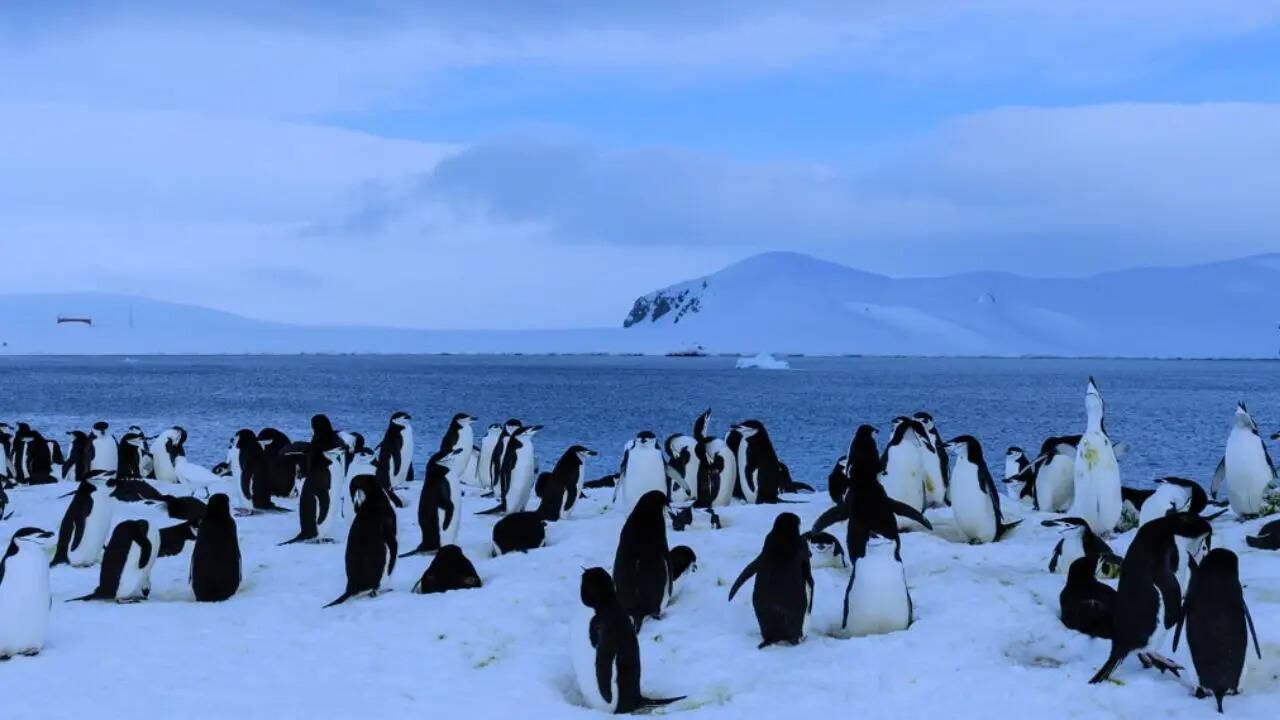
The wind in Antarctica does not whistle. It screams with a physical weight, a pressure against the eardrums that feels like the earth itself is trying to push you out. If you stood at the South Pole today, you would be standing on nearly two miles of ice. Beneath that ice is rock, but for all practical purposes, you are adrift on a frozen ocean of white silence.
Imagine a scientist named Elias. He is a hypothetical composite of the thousands who rotate through research stations like McMurdo or Amundsen-Scott. Elias is brilliant, hardy, and currently, he is shivering. He has been out of his climate-controlled module for exactly four minutes to check a sensor array. In that time, the moisture in his breath has turned to ice crystals on his eyelashes. His world has shrunk to the size of his goggles.
Elias represents our best attempt to colonize the bottom of the world. But Elias is a guest, and a temporary one at that. He is living on life support, no different from an astronaut on the International Space Station, except his "oxygen" is a supply chain that stretches thousands of miles across the Southern Ocean.
The Biological Wall
Humans are remarkably adaptable. We have conquered the sweltering humidity of the Amazon and the thin, oxygen-starved air of the Himalayas. But Antarctica is not just a different climate; it is a different biological category. It is the only continent on Earth with no native terrestrial mammals, no reptiles, and no trees.
The reason is simple: energy. Life is an exchange of heat and calories. In the Antarctic interior, temperatures can plummet to $-80$°C ($-112$°F). At these levels, the physics of survival break down. Steel becomes brittle and snaps like glass. Human skin freezes in seconds. To stay alive, Elias must consume roughly 5,000 calories a day—double the average human intake—just to provide his body with enough fuel to maintain its internal furnace.
Nature here is not just indifferent; it is exclusionary. Because there is no soil, there is no agriculture. Every single calorie Elias consumes, from the powdered eggs to the frozen steaks, must be flown or shipped in. If the planes stop flying, the clock starts ticking. This is the fundamental reason why there are no cities. A city requires a hinterland—a surrounding area of land that provides resources. Antarctica has no hinterland. It is a void that consumes resources and returns only data.
The Illusion of Sovereignty
Maps of Antarctica often look like a sliced pie. Slices belong to Australia, France, Norway, New Zealand, Chile, Argentina, and the United Kingdom. These claims are colorful lines on a page, leftovers from an era of imperial exploration.
But look closer. The Antarctic Treaty of 1959 did something miraculous: it froze these claims in time. It didn’t recognize them, and it didn’t deny them. It simply pushed them aside in favor of science. The continent became a global commons.
This isn't out of pure altruism. It’s out of necessity. No nation can afford to "settle" Antarctica in any traditional sense. To build a permanent, self-sustaining colony would require a level of geo-engineering we simply do not possess. You cannot lay a foundation on ice that is constantly, albeit slowly, flowing toward the sea. If you build a house on the plateau, the snow doesn't melt; it accumulates. Year after year, the weight increases until your home is swallowed, crushed by the very ground it sits on.
Old stations are now buried dozens of feet beneath the surface, ghosts of human ambition slowly being ground into the sea by the relentless march of the glaciers.
The Psychological Toll of the Long Night
Survival is more than just calories and parkas. It is the mind.
In the austral winter, the sun disappears for months. For someone like Elias, the world becomes a claustrophobic box. He is trapped indoors with the same forty people, hearing the same jokes, smelling the same recycled air, while a lethal vacuum exists just outside the airlock.
Psychologists call this "Isolated, Confined, and Extreme" (ICE) environments. The brain begins to change. Circadian rhythms shatter. People develop "the Antarctic stare," a vacant look born of sensory deprivation. There are no smells of rain or cut grass. There is no sound of birds. There is only the hum of the generators. If those generators fail, the silence becomes a death sentence.
We often talk about "settling" new frontiers as if it's just a matter of grit. But humans are social, biological organisms that evolved to be part of an ecosystem. Antarctica is not an ecosystem; it is a laboratory. When we stay there, we are not living; we are enduring.
The Logistics of a Ghost Continent
Consider the sheer mechanical defiance required to keep a human heart beating at the South Pole.
Fuel is the lifeblood. It is "JP-8" specialized kerosene that doesn't freeze at standard temperatures. To get it to the interior, it must be hauled by "traverses"—massive tractor trains that crawl across the ice at five miles per hour, dragging sleds of fuel bladders. It takes weeks. One crack in the ice, a hidden crevasse masked by a snow bridge, can swallow a multi-million dollar vehicle in a heartbeat.
This is the hidden cost of the "dry facts" about Antarctica. It isn't just "cold." It is a logistical nightmare that defies the laws of economics. There is no "industry" in Antarctica that can pay for this. Tourism brings in a few thousand people a year to the coast, but they stay on ships. They are observers, peering through the glass at a world that does not want them.
The Fragile Protector
There is a deeper, more emotional reason why we don't—and shouldn't—stay there forever.
Antarctica is the world’s cooling system. It reflects the sun’s energy back into space and drives the ocean currents that regulate our climate. It is also a pristine record of our past. In the bubbles of air trapped miles deep in the ice, we can breathe the atmosphere of 800,000 years ago.
If we were to truly colonize it—to build roads, cities, and sewage systems—we would destroy the very thing that makes it valuable. We would smudge the record. The heat from our cities would melt the foundations. Our waste would contaminate the purest water on the planet.
Elias packs his bags in October, just as the first light of spring touches the horizon. He has lost weight. He is pale. He misses the smell of dirt. As his LC-130 Hercules transport plane skis off the ice runway, he looks down at the vast, wrinkled skin of the continent.
He feels a profound sense of relief, but also a haunting respect. Antarctica remains the only place on Earth we haven't broken. It stays empty not because we lack the courage to go, but because the land itself has set a boundary that our biology cannot cross. It is a reminder that we are not the masters of every landscape, and that some places are meant to be visited, studied, and then left exactly as they were found: cold, silent, and free.
The shadow of the plane grows smaller against the blinding white, a tiny speck of heat fleeing a world of absolute zero.