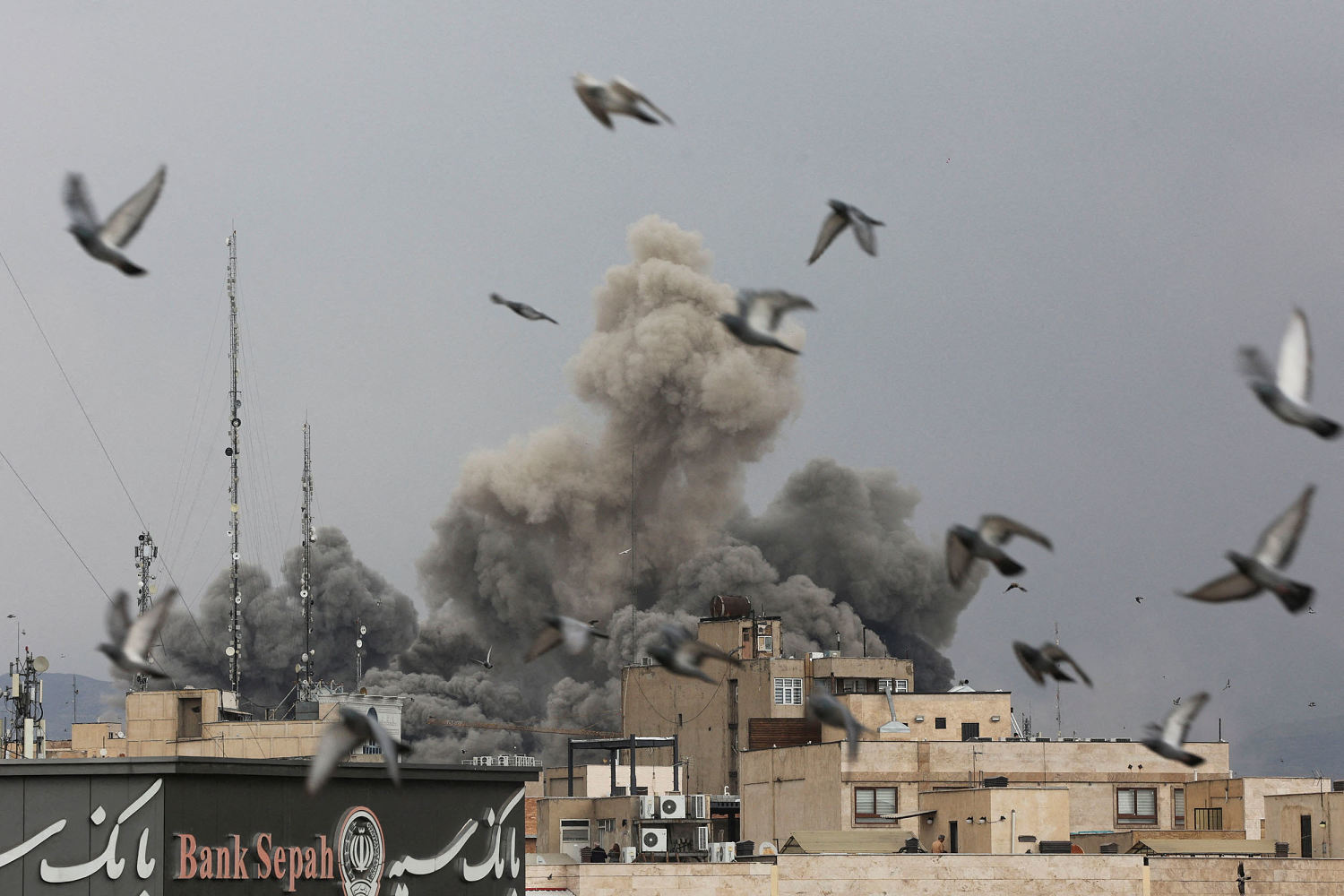
Donald Trump stands in the Oval Office, flanked by German Chancellor Friedrich Merz, and rewrites the history of a war that is barely four days old. He tells a room of reporters that he "might have forced Israel’s hand" to strike Iran. It is a stunning reversal of the narrative that has dominated Washington since the first Tomahawk missiles hit Tehran last Saturday. Until this moment, the prevailing theory—fueled by Trump’s own Secretary of State, Marco Rubio—was that Israel had cornered the United States into a preemptive conflict.
The distinction is not merely academic. It is a desperate scramble for the steering wheel of a Middle Eastern conflagration that has already claimed over 1,500 lives, including the Iranian Supreme Leader, Ali Khamenei. By claiming he was the aggressor, not the assistant, Trump is attempting to quiet a growing rebellion within his own base. Populist influencers and "America First" skeptics in Congress have spent the last 72 hours accusing the administration of being "bounced" into a foreign war by Prime Minister Benjamin Netanyahu.
The Rubio Leak and the Policy Pivot
The confusion began on Monday evening when Marco Rubio gave a candid briefing to reporters at the Capitol. He suggested that Washington moved against the Islamic Republic only after realizing that Israel was going to strike regardless of American approval. Rubio’s logic was grounded in military pragmatism. If Israel strikes, Iran retaliates against U.S. bases in the region. If the U.S. is going to be hit anyway, it might as well strike first to degrade the threat.
But the political blowback was immediate. From the War Room podcast to the halls of the Senate, the "Israel forced our hand" narrative looked like a failure of American sovereignty. Trump, never one to be seen as a secondary player in his own foreign policy, used the Merz visit to reclaim the alpha position. He argued that his own assessment of the failed nuclear negotiations in February led him to believe the "lunatics" in Tehran were preparing an imminent strike.
"They were going to attack," Trump insisted. "I felt strongly about that. So, if anything, I might have forced Israel's hand."
Operation Epic Fury by the Numbers
While the White House manages the messaging, the Pentagon is managing the most aggressive air campaign since the 2003 invasion of Iraq. Operation Epic Fury has moved with a speed that caught regional analysts off guard. The mission objectives are clear: total degradation of the Iranian military and, for the first time in official U.S. policy, explicit regime change.
The results, according to recent briefings, have been devastating for the Islamic Republic’s conventional capabilities.
- The Navy: Nine Iranian naval vessels have been confirmed sunk. Trump claims the Iranian Navy is effectively "knocked out."
- Air Defenses: Joint U.S.-Israeli strikes have targeted the S-300 and S-400 batteries surrounding Tehran, Isfahan, and Natanz.
- The Leadership: The assassination of Ayatollah Ali Khamenei has left a power vacuum. An "Interim Leadership Council" is reportedly attempting to maintain order, but the command structure of the IRGC is fractured.
However, the cost is mounting. The Iranian Red Crescent Society reports over 780 dead, while independent monitors like Hengaw place the figure closer to 1,500. This includes a horrific strike on a girls' elementary school in southern Iran that killed 168 people—an "accidental" mass casualty event that has complicated the administration's attempt to win over the Iranian public.
The European Schism and the Spanish Trade Cutoff
The war has also triggered a brutal reorganization of Western alliances. Trump’s meeting with Friedrich Merz was intended to show a united front, with Germany providing landing rights for U.S. forces. But the rest of Europe is far from "on the same page."
Spain has emerged as the chief antagonist in the President’s eyes. After Madrid refused to allow U.S. planes to use its bases for missions over Iran, Trump retaliated with a sledgehammer. He has ordered Treasury Secretary Scott Bessent to "clear off all dealings" with Spain, effectively cutting off trade with a major NATO ally. It is a return to the "with us or against us" diplomacy that defined the early 2000s, but with a protectionist, 2026 twist.
The United Kingdom is also in the crosshairs. While Prime Minister Keir Starmer allowed the use of British bases, he has refused to commit British kinetic forces to the strikes. Trump’s assessment was characteristically blunt: "This is not Winston Churchill that we’re dealing with."
The Strait of Hormuz and the Oil Crisis
The economic reality of the war is hitting the pumps faster than the headlines can keep up. Iran has officially closed the Strait of Hormuz, the maritime artery for 34% of the world’s seaborne oil. In response, Trump has announced a plan for the U.S. Navy to escort tankers and has ordered the development of "political risk insurance" for shippers.
Despite the President's claims that the Iranian military is "knocked out," the threat to global energy is not gone. Iran’s "asymmetric" capabilities—naval mines, hidden drone swarms, and underground missile silos—remain a wildcard. The U.S. Navy's carrier force is already overstretched, and rotating new groups into the Persian Gulf will strain a military budget already under fire from fiscal hawks in Washington.
The Endgame of Regime Change
The most significant shift is the open embrace of a "New Iran." Trump has told the Iranian people that this is their "only chance for generations" to take back their country. But the "day after" remains a fog of war. When asked about potential new leadership, Trump admitted that "most of the people we had in mind are dead."
The administration is betting on a spontaneous uprising. They are hoping that the combination of a devalued rial—engineered by a dollar shortage—and the decapitation of the clerical leadership will lead to a democratic surge. It is a high-stakes gamble that ignores the historical precedent of how nationalist sentiment often rallies around a flag when foreign bombs are falling.
The war is expected to last another four weeks, according to White House timelines. But as any veteran of the last thirty years of Middle Eastern intervention knows, the "kinetic" phase is the easy part. The "big scale hitting," as Trump calls it, may be finishing, but the vacuum left behind is just beginning to pull the rest of the world in.
Would you like me to look into the specifics of the Treasury Department's trade restrictions on Spain?