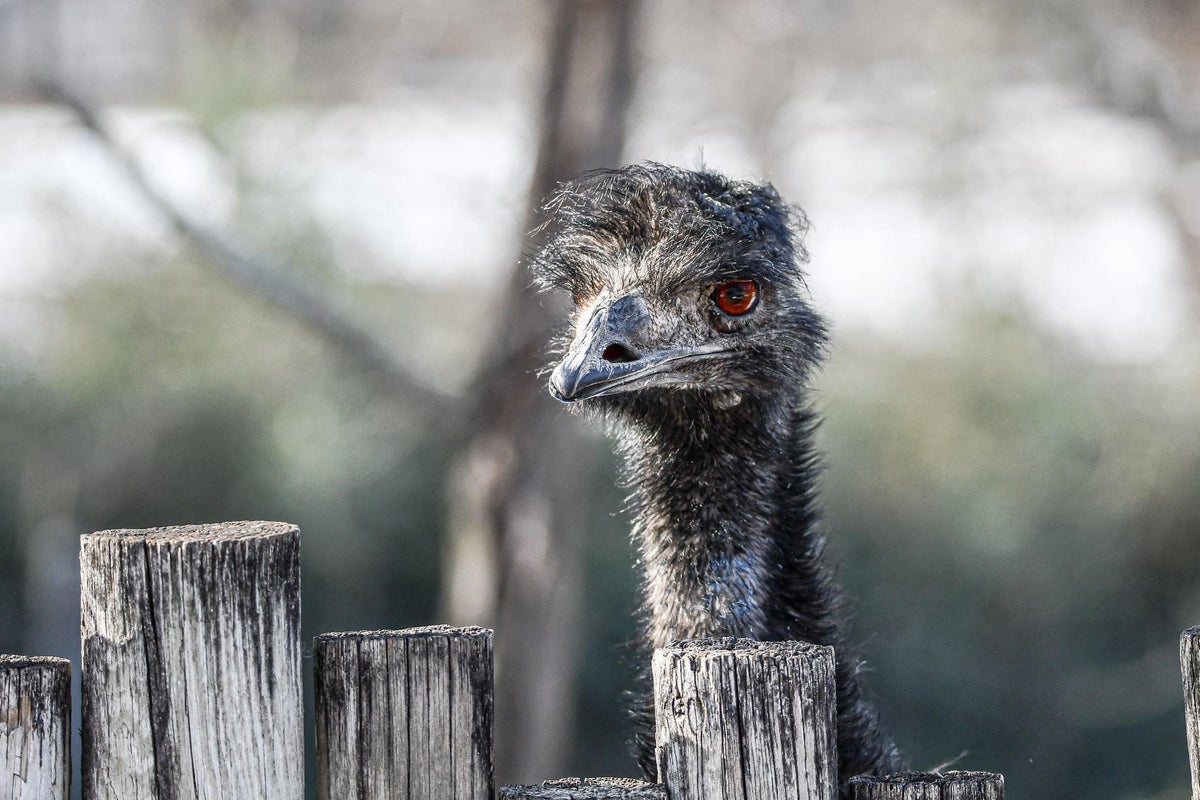
The headlines were predictably hysterical. "Adam the emu battered to death." "Tragedy at the zoo." The internet wept for a 24-year-old bird in Missouri that got caught in a hail storm. We love a good tragedy because it allows us to perform grief without changing our behavior. But if you think Adam’s death was an "act of God" or a freak weather incident, you are falling for the oldest PR trick in the book: the inevitability defense.
Adam didn't die because of a storm. Adam died because of a systemic failure in how we define "animal welfare" in modern captivity.
Most people look at a zoo and see a sanctuary. I see a high-stakes engineering puzzle where the margins for error are razor-thin and the consequences are lethal. When a bird of that size and value is left exposed to four-inch hailstones, it isn't bad luck. It is a failure of infrastructure. We have become so obsessed with "naturalistic habitats" that we have forgotten the primary duty of a captive environment: protection from the very nature we claim to replicate.
The Naturalistic Fallacy
The "lazy consensus" in modern zookeeping is that animals should live in environments that mimic their wild origins. It sounds noble. It looks great on a brochure. But it’s a death trap.
In the wild, an emu has an entire continent to find cover. They are nomadic. They track weather patterns. They move. In a zoo, an emu is a prisoner of a specific coordinate. If that coordinate happens to be in the path of a supercell, and the "naturalistic" enclosure lacks a reinforced, accessible, and—most importantly—instinct-driven shelter, the animal is toast.
We spend millions on aesthetics. We build fake rock walls and plant exotic grasses so the humans feel like they’re on a safari. We spend pennies on "hard" infrastructure. We ignore the fact that a Missouri spring is effectively a war zone for anything without a roof.
The Failure of "Enrichment"
"People Also Ask" columns will inevitably focus on whether the keepers could have moved him. They’ll ask if there was a warning. These are the wrong questions. The real question is: Why was a flightless bird’s survival dependent on human intervention in the first place?
Any system that requires a human to run out into a hail storm to "save" an animal is a broken system. In high-reliability organizations—think nuclear power or aviation—we design for "passive safety." A passive safety system doesn’t need a person to flip a switch; it works because the physics of the environment dictate it.
Zoo enclosures are rarely designed with passive safety for extreme weather. They are designed for containment and visibility.
- Containment: Keep the animal in.
- Visibility: Let the paying customers see the animal.
- Safety: (Usually an afterthought involving a wooden shed).
If the shed is at the far end of the paddock, or if the animal doesn't perceive it as a safe haven during a high-decibel storm, it’s useless. Adam likely panicked. Emus are high-strung, powerful, and remarkably stupid when stressed. They don't think; they react. When the sky starts throwing ice rocks, an emu’s instinct isn't to look for a door. It’s to run until it hits a fence.
The Infrastructure Gap
I’ve seen facilities spend $5 million on a new entrance gate while their herbivore paddocks are still using 1970s-era drainage and shelter. It’s a classic business mistake: prioritizing the "front of house" because that’s where the revenue is generated, while the "back of house" rots.
In Missouri, giant hail isn't a "once in a lifetime" event. It’s an annual tradition. If your facility is in a region prone to tornadic activity and extreme hail, and your animals are still dying from impact trauma, you aren't running a zoo. You’re running a lottery.
Let's talk about the physics of a four-inch hailstone.
We are talking about an object with a terminal velocity that can exceed 100 mph. Using the kinetic energy formula $E_k = \frac{1}{2}mv^2$, a hailstone of that size carries enough force to crack a human skull or, in this case, shatter the light bones of a large bird. To leave an animal in an open paddock during a forecasted severe weather event is a calculated risk. The zoo lost the bet, and Adam paid the price.
The Myth of the "Tragic Accident"
We need to stop using the word "accident" for events that are statistically certain to happen over a long enough timeline.
If you build a house on a floodplain, it’s not an accident when it gets wet. If you keep large, flightless birds in "Tornado Alley" without automated, hardened shelters, it’s not an accident when one gets bludgeoned. It’s a design flaw.
But the industry won't admit this. Why? Because hardening every enclosure in every zoo in the Midwest would cost billions. It would mean more concrete, more steel, and less "natural" beauty. It would make zoos look like what they actually are: high-security bio-containment facilities.
The public doesn't want to see an emu in a bunker. They want to see an emu on a lawn. We prioritize our visual pleasure over the animal's physical survival, and then we cry when the bill comes due.
What Real Welfare Looks Like
If we actually cared about these animals beyond their value as "content" or "ambassadors," we would change the E-E-A-T (Experience, Expertise, Authoritativeness, Trustworthiness) of our zoo boards.
- Experience: We need fewer "animal lovers" and more structural engineers on the planning committees.
- Expertise: We need to stop listening to architects who prioritize sightlines and start listening to meteorologists and trauma specialists.
- Authoritativeness: The Association of Zoos and Aquariums (AZA) needs to mandate extreme-weather infrastructure that goes beyond a simple "weather plan" on a clipboard.
- Trustworthiness: Facilities need to be honest about the risks of keeping certain species in certain climates.
Maybe an emu shouldn't be in Missouri. Maybe a polar bear shouldn't be in North Carolina. But those are "disruptive" thoughts that threaten the bottom line.
The Hard Truth
The death of Adam the emu is being used to garner sympathy and perhaps a few donations for "storm recovery." It’s a brilliant move. Turn a failure of stewardship into a fundraising opportunity.
But don't be fooled. Every time a zoo animal dies from a predictable weather event, it is a reminder that we are failing the basic contract of captivity. We took them out of the wild—where they at least had a fighting chance to move and adapt—and put them in a cage where their life depends on a human checking a radar app in time.
We don't need more thoughts and prayers for dead emus. We need better buildings. We need to stop pretending that a fence and a patch of grass is a "habitat." It's a stage. And when the weather gets bad, the actors are left to die while the audience watches from the safety of their homes.
Stop mourning the bird and start demanding better blueprints. If a hailstone can kill your "star attraction," your facility is a failure of engineering, not a victim of nature.
Build better or shut down. There is no middle ground.