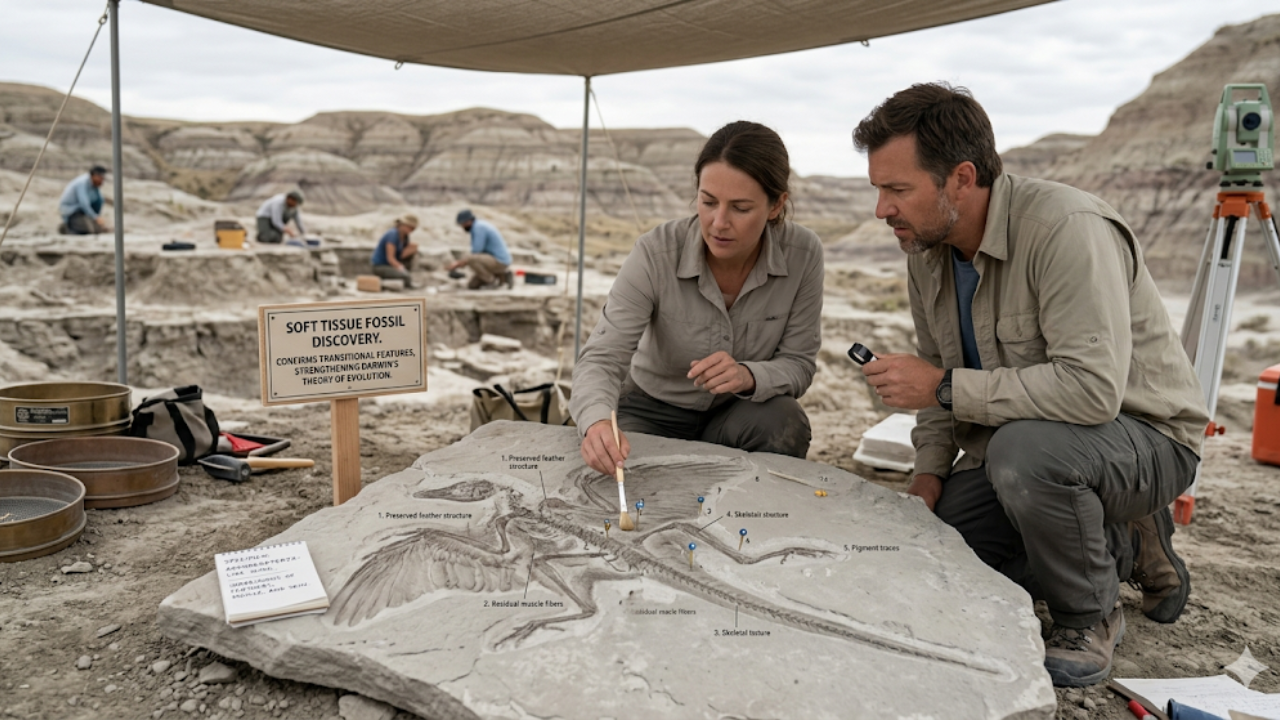
The desert wind in Wyoming doesn’t just blow; it scours. It carries the grit of the Morrison Formation, a vast, dry graveyard of the Late Jurassic that stretches across the American West like a dusty shroud. For decades, paleontologists have walked these ridges, hammers in hand, looking for the heavy, mineralized thud of bone against steel. They were looking for skeletons. They were looking for the architecture of the dead.
But they weren’t looking for the heartbeat.
In a small, sterile lab thousands of miles away from the heat of the dig site, a researcher leans over a microscope. The air smells of ozone and isopropyl alcohol. Under the lens lies a fragment of a 150-million-year-old fossil. To the naked eye, it looks like a common rock, a bit of sediment frozen in time. Under high-resolution imaging, however, the stone begins to breathe.
There, nestled within the mineral matrix, is something that shouldn’t exist. It isn't a bone. It isn't a tooth. It is a cluster of soft tissue—pliant, organic, and impossibly preserved.
We have been taught that the past is a brittle place. We grew up believing that when a creature died during the reign of the dinosaurs, its flesh withered, its skin dissolved, and only the hardest parts of its being—the calcium-rich bones—survived the crushing weight of the eons. This discovery shatters that comfort. It suggests that the past isn't just a collection of skeletons; it’s a library of biological blueprints that managed to survive a literal eternity.
The Impossible Survival
Think about a piece of fruit left on a counter. Within a week, it is a puddle. Within a month, it is dust. Now, try to fathom that same delicate biological material surviving 150 million years of tectonic shifts, ice ages, and the relentless chemical assault of the earth’s crust.
It feels like a miracle. It isn't.
The preservation of soft tissue—blood vessels, skin cells, and connective fibers—requires a perfect storm of chemistry. Imagine a creature falling into a muddy creek bed. If the mineral content of that mud is exactly right, and if the oxygen is squeezed out quickly enough, a process called "molecular mineralization" begins. The minerals don't just replace the bone; they coat the individual cells in a protective shield of quartz or calcite before they can rot.
It is a biological time capsule. When researchers found these soft structures in a specimen dating back to the Jurassic period, the scientific community felt a collective jolt of electricity. This wasn't just another dinosaur bone to put on a pedestal in a museum lobby. This was a direct link to the mechanics of life as it functioned when the world was young.
Why Darwin is Smiling
For over a century, the primary argument against Charles Darwin’s theory of evolution was the "missing link." Critics pointed to the gaps in the fossil record, arguing that if species truly transitioned over millions of years, we should see every tiny, incremental change in their anatomy.
The problem, of course, was that bone only tells half the story.
You can look at the frame of a house and guess where the windows were, but you can’t see the color of the curtains or the warmth of the insulation. Soft tissue is the insulation of evolution. By finding 150-million-year-old skin and muscle fibers, scientists can finally see how the "soft" parts of animals changed alongside their skeletons.
Consider the transition from dinosaurs to birds. We knew the bones changed—arms became wings, heavy tails shortened. But how did the skin become feathers? How did the respiratory system adapt to the high-energy demands of flight?
The discovery of these ancient soft tissues confirms that the internal organs and cellular structures were evolving in lockstep with the frame. It provides the "connective tissue" of the evolutionary narrative. It proves that the transition wasn't just a series of happy accidents in bone growth, but a total biological overhaul. Darwin didn't just guess right about the big picture; he was right about the microscopic details he couldn't even see.
The Human Stakes of Ancient Dust
You might wonder why a person working a nine-to-five in a city should care about a microscopic speck of Jurassic skin. The answer isn't in the past. It’s in our own mirrors.
We are currently in a race to understand how life survives extreme shifts in the environment. As our own climate changes, we are looking for the limits of biological resilience. These fossils show us how life handled a world that was radically different from our own—a world with higher CO2 levels, different atmospheric pressures, and a completely different map of the continents.
By studying how these ancient cells were constructed, we are learning about the fundamental durability of DNA and protein. We are discovering that life is much "stickier" than we thought. It persists. It finds a way to leave a footprint even when the foot itself has been gone for a hundred million years.
The Ghostly Reality
There is a certain loneliness in paleontology. You spend your life chasing ghosts. You touch a stone and realize you are the first living thing to touch that particular creature since it took its last breath in a world where the Atlantic Ocean hadn't even finished opening up.
But this discovery changes the nature of that contact.
When you find soft tissue, you aren't just touching a ghost’s shadow. You are touching the ghost itself. You are looking at the same proteins that allowed a creature to move, to hunt, and to survive in a landscape of giants. It makes the deep past feel dangerously close.
The skepticism that used to surround these finds is evaporating. Years ago, when Mary Schweitzer first proposed that she had found soft tissue in a T-Rex bone, she was met with intense doubt. People claimed it was "biofilm"—basically modern bacteria that had crawled into the bone recently.
But the evidence has become undeniable.
The chemistry doesn't lie. We are seeing collagen. We are seeing the building blocks of life that have survived the death of their owners by a margin of time that the human mind can barely compute. If you represented the history of the Earth as a 24-hour clock, these tissues have been sitting in the dark for hours, waiting for us to turn on the lights.
The Invisible Bridge
The real beauty of this find is that it demystifies the "magic" of life. It shows that we are all made of the same resilient stuff. The proteins in your hand as you scroll through this article are remarkably similar to the proteins found in that 150-million-year-old fossil.
We are part of an unbroken chain.
Every time we find a fragment like this, the gap between "us" and "them" shrinks. We stop seeing dinosaurs as monsters from a movie and start seeing them as biological kin. They had circulatory systems that pumped blood. They had skin that felt the sun. They had the same basic cellular mission that we have: to persist.
The lab technician in the ozone-scented room eventually turns off the microscope. The fossil goes back into its tray. Outside, the world continues its frantic, modern pace. Cars honk. Phones buzz. People rush toward their futures, largely unaware that under their feet, the Earth is holding onto its secrets with a grip of iron and stone.
We used to think the past was written in bone, easily broken and often lost. Now we know it was written in something much more intimate. It was written in the very fabric of life itself, waiting for us to develop the eyes to see it.
The stone has a heartbeat, if only we are quiet enough to listen.