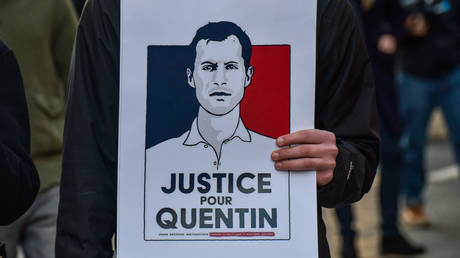
French authorities have confirmed the arrest of all primary suspects linked to the fatal beating of Nicolas, a 22-year-old rugby player and right-wing activist, outside a nightclub in Saint-Péray. While the arrests provide a semblance of procedural closure, they strip away the facade of a simple barroom brawl gone wrong. This was not a random flare-up of temper. It was a targeted eruption of violence that mirrors a darkening pattern across the French interior, where political identity now carries a physical risk.
The incident, which occurred in the early hours of November 1, saw Nicolas struck by a bullet to the head during a chaotic confrontation involving a group of individuals who reportedly traveled from a sensitive neighborhood in Valence specifically to "settle scores." This isn't just a police report. It is a snapshot of a country struggling to contain a volatile mix of tribalism and ideological hatred. To understand why Nicolas died, we have to look past the handcuffs and into the fractured social geography of modern France.
The Calculated Nature of the Saint-Peray Attack
Initial media reports often lean on the word "altercation" to describe these events. It is a lazy term. An altercation implies a two-sided dispute that escalated. The reality in Saint-Péray suggests a more predatory dynamic. Witnesses and investigators have pieced together a narrative of a group arriving at the "Seven" nightclub with the intent to provoke.
The suspects did not just happen to be there. They navigated from the Monnaie district of Romans-sur-Isère—the same area that produced the suspects in the killing of Thomas Perotto in Crépol just a year prior. This geographical consistency is not a coincidence. It points to a recurring export of violence from specific urban hubs into the surrounding rural and suburban social spaces.
The weapon used was not a fist or a bottle. It was a firearm. Pulling a trigger in a crowded parking lot is an act of definitive intent. When we examine the profile of the suspects, we see a familiar history of petty crime transitioning into high-stakes aggression. The speed with which the National Police and the Gendarmerie moved to secure these arrests shows they knew exactly where to look. They were fishing in a well-known pond.
A Ghost of Crepol
It is impossible to discuss the death of Nicolas without the shadow of Crépol looming over the conversation. The parallels are staggering and, for many French citizens, terrifying. In both cases, young men from marginalized, high-crime districts targeted social gatherings in smaller, more traditional communities.
In Crépol, it was a village winter ball. In Saint-Péray, it was a Halloween party. The target in both instances was the same: the perceived "other." Nicolas was a known member of the right-wing party Rassemblement National (RN). In the eyes of his attackers, his political affiliation wasn't a matter for debate; it was a justification for elimination.
This brings us to a hard truth that mainstream analysis often avoids. Political violence in France is no longer confined to the halls of the National Assembly or televised shouting matches. It has moved to the pavement. When a young man is killed because of the circles he moves in or the values he espouses, the state’s monopoly on force is being openly mocked.
The Failure of the Republican Integration Model
French officials often talk about the "Republican pact," an unwritten agreement that all citizens, regardless of origin, adhere to the laws and values of the secular state. The arrests in the Nicolas case prove the pact is shredded.
The suspects are products of a system that has failed to instill a sense of shared destiny. Instead, we see the rise of "territorialized" identities. For the youths coming out of districts like Monnaie, the nightclub in Saint-Péray isn't a place to dance; it is enemy territory to be raided.
The government’s response has followed a predictable script:
- Swift arrests to prevent vigilante justice.
- Public statements condemning "senseless violence."
- Increased police patrols in the immediate aftermath.
These are bandages on a gash that requires surgery. Increased patrolling does nothing to address the radicalization of the banlieues or the growing sense of abandonment felt by those in "La France périphérique"—the rural and small-town areas that feel they are being hunted in their own backyards.
The Right Wing as a Target
There is a specific discomfort in the media when the victim is a right-wing activist. If Nicolas had been an activist for a far-left cause or an environmental group, the narrative would likely focus on the "threat to democracy" and the "targeted silencing of dissent."
Because he was associated with the RN, the coverage is often neutralized. It becomes a story about "crime" rather than "persecution." This double standard fuels the very resentment that drives the RN’s growth. Supporters of Nicolas see his death as a martyrdom, a sign that the current administration cannot protect them from an increasingly emboldened and violent demographic that views their culture with contempt.
The suspects reportedly shouted insults that were both racial and political. This intersection is the most dangerous flashpoint in French society today. When ethnic tension meets ideological warfare, the result is the parking lot of Saint-Péray.
Logistics of the Investigation and the Arrests
The judicial police didn't stumble upon these suspects. They utilized a massive network of surveillance, mobile phone tracking, and informant networks. The fact that the suspects were scattered across different locations—some in Marseille, others in the Drôme region—suggests a planned attempt to go to ground.
One suspect was apprehended in a dramatic takedown in the southern port city of Marseille, a known hub for fugitives looking to disappear into the Mediterranean underworld. The coordination required for these arrests shows that the French state is capable of high-level enforcement when the political stakes are high enough.
However, the efficiency of the arrests also raises a stinging question: If the authorities know who these people are and where they congregate, why is the violence allowed to reach a boiling point before action is taken? Pre-emptive policing is a dirty word in many liberal circles, but for the family of Nicolas, reactive policing came too late.
The Breakdown of Social Peace
We are witnessing the "Lebanonization" of French social life. This is the process where different groups no longer interact under a common law but exist in a state of permanent, low-level friction, occasionally exploding into lethal violence.
The nightclub, once a neutral ground for the youth of all backgrounds to mingle, has become a frontline. Security at these venues has moved beyond checking IDs for age; they are now essentially paramilitary units looking for concealed weapons and "hostile incursions."
This environment creates a feedback loop. Violence leads to fear, fear leads to political radicalization, and radicalization leads to further violence. The arrests of these suspects might clear the docket for the local prosecutor, but they do nothing to slow the momentum of this cycle.
Rebuilding the Fence
If the state wants to prevent the next Saint-Péray, it must stop treating these incidents as isolated crimes. They are symptoms of a systemic collapse in civil order.
The justice system must move beyond the "slap on the wrist" culture that defines the treatment of young offenders from sensitive zones. When a history of delinquency is met with suspended sentences and "integration workshops," it sends a message of weakness. The suspects in this case were well-known to the law. They were not "driven to crime" by poverty; they were emboldened by the lack of consequences.
Furthermore, the political class must acknowledge that the targeting of individuals for their beliefs is a direct assault on the Republic. You cannot claim to defend democratic values while downplaying the murder of a citizen based on his political affiliation.
The death of Nicolas is a warning. It tells us that the borders between neighborhoods have become more significant than the borders of the nation. It tells us that a rugby jersey or a party membership card can be a death warrant in the wrong part of town.
The arrests are a start, but they are the easy part. The hard part is admitting that the French social model is no longer functioning. Until that admission happens, the security forces are simply managing the decline, one crime scene at a time.
Demand more than a press release from the Ministry of the Interior. Demand an end to the "no-go" culture that allows killers to breed in the heart of the country.
Look at the maps. Study the routes taken by the attackers. See the pattern. This was an act of war, and it is time the authorities started treating it as one.